格物

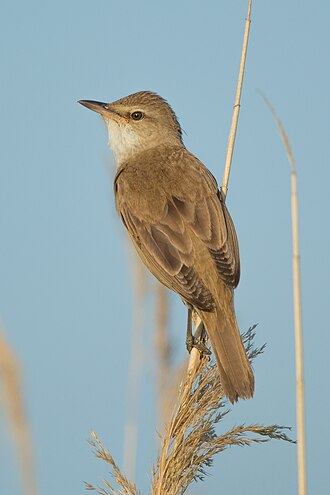
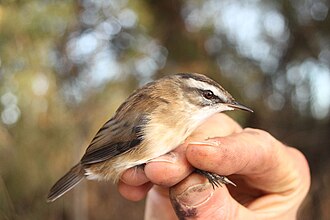
图:Acrocephalus schoenobaenus 1 (Marek Szczepanek).jpg: Marek S… · CC BY-SA 3.0 · Wikimedia Commons
- 学名
- Acrocephalus schoenobaenus
- 分类等级
- 种
- 上级类群
- 苇莺属
- 大类
- 鸟类
- 命名
- 卡尔·林奈,1758 年
- 保护状况(IUCN)
- 无危物种
- 体重
- 1.65 克(出生体重)
- 数据库
- NCBI 分类 · GBIF · IUCN 红色名录
百科正文
英文维基百科补充中文条目比较短,下面是英文条目「Sedge warbler」的原文
The sedge warbler (Acrocephalus schoenobaenus) is an Old World warbler in the genus Acrocephalus. It is a medium-sized warbler with a brown, streaked back and wings and a distinct pale supercilium. Sedge warblers are migratory, crossing the Sahara to get from their European and Asian breeding grounds to spend winter in Africa. The male's song is composed of random chattering phrases and can include mimicry of other species. The sedge warbler is mostly insectivorous.
Taxonomy
The sedge warbler was formally described by the Swedish naturalist Carl Linnaeus in 1758 in the tenth edition of his Systema Naturae under the binomial name Motacilla schoenobaenus. The species is now placed in the genus Acrocephalus that was introduced in 1811 by Johann Andreas Naumann and his son Johann Friedrich Naumann. British ornithologists did not distinguish the species from the common reed warbler until the 18th century. The genus name Acrocephalus is from Ancient Greek akros, "highest", and kephale, "head". It is possible that the Naumanns thought akros meant "sharp-pointed". The specific schoenobaenus is from Ancient Greek skhoinos, "reed", and baino, "to tread". It is a translation of the old Swedish name for the bird, Sävstigare. The species is considered to be monotypic: no subspecies are recognised.
Description
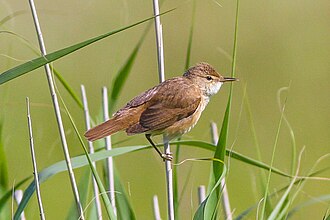
This is a medium-sized warbler, 11.5–13 cm (4.5–5.1 in) long and weighing around 12 g (0.42 oz). It has a streaked brown back and wings, and pale underparts. The rump is warm brown and unstreaked, contrasting with the duller wings. The forehead is flattened, the crown is streaked with black, and the bill is strong and pointed. There is a prominent whitish supercilium. The legs are greyish.
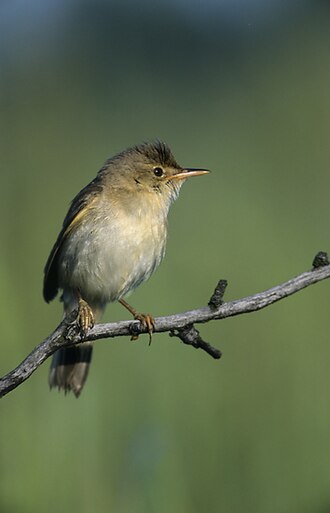
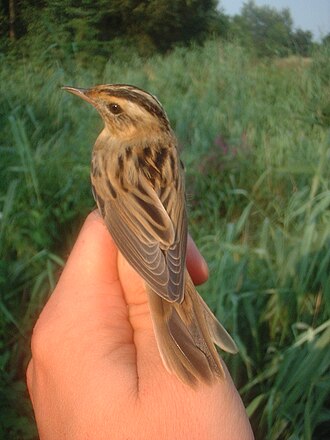
The plumage of the sexes is identical, although they can be told apart when caught for ringing by the presence of a brood patch or cloacal protuberance. Juvenile birds have dark spots on the breast. They can be easier to confuse with aquatic warblers due to an apparent pale central crown stripe contrasting with the darker edges. Other similar species include moustached warblers and Pallas's grasshopper warblers. The oldest recorded sedge warbler was a bird ringed in Finland which reached the age of 10 years, 1 month. The typical lifespan is 2 years.
The song is varied, rushed and chattering, with sweeter phrases and some mimicry, typical of the Acrocephalus warblers.
Distribution and habitat
The sedge warbler has a large range and an estimated Global Extent of Occurrence of 10 million square kilometres, with a large global population including between 8.8 million and 15 million birds in Europe. Data analysis by the British Trust for Ornithology has shown that fluctuations in the sedge warbler population stem from the adult survival rate, due to changes in rainfall on the birds' wintering grounds. Global changes in population have not been measured, but the sedge warbler's status is designated 'of least concern' by BirdLife International.
It breeds across Europe and western and central Asia and is migratory. After feeding up post-breeding, they migrate quickly across southern Europe and the Sahara from August to September. Studies in Nigeria and Uganda suggest that sedge warblers return to spend winter at the same sites, year after year.
All sedge warblers spend winter in sub-Saharan Africa, from Senegal in the west to Ethiopia in the east, and as far south as the eastern Cape Province of South Africa and northern Namibia.
Behaviour
Breeding
Male sedge warblers commence singing only a few hours after arriving on their breeding territory. The song is given from a bare perch such as a reed stem or bush, or from cover and during routine flights within their territory. Song-flights are also performed: while singing, the bird takes off, rises to a height of around 2–5 metres (6.6–16.4 ft) and then after a short circling flight, makes a slow, 'parachuting' descent, often with the wings held up in a 'v' shape. The song has the function of attracting a mate, rather than keeping other males away, and is stopped as soon as a mate is found. Contact calls are described as chirr or kerr; and these calls are repeated quickly to form a rattling alarm call.
Studies have found that early-arriving males occupy the best breeding territories. A study in Nottinghamshire, England, showed that a third of males which returned bred within 50 m or less of their previous breeding site, and only 14% bred further than 400 m (1,300 ft) away.
以上节选摘自英文维基百科「Sedge warbler」,按 CC BY-SA 4.0 使用,去掉了参考文献、外部链接等尾部小节,公式改写成了纯文本。篇幅所限,较长的小节只摘了开头一部分,有的小节没有收;全文、配图和出处见原文。