格物
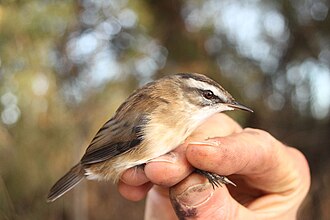
图:ChristopheBernier30 · CC BY-SA 3.0 · Wikimedia Commons
- 学名
- Acrocephalus melanopogon
- 分类等级
- 种
- 英文名
- Moustached Warbler
- 上级类群
- 苇莺属
- 大类
- 鸟类
- 命名
- 昆拉德·雅各布·特明克,1823 年
- 保护状况(IUCN)
- 无危物种
- 特有于
- Thol Lake
- 数据库
- NCBI 分类 · GBIF · IUCN 红色名录
百科正文
特征
须苇莺体重约10.9克,翼长约56.7毫米,嘴峰长约12.7毫米,喙宽度约2.6毫米,喙厚度约2.5毫米,跗跖长约19毫米,尾长约47.8毫米。须苇莺是候鸟,其栖息在开放的湖泊、沼泽等湿地环境中,食性为肉食性,主要食物来源是陆生无脊椎动物。
亚种
A. m. melanopogon:分布于地中海周边的欧洲和北非。
A. m. mimicus:分布于土耳其西部至俄罗斯南部、伊拉克、伊朗和阿富汗。
A. m. albiventris:分布于俄罗斯(亚速海东岸至顿河下游)。
以上内容摘自维基百科「须苇莺」,按 CC BY-SA 4.0 使用,去掉了参考文献、外部链接等尾部小节,公式改写成了纯文本。全文、配图和出处见原文。
英文维基百科补充中文条目比较短,下面是英文条目「Moustached warbler」的原文
The moustached warbler (Acrocephalus melanopogon) is an Old World warbler in the genus Acrocephalus. It breeds in southern Europe and southern temperate Asia with a few breeding in north-west Africa. It is partially migratory. South-west European birds are resident, south-east European birds winter in the Mediterranean breeding range, and the Asiatic race migrates to Arabia, India and Pakistan.
Taxonomy
The moustached warbler was formally described and illustrated in 1823 by the Dutch zoologist Coenraad Jacob Temminck based on a specimen collected near Rome in Italy. He coined the binomial name Sylvia melanopogon. The moustached warbler is now one of 42 warblers placed in the genus Acrocephalus that was introduced in 1811 by the German naturalist Johann Andreas Naumann and his son Johann Friedrich Naumann. The genus name combines the Ancient Greek ακρος/akros meaning "point" or "crest" with -κεφαλος/-kephalos meaning "-headed". The specific epithet melanopogon combines the Ancient Greek μελας/melas, μελανος/melanos meaning "black" with πωγων/pōgōn, πωγωνος/pōgōnos meaning "beard".
Three subspecies are recognised:
A. m. melanopogon (Temminck, 1823) – south Europe to Ukraine and west Turkey, northwest Africa
A. m. mimicus (Madarász, G, 1903) – east Turkey to south Russia, Kazakhstan, northwest China, Iran and Iraq
A. m. albiventris (Kazakov, 1974) – southeast Ukraine and southwest Russia
Description
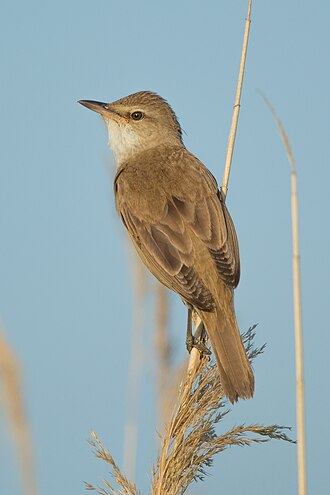
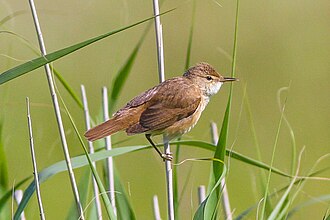
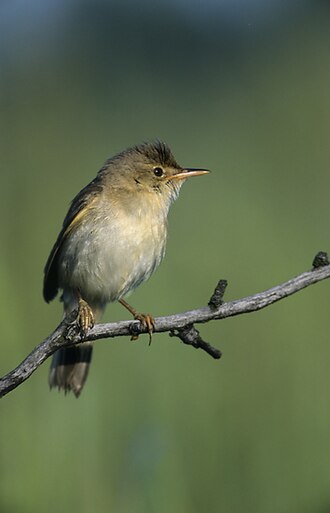
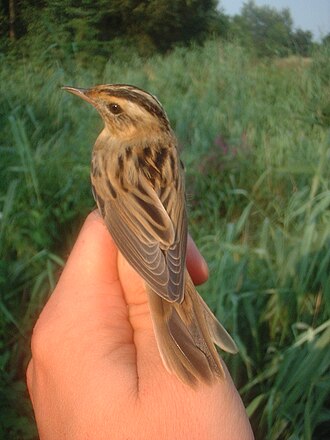
The moustached warbler is 12–13 cm (4.7–5.1 in) long, slightly smaller than the similar sedge warbler (Acrocephalus schoenobaenus). The adult has a finely streaked brown back and white underparts. The forehead is flattened, there is a prominent whitish supercilium, grey ear coverts, and the bill is strong and pointed. The sexes are identical, as with most warblers, but young birds are more heavily streaked and have markings on the breast.
The song is fast and similar to the sedge warbler and reed warbler, with some mimicry and typically acrocephaline whistles added. Its song is softer and more melodious than those of its relatives, and includes phrases reminiscent of the nightingale. Unlike the sedge warbler, it does not sing in flight.
Distribution and habitat
It is scarce north of its range, but has occurred as a very rare vagrant as far as Poland and Denmark. There have been a few reports from Great Britain, including a pair breeding in Cambridgeshire in 1946, but these records have recently been removed from the official list of British birds, being unconvincingly distinguished from sedge warblers or paddyfield warblers. It is found in upright aquatic vegetation such as reeds and sedge.
Behaviour
Feeding
Like most warblers, it is insectivorous.
Breeding
The moustached warbler is usually monogamous. The deep cup nest is built by the female suspended over water among reeds or rushes or in a bush. A clutch of 3 to 6 eggs are laid from mid-April. They are incubated by both sexes for 13 to 15 days. Both parents feed the young. They leave the nest after around 12 days and become independent of their parents 18-22 days after fledging. Two broods are raised each year.
以上内容摘自英文维基百科「Moustached warbler」,按 CC BY-SA 4.0 使用,去掉了参考文献、外部链接等尾部小节,公式改写成了纯文本。全文、配图和出处见原文。