 格物
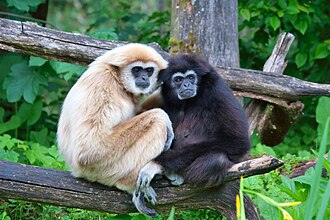
图:User:MatthiasKabel · CC BY 2.5 · Wikimedia Commons
生命之树 › 真核生物 › 动物界 › 真后生动物亚界 › 两侧对称动物 › 后口动物总门 › 脊索动物门 › 脊椎动物亚门 › 有颌下门 › 肉鳍鱼总纲 › 四足形类 › 希望螈目 › 四足总纲 › 哺乳动物 › 兽型类 › 全兽类 › 兽亚纲 › 有胎盘类 › 北方真兽高目 › 灵长总目 › 灵长目 › 简鼻亚目 › 类人猿下目 › 狭鼻小目 › 人猿总科
长臂猿科科
Hylobatidae
长臂猿科 也称小型猿类,哺乳纲灵长目的一科,传统分类法只包括长臂猿属一属,现今根据其遗传演化之间的时间,可分为四属20种,分别为:长臂猿属(44对)、白眉长臂猿属(38对)、冠长臂猿属(52对)和合趾猿属(50对)。其分布范围东起中国云南、广西、海南省,西至印度阿萨姆邦以及整个东南亚地区。栖地形态从一般热带雨林至常绿阔叶林不等,海拔范围可至2700米(中国云南省)。
摘自维基百科「长臂猿」,CC BY-SA 4.0
- 学名
- Hylobatidae
- 分类等级
- 科
- 英文名
- gibbon
- 上级类群
- 人猿总科
- 大类
- 哺乳动物
- 命名
- 约翰·爱德华·格雷,1871 年
- 体重
- 8.5 千克
- 数据库
- NCBI 分类 · GBIF
下级类群(3)
百科正文
习性
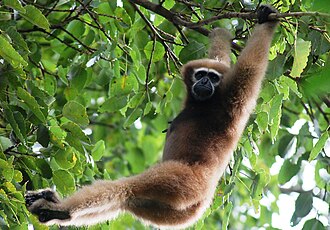
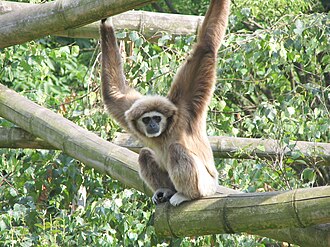
长臂猿善鸣。产于亚洲,无尾,手腕关节灵活,擅于作手臂渡越的动作,动作快速灵巧,有“森林特技家”的美誉。
古籍中的描述
朝辞白帝彩云间,千里江陵一日还。两岸猿声啼不住,轻舟已过万重山。- 唐·李白《早发白帝城》。白帝城在今重庆市奉节县城东瞿塘峡口,江陵在今湖北江陵县。从白帝城到江陵约一千二百里,其间包括七百里三峡,由诗中可见,唐时两岸山林中长臂猿颇多。
自三峡七百里中,两岸连山,略无阙处。重岩叠嶂,隐天蔽日,自非亭午夜分,不见曦月。至于夏水襄陵,沿溯阻绝。或王命急宣,有时朝发白帝,暮到江陵,其间千二百里,虽乘奔御风,不以疾也。春冬之时,则素湍绿潭,回清倒影。绝𪩘多生怪柏,悬泉瀑布,飞漱其间,清荣峻茂,良多趣味。每至晴初霜旦,林寒涧肃,常有高猿长啸,属引凄异,空谷传响,哀转久绝。故渔者歌曰:“巴东三峡巫峡长,猿鸣三声泪沾裳。” - 北魏·郦道元《水经注》卷三四《江水》
以上内容摘自维基百科「长臂猿」,按 CC BY-SA 4.0 使用,去掉了参考文献、外部链接等尾部小节,公式改写成了纯文本。全文、配图和出处见原文。
英文维基百科补充中文条目比较短,下面是英文条目「Gibbon」的原文
Gibbons are apes in the family Hylobatidae (; hylobatids). The family historically contained one genus, but now is split into four extant genera and 20 species. Gibbons live in subtropical and tropical forests from eastern Bangladesh and Northeast India to Southeast Asia and Indonesia (including the islands of Sumatra, Borneo and Java).
Also called the lesser apes, gibbons differ from the great apes (chimpanzees, gorillas, orangutans and humans) in being smaller, exhibiting low sexual dimorphism, and not making nests. Like all of the apes, gibbons are tailless. Unlike most of the great apes, gibbons frequently form long-term pair bonds. Their primary mode of locomotion, brachiation, involves swinging from branch to branch for distances up to 15 m (50 ft), at speeds as fast as 55 km/h (34 mph). They can also make leaps up to 8 m (26 ft), and walk bipedally with their arms raised for balance. They are the fastest of all tree-dwelling, nonflying mammals.
Depending on the species and sex, gibbons' fur coloration varies from dark- to light-brown shades, and any shade between black and white, though a completely "white" gibbon is rare.
Etymology
The English word "gibbon" is a reborrowing from French and may originally derive from an Orang Asli word.
以上节选摘自英文维基百科「Gibbon」,按 CC BY-SA 4.0 使用,去掉了参考文献、外部链接等尾部小节,公式改写成了纯文本。篇幅所限,较长的小节只摘了开头一部分,有的小节没有收;全文、配图和出处见原文。