格物
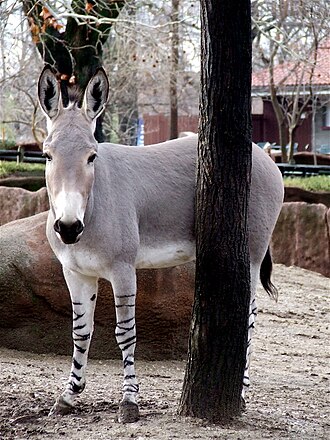
图:päts from Mexico · CC BY 2.0 · Wikimedia Commons
- 学名
- Equus africanus
- 分类等级
- 种
- 上级类群
- 马属
- 大类
- 哺乳动物
- 命名
- 特奥多尔·冯霍伊格林、费卿格,1866 年
- 保护状况(IUCN)
- 极危物种
- 特有于
- 索马里
- 数据库
- GBIF · IUCN 红色名录
百科正文
特征
非洲野驴约为5呎高及6.5呎长。它们一般重440至510磅。尾巴约1.5呎长。
身体是短少平滑的毛皮,呈浅灰色至淡黄褐色,但在腹部及脚部很快转为白色。在所有亚种的背部都有细长深色的斑纹,而努比亚野驴(学名E. a. africanus)就如驴一样,斑纹越过肩膀。而索马里野驴(学名E. a. somalicus)的脚部有黑色的横间,彷如斑马一般。在颈背有竖挺黑色的鬃毛。耳朵颇大有黑边。尾巴亦是黑色结尾。蹄较纤细,约为脚的直径。
行为
非洲野驴在暮晨及黄昏较冷的时候出没,在日头会在石山寻找阴凉或遮盖处。它们在粗糙石山的行动依然迅速及步履稳健,时速可达50km/h。成熟的雄性会保卫自己约23公里大小的领域,并边界摆放粪堆作为重要的记号。由于身形的问题,它们在领域中不能驱赶其他雄性入侵者,反而会容忍并当作是从属看待,它们亦会将这些入侵者尽可能与雌性分隔。当有发情的雌性时,雄性会大叫。它们的族群较松散,数量约有50头。
饮食
非洲野驴主要以草、树皮及树叶作食粮。除了生长在干燥的气候外,它们亦需要水分,若在不能从食物中吸收水分,它们每三天需要饮水一次。但是,它们却可以在缺乏水分下生存,有指它们亦会饮用咸或污黑的水。
以上内容摘自维基百科「非洲野驴」,按 CC BY-SA 4.0 使用,去掉了参考文献、外部链接等尾部小节,公式改写成了纯文本。全文、配图和出处见原文。
英文维基百科补充中文条目比较短,下面是英文条目「African wild ass」的原文
The African wild ass (Equus africanus) or African wild donkey, is a wild member of the horse family, Equidae. This species is thought to be the ancestor of the domestic donkey (Equus asinus), which is sometimes placed within the same species. They live in the deserts and other arid areas of the Horn of Africa, in Eritrea, Ethiopia and Somalia. It formerly had a wider range north and west into Sudan, Egypt, and Libya. It is critically endangered, with about 570 existing in the wild, making it the most threatened species of the family.
Description
The African wild ass is about 1.2 metres (4 ft) tall and weighs approximately 250 kilograms (600 lb). The short, smooth coat is a light grey to fawn colour, fading quickly to white on the undersides and legs. There is a slender, dark dorsal stripe in all subspecies, while in the Nubian wild ass (E. a. africanus), as well as the domestic donkey, there is a stripe across the shoulder. The legs of the Somali wild ass (E. a. somaliensis) are horizontally striped with black, resembling those of a zebra.
Evolution
The genus Equus, which includes all extant equines, is believed to have evolved from Dinohippus, via the intermediate form Plesippus. One of the oldest species is Equus simplicidens, described as zebra-like with a donkey-shaped head. The oldest fossil to date is ~3.5 million years old from Idaho in the United States. The genus appears to have spread quickly into the Old World, with the similarly aged Equus livenzovensis documented from western Europe and Russia.
Taxonomy
Different authors consider the African wild ass and the domesticated donkey one or two species; either view is technically legitimate, though the former is phylogenetically more accurate. However, the American Society of Mammalogists classifies the donkey as a distinct species, as it does with almost all domestic mammals.
The species name for the African wild ass is sometimes given as asinus, from the domestic donkey, whose specific name is older and usually would have priority.
Habitat
African wild asses are found in desert or semidesert environments. They have tough digestive systems, which can break down desert vegetation and extract moisture from food efficiently. They are adapted to live with little water for long stretches of time. Their large ears give them a sharp sense of hearing and help in cooling.
Behavior
The African wild ass is primarily active in the cooler hours between late afternoon and early morning, seeking shade and shelter amongst the rocky hills during the day. The Somali wild ass is also very agile and nimble-footed, capable of moving quickly across boulder fields and in the mountains. On the flat, it has been recorded reaching speeds of 70 km/h (43 mph). In keeping with these feats, its soles are particularly hard and its hooves grow very quickly.
Diet
The African wild asses' diet consists of grasses, bark, and leaves. Despite being primarily adapted for living in an arid climate, they are dependent on water, and when not receiving the needed moisture from vegetation, they must drink at least once every three days. However, they can survive on a surprisingly small amount of liquid, and have been reported to drink salty or brackish water.
Conservation status
Though the species itself is under no threat of extinction, due to abundant domestic stock (donkeys and burros), the two extant wild subspecies are both listed as critically endangered. African wild asses have been captured for domestication for centuries and this, along with interbreeding between wild and domestic animals, has caused a distinct decline in population numbers. There are now only a few hundred individuals left in the wild.
In captivity
There are about 150 individual Somali wild asses living in zoos around the globe, of which 36 were born at Zoo Basel, where this species' breeding program started with Basel's first Somali wild asses in 1970 and the first birth in 1972.
Zoo Basel manages the European studbook for the Somali wild ass and coordinates the European Endangered Species Programme (EEP).
以上节选摘自英文维基百科「African wild ass」,按 CC BY-SA 4.0 使用,去掉了参考文献、外部链接等尾部小节,公式改写成了纯文本。篇幅所限,较长的小节只摘了开头一部分,有的小节没有收;全文、配图和出处见原文。