格物
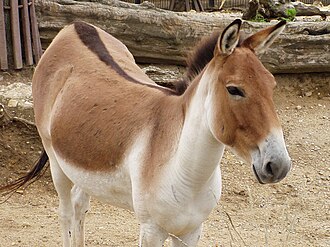
图:Bodlina · CC BY 3.0 · Wikimedia Commons
生命之树 › 真核生物 › 动物界 › 真后生动物亚界 › 两侧对称动物 › 后口动物总门 › 脊索动物门 › 脊椎动物亚门 › 有颌下门 › 肉鳍鱼总纲 › 四足形类 › 希望螈目 › 四足总纲 › 哺乳动物 › 兽型类 › 全兽类 › 兽亚纲 › 有胎盘类 › 北方真兽高目 › 劳亚兽总目 › 奇蹄目 › 马形亚目 › 马科 › 马亚科 › 马族 › 马属
西藏野驴种
Equus kiang
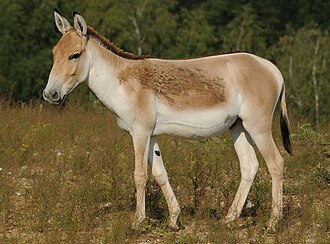
西藏野驴,又名藏野驴,是大型马科哺乳动物,分布于青藏高原海拔4000-7000米的地区,是所有野生驴中体型最大的一种,平均肩高为140厘米。它们与波斯野驴 有着亲缘关系,有些分类学家将它归为波斯野驴的一个亚种。
摘自维基百科「西藏野驴」,CC BY-SA 4.0
- 学名
- Equus kiang
- 分类等级
- 种
- 英文名
- kiang
- 上级类群
- 马属
- 大类
- 哺乳动物
- 命名
- 威廉·穆克罗夫特,1841 年
- 中文别名
- 藏野驴
- 保护状况(IUCN)
- 无危物种
- 栖息地
- 稀树草原、灌丛
- 数据库
- NCBI 分类 · GBIF · IUCN 红色名录
百科正文
亚种
- 西藏野驴共有三个亚种:
- 西部亚种 Equus kiang kiang
- 东部亚种 Equus kiang holdereri
- 南部亚种 Equus kiang polyodon
保育状况
其被列为《濒危野生动植物种国际贸易公约》附录二的物种,被限制出口及贸易。
以上内容摘自维基百科「西藏野驴」,按 CC BY-SA 4.0 使用,去掉了参考文献、外部链接等尾部小节,公式改写成了纯文本。全文、配图和出处见原文。
英文维基百科补充中文条目比较短,下面是英文条目「Kiang」的原文
The kiang (Equus kiang) is the largest species of the Asinus subgenus. It is native to the Tibetan Plateau in Ladakh India, northern Pakistan, China and northern Nepal. It inhabits montane grasslands and shrublands. Other common names for this species include Tibetan wild ass, khyang and gorkhar.
Description
The kiang is the largest of the wild asses, with an average height at the withers of 140 cm (55 in). They range from 132 to 142 cm (52 to 56 in) high at the withers, with a body 182 to 214 cm (72 to 84 in) long, and a tail of 32 to 45 cm (13 to 18 in). Kiangs have only slight sexual dimorphism, with the males weighing from 350 to 400 kg (770 to 880 lb), while females weigh 250 to 300 kg (550 to 660 lb). They have a large head, with a blunt muzzle and a convex nose. The mane is upright and relatively short.
Genomics
Results of a chromosome-level genome study indicate that expanded gene families and positively selected genes in the kiang were mainly associated with hypoxia response, as well as metabolism and immunity, consistent with adaptation to high-elevation environments.
A telomere-to-telomere chromosome-level genome assembly of the kiang published in 2026 is approximately 2.48 Gb, with 96.85% of the sequence anchored to 27 pseudochromosomes. This assembly has a BUSCO completeness of 96.3% and contains 20,654 predicted protein-coding genes.
Evolution
The genus Equus, which includes all extant equines, is believed to have evolved from Dinohippus, via the intermediate form Plesippus. One of the oldest species is Equus simplicidens, described as zebra-like with a donkey-shaped head. The oldest fossil to date is about 3.5 million years old from Idaho, US. The genus appears to have spread quickly into the Old World, with the similarly aged Equus livenzovensis documented from western Europe and Russia.
Molecular phylogenies indicate the most recent common ancestor of all modern equids lived about 3.9 to 7.8 million years ago.
Taxonomy
The kiang is closely related to the onager (Equus hemionus), and in some classifications it is considered a subspecies, E. hemionus kiang. Molecular studies indicate that the kiang is nested deeply within the extant radiation of E. hemionus. Based on a 1967 morphological study the two are considered separate species by the IUCN as of 2026.
Kiangs can crossbreed with onagers, horses, donkeys, and Burchell's zebras in captivity, although, like mules, the resulting offspring are sterile. Kiangs have never been domesticated.
Distribution and habitat
The kiang is distributed in the Himalayas and Tibetan Plateau from northern Pakistan, Ladakh, Himachal Pradesh and Uttarakhand states of India to Qinghai, Gansu, southern Xinjiang and Sichuan regions of China.
It inhabits alpine meadows and steppe country at elevations from 2,700 to 5,300 m (8,900 to 17,400 ft), preferring relatively flat plateaus, wide valleys, and low hills, dominated by grasses, sedges, and other short vegetation.
In Pakistan, the kiang occurs in the area between the Oprang river and the Shaksgam River with its presence confirmed in Khunjerab National Park.
Behavior and ecology
The kiang is a herbivore, feeding on grasses and sedges, especially Stipa, but also on other plants such as bog sedges, true sedges, and meadow grasses. When little grass is available, such as during winter or in the more arid margins of their native habitat, kiangs have been observed eating shrubs, herbs, and even Oxytropis roots dug from the ground. Although they do sometimes drink from waterholes, such sources of water are rare on the Tibetan Plateau, and they likely obtain most of their water from the plants they eat, or possibly from snow in winter.
In culture
Natural historian Chris Lavers points to travellers' tales of the kiang as one source of inspiration for the unicorn, first described in Indika by the Ancient Greek physician Ctesias.
Ekai Kawaguchi, a Japanese monk who traveled in Tibet from July, 1900 to June 1902, reported:
As I have already said, khyang is the name given by the Tibetans to the wild horse of their northern steppes. More accurately it is a species of ass, quite as large in size as a large Japanese horse. In color it is reddish brown, with black hair on the ridge of the back and black mane and with the belly white.
以上节选摘自英文维基百科「Kiang」,按 CC BY-SA 4.0 使用,去掉了参考文献、外部链接等尾部小节,公式改写成了纯文本。篇幅所限,较长的小节只摘了开头一部分,有的小节没有收;全文、配图和出处见原文。