格物

图:Micha L. Rieser · Attribution · Wikimedia Commons
- 学名
- Equus zebra
- 分类等级
- 种
- 英文名
- mountain zebra
- 上级类群
- 马属
- 大类
- 哺乳动物
- 命名
- 卡尔·林奈,1758 年
- 保护状况(IUCN)
- 易危物种
- 栖息地
- 稀树草原
- 数据库
- NCBI 分类 · GBIF · IUCN 红色名录
百科正文
保护
山斑马目前被国际自然保护联盟(IUCN)列为易危物种。海角山斑马被狩猎到几乎灭绝。在1930年代,数量减少到大约100只。不过持续不断强而有力的保育手段,成功阻止数量的下降,并且在1998年,海角山班马的数量,估计已经增加到约1200只,大约540只在国家公园,490只在国家自然保护区,并且有165只在其它保护区。但是由于保育成功,野外的数量已经增加到大约2700只。
尽管山班马的两个亚种,现在已在国家公园被保护,它们仍然受到威胁。目前已经为它们建立了“欧洲动物园濒危物种计划”和合作管理全世界动物园里的数量。
以上内容摘自维基百科「山斑马」,按 CC BY-SA 4.0 使用,去掉了参考文献、外部链接等尾部小节,公式改写成了纯文本。全文、配图和出处见原文。
英文维基百科补充中文条目比较短,下面是英文条目「Mountain zebra」的原文
The mountain zebra (Equus zebra) is a zebra species in the family Equidae, native to southwestern Africa. There are two subspecies, the Cape mountain zebra (E. z. zebra) found in South Africa and Hartmann's mountain zebra (E. z. hartmannae) found in south-western Angola and Namibia.
Taxonomy
The mountain zebra comprises two subspecies:
In 2004, C. P. Groves and C. H. Bell investigated the taxonomy of the zebras (genus Equus, subgenus Hippotigris). They concluded that the Cape mountain zebra (Equus zebra zebra) and Hartmann's mountain zebra (Equus zebra hartmannae) are distinct, and suggested that the two would be better classified as separate species, Equus zebra and Equus hartmannae.
However, in a sexual genetic study that included 295 mountain zebra specimens, Moodley and Harley (2005) found nothing to support the separation of the two mountain zebra populations into separate species. They concluded that the Cape mountain zebra and Hartmann's mountain zebra should remain as subspecies.
Appearance
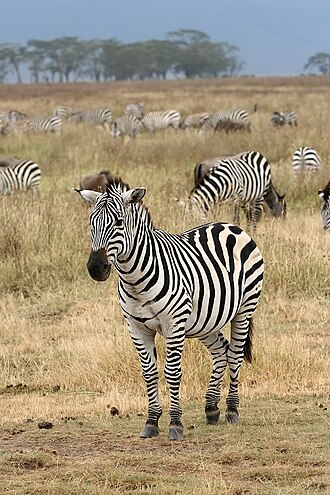
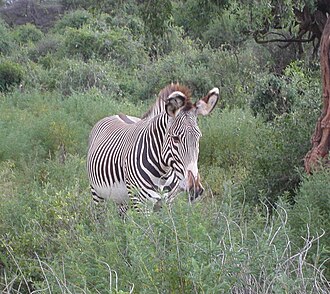
The mountain zebra has a dewlap, which is more conspicuous in E. z. zebra than in E. z. hartmannae. Like all extant zebras, mountain zebras are boldly striped in black or dark brown, and no two individuals look exactly alike. The whole body is striped except for the belly. In the Cape mountain zebra, the ground colour is effectively white, but the ground colour in Hartmann's zebra is slightly buff.
Adult mountain zebras have a head-and-body length of 2.1 to 2.6 m (6 ft 11 in to 8 ft 6 in) and a tail of 40 to 55 cm (16 to 22 in) long. Wither height ranges from 1.16 to 1.5 m (3 ft 10 in to 4 ft 11 in). They weigh from 204 to 372 kg (450 to 820 lb).
Habitat
Mountain zebras are found on mountain slopes, open grasslands, woodlands, and areas with sufficient vegetation, but their preferred habitat is mountainous terrain, especially escarpment with a diversity of grass species.
Ecology
Mountain zebras live in hot, dry, rocky, mountainous and hilly habitats. They prefer slopes and plateaus as high as 2,000 m (6,600 ft) above sea level, although they do migrate lower during winter. Their preferred diet is tufted grass, primarily Themeda triandra, but in times of shortage, they browse, eating bark, twigs, leaves, buds, fruit, and roots. Other grasses consumed include Cymbopogon pospischilii, Heteropogon contortus, Setaria sphacelata, and Enneapogon scoparius.
They drink every day. When no surface water is available due to drought, they commonly dig for ground water in dry river beds.
Behavior and life cycle
Mountain zebras do not aggregate into large herds like plains zebras; they form small family groups consisting of a single stallion and one to five mares, together with their recent offspring. Bachelor males live in separate groups, and mature bachelors attempt to capture young mares to establish a harem. In this they are opposed by the dominant stallion of the group.
Mares give birth to one foal at a time, for about 3 years baby foals gets weaned onto solid forage. Cape mountain zebra foals generally move away from their maternal herds sometime between the ages of 13 and 37 months. However, with Hartmann's mountain zebra, mares try to expel their foals when they are aged around 14 to 16 months.
Threats
The main threats to the species are the loss of habitat to agriculture, hunting, and persecution. Poaching for food (for example, during guerrilla fighting) has decreased their numbers.
Conservation
The species is listed as vulnerable under the IUCN Red List and both sub-species are included in Appendix II of the Convention on International Trade in Endangered Species (CITES). The Cape mountain zebra was hunted to near extinction. In the 1930s, their population was reduced to about 100 individuals. However, consistent and vigorous conservation measures have succeeded in reversing the decline, and in 1998, the population of the Cape mountain zebra was estimated to have increased to some 1200, about 540 in national parks, 490 in provincial nature reserves, and 165 in other reserves. However, the population has increased to about over 2,700 in the wild due to conservation efforts.
以上节选摘自英文维基百科「Mountain zebra」,按 CC BY-SA 4.0 使用,去掉了参考文献、外部链接等尾部小节,公式改写成了纯文本。篇幅所限,较长的小节只摘了开头一部分,有的小节没有收;全文、配图和出处见原文。