格物
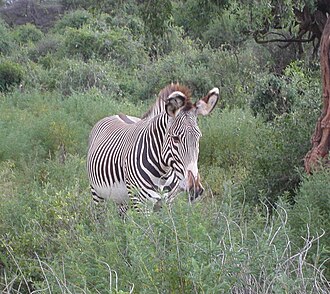
图:Jesse Hull · CC BY 2.0 · Wikimedia Commons
生命之树 › 真核生物 › 动物界 › 真后生动物亚界 › 两侧对称动物 › 后口动物总门 › 脊索动物门 › 脊椎动物亚门 › 有颌下门 › 肉鳍鱼总纲 › 四足形类 › 希望螈目 › 四足总纲 › 哺乳动物 › 兽型类 › 全兽类 › 兽亚纲 › 有胎盘类 › 北方真兽高目 › 劳亚兽总目 › 奇蹄目 › 马形亚目 › 马科 › 马亚科 › 马族 › 马属
细纹斑马种
Equus grevyi
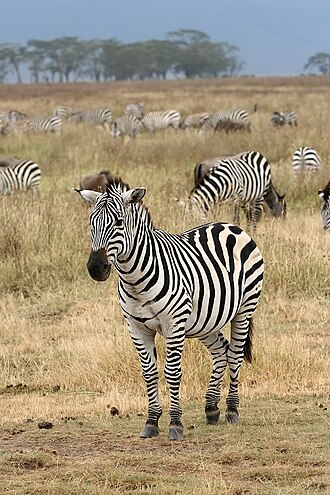
细纹斑马 又名格利威斑马、狭纹斑马,是三种斑马中体型最大的一种。分布于非洲的肯尼亚和埃塞俄比亚。与其他斑马相比,细纹斑马的个子较高,耳较大,斑纹则更加狭窄,差别较为明显,相对而言,细纹斑马与驴的亲缘关系较接近。细纹斑马与平原斑马(普通斑马)的分布范围有所重叠。
摘自维基百科「细纹斑马」,CC BY-SA 4.0
- 学名
- Equus grevyi
- 分类等级
- 种
- 英文名
- Grevy's zebra
- 上级类群
- 马属
- 大类
- 哺乳动物
- 命名
- 埃米尔·乌斯塔莱,1882 年
- 保护状况(IUCN)
- 濒危 (保育状况)
- 体重
- 40 千克(出生体重)
- 数据库
- NCBI 分类 · GBIF · IUCN 红色名录
百科正文
特征
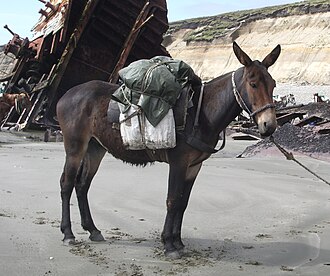
细纹斑马是所有马科动物中最大的一种,体长为2.5-3米,尾长38-75厘米,肩高1.25-1.6米。体重为350-450千克。斑纹及间距都十分窄小,一直到蹄部都有,颈部较宽,下腹部和尾根部没有斑纹。耳很大,呈圆锥形。头部长而窄,形状十分接近骡。鬃毛较长并竖立。
食性
主要以草为食,同时也吃水果、灌木和树皮。每天60%以上的时间都被用于进食。
行为与繁殖
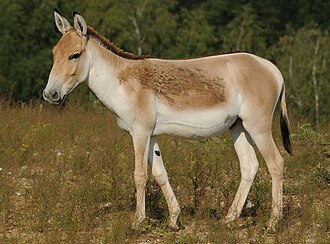
细纹斑马在行为上与驴有很多相似之处。比如,成年细纹斑马会在短期内组成小规模的种群。成年公斑马以独居为主,其领地范围为2-12 km²,比野驴的范围小些。
领地主要由粪便来划定,母细纹斑马只与本领地内的公斑马交配。这种社会结构适应于细纹斑马生活的干燥的灌木林和平原地区。细纹斑马通过打斗来决定领地和交配权。
细纹斑马的孕期为350-400天,每胎仅产一仔。
保护及现况
目前的状况为濒危,面临的主要威胁来自偷猎。细纹斑马的皮毛可以在市场上卖到极高的价格。同时栖息地的破坏、人类的干扰以及其他动物的竞争,也是细纹斑马数量减少的重要因素。目前全世界野外生存的细纹斑马大约还有2500头左右。不过,全世界动物园中的斑马很多都是细纹斑马。
以上内容摘自维基百科「细纹斑马」,按 CC BY-SA 4.0 使用,去掉了参考文献、外部链接等尾部小节,公式改写成了纯文本。全文、配图和出处见原文。
英文维基百科补充中文条目比较短,下面是英文条目「Grévy's zebra」的原文
Grévy's zebra (Equus grevyi), also known commonly as the imperial zebra, is the largest living species of wild equid and the most threatened of the three species of zebras, the other two being the plains zebra and the mountain zebra. Named after French president Jules Grévy, it is found in parts of Kenya and Ethiopia. Superficially, Grévy's zebra's physical features can help to identify it from the other zebra species; its overall appearance is slightly closer to that of a mule and donkey, compared to the more "equine" (horse) appearance of the plains and mountain zebras. Compared to other zebra species, Grévy's zebra is the tallest; it has mule-like, larger ears, and has the narrowest stripes of all zebras. It has a distinctively erect mane, and a more slender snout.
Grévy's zebra lives in semi-arid savanna, where it feeds on grasses, legumes, and browse, such as acacia; it can survive up to five days without water. It differs from the other zebra species in that it does not live in a harem, and it maintains few long-lasting social bonds. Stallion territoriality and mother–foal relationships form the basis of the social system of the Grévy's zebra. Despite a handful of zoos and animal parks around the world having had successful captive-breeding programs, in its native home this zebra is listed by the IUCN as endangered. Its population has declined from 15,000 to 2,000 since the 1970s. In 2016, the population was reported to be "stable"; however, as of 2020, the wild numbers are still estimated at only around 2,250 animals, in part due to anthrax outbreaks in eastern Africa.
Taxonomy and naming
The Grévy's zebra was first described by French naturalist Émile Oustalet in 1882. He named it after Jules Grévy, then president of France, who, in the 1880s, was given one as a gift by the government of Ethiopia. Traditionally, this species was classified in the subgenus Dolichohippus with plains zebra and mountain zebra in Hippotigris. Groves and Bell (2004) place all three species in the subgenus Hippotigris.
Fossils of zebra-like equids have been found throughout Africa and Asia in the Pliocene and Pleistocene deposits. Notable examples include E.
Description
Grévy's zebra is the largest of all wild equines. It is 2.5–2.75 m (8.2–9.0 ft) in head-body length, with a tail 55–75 cm (1.80–2.46 ft) long, stands 1.45–1.6 m (4.8–5.2 ft) high at the withers, and weighs 350–450 kg (770–990 lb). Grévy's zebra differs from the other two zebras in its more primitive characteristics. It is particularly mule-like in appearance; the head is large, long, and narrow with elongated nostril openings; the ears are very large, rounded, and conical, and the neck is short but thick.
Range and ecology
Grévy's zebra largely inhabits northern Kenya, with some isolated populations in Ethiopia. It was extirpated from Somalia and Djibouti and its status in South Sudan is uncertain. It lives in Acacia-Commiphora bushlands and barren plains. Ecologically, this species is intermediate between the arid-living African wild ass and the water-dependent plains zebra. Lactating mares and non-territorial stallions use areas with green, short grass and medium, dense bush more often than non-lactating mares and territorial stallions.
Behaviour and life history
Adult stallions mostly live in territories during the wet seasons but some may stay in them year round if there's enough water left. Stallions that are unable to establish territories are free-ranging and are known as bachelors. Mares, young and non-territorial stallions wander through large home ranges. The mares will wander from territory to territory preferring the ones with the highest-quality food and water sources. Up to nine stallions may compete for a mare outside of a territory. Territorial stallions will tolerate other stallions who wander in their territory.
Relationship with humans
The Grévy's zebra was known to the Europeans in antiquity and was used by the Romans in circuses. It was subsequently forgotten in the Western world for a thousand years. In the seventeenth century, the king of Shoa (now central Ethiopia) exported two zebras; one to the Sultan of Turkey and another to the Dutch governor of Jakarta. A century later, in 1882, Menelik II as emperor of Ethiopia sent one to France as a gift to president Jules Grévy.
以上节选摘自英文维基百科「Grévy's zebra」,按 CC BY-SA 4.0 使用,去掉了参考文献、外部链接等尾部小节,公式改写成了纯文本。篇幅所限,较长的小节只摘了开头一部分,有的小节没有收;全文、配图和出处见原文。