格物
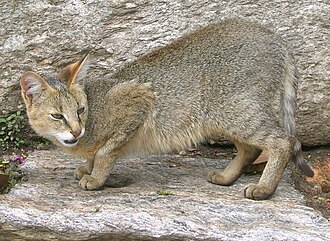
图:L. Shyamal · CC BY-SA 3.0 · Wikimedia Commons
生命之树 › 真核生物 › 动物界 › 真后生动物亚界 › 两侧对称动物 › 后口动物总门 › 脊索动物门 › 脊椎动物亚门 › 有颌下门 › 肉鳍鱼总纲 › 四足形类 › 希望螈目 › 四足总纲 › 哺乳动物 › 食肉目 › 猫型亚目 › Aeluroidea › 猫总科 › 猫科 › 猫亚科 › 猫属
丛林猫种
Felis chaus
丛林猫 为猫科猫属的动物。分布于亚洲(中西部)以及中国大陆的西藏、云南等地,多见于沿河、环湖边的芦苇或灌丛、海岸边森林、或具有高草的树林、田野。不见于热带雨林中,可活动在接近海平面的低地,亦见于2500米高地。该物种的模式产地在高加索以北的捷列克河。
摘自维基百科「丛林猫」,CC BY-SA 4.0
- 学名
- Felis chaus
- 分类等级
- 种
- 英文名
- Jungle cat
- 上级类群
- 猫属
- 大类
- 哺乳动物
- 命名
- 约翰·克里斯蒂安·丹尼尔·冯·施雷贝尔,1777 年
- 保护状况(IUCN)
- 无危物种
- 栖息地
- 森林
- 数据库
- NCBI 分类 · GBIF · IUCN 红色名录
百科正文
保护
中国国家重点保护动物等级:二级
中国濒危动物红皮书等级:稀有
亚种
2005年,《世界哺乳动物物种》将丛林猫划分为以下10个亚种:
丛林猫云南亚种(学名:Felis chaus affinis),Gray于1830年命名,分布于克什米尔、尼泊尔、锡金、不丹、云南和东南亚西北。在中国大陆,分布于西藏、云南(南部)等地。该物种的模式产地在印度北部Gangootri。
丛林猫指名亚种(学名:Felis chaus chaus),土耳其东南部、高加索、叙利亚、黎巴嫩、以色列、约旦、伊拉克、伊朗、巴基斯坦、阿富汗和中亚
丛林猫东南亚亚种(学名:Felis chaus fulvidina),缅甸、泰国、老挝、柬埔寨和越南
- (学名:Felis chaus furax)
- (学名:Felis chaus kelaarti),斯里兰卡
- (学名:Felis chaus kutas),印度西部、巴基斯坦
- (学名:Felis chaus maimanah)
- (学名:Felis chaus nilotica),埃及尼罗河谷
- (学名:Felis chaus oxiana)
- (学名:Felis chaus prateri),印度西部
2017年,猫科动物专家组将丛林猫各亚种合并,只保留前3个亚种。
以上内容摘自维基百科「丛林猫」,按 CC BY-SA 4.0 使用,去掉了参考文献、外部链接等尾部小节,公式改写成了纯文本。全文、配图和出处见原文。
英文维基百科补充中文条目比较短,下面是英文条目「Jungle cat」的原文
The jungle cat (Felis chaus), also called reed cat and swamp cat, is a medium-sized cat native from the Eastern Mediterranean region and the Caucasus to parts of Central, South and Southeast Asia. It inhabits foremost wetlands like swamps, littoral and riparian areas with dense vegetation. It is listed as Least Concern on the IUCN Red List, and is mainly threatened by destruction of wetlands, trapping and poisoning.
The jungle cat has a uniformly sandy, reddish-brown or grey fur without spots; melanistic and albino individuals are also known. It is solitary in nature, except during the mating season and mother–kitten families.
Adults maintain territories by urine spraying and scent marking. Its preferred prey is small mammals and birds. It hunts by stalking its prey, followed by a sprint or a leap; the ears help in pinpointing the location of prey. Both sexes become sexually mature by the time they are one year old; females enter oestrus from January to March. Mating behaviour is similar to that in the domestic cat: the male pursues the female in oestrus, seizes her by the nape of her neck and mounts her. Gestation lasts nearly two months. Births take place between December and June, though this might vary geographically. Kittens begin to catch their own prey at around six months and leave the mother after eight or nine months.
The species was first described by Johann Anton Güldenstädt in 1776 based on a specimen caught in a Caucasian wetland. Johann Christian Daniel von Schreber gave the jungle cat its present binomial name and is therefore generally considered as binomial authority. Three subspecies are recognised at present.
Taxonomy and phylogeny
Taxonomic history
Johann Anton Güldenstädt was the first scientist who caught a jungle cat near the Terek River at the southern frontier of the Russian empire, a region that he explored in 1768–1775 on behalf of Catherine II of Russia. He described this specimen in 1776 under the name "Chaus".
In 1778, Johann Christian Daniel von Schreber used chaus as the species name and is therefore considered the binomial authority.
Characteristics
The jungle cat is a medium-sized, long-legged cat, and the largest of the extant Felis species. The head-and-body length is typically between 59 and 76 cm (23 and 30 in). It stands nearly 36 cm (14 in) at shoulder and weighs 2–16 kg (4.4–35.3 lb). Its body size decreases from west to east; this was attributed to greater competition from small cats in the east. Its body size shows a similar decrease from the northern latitudes toward the tropics.
Distribution and habitat
The jungle cat is found in the Middle East, the Caucasus, the Indian subcontinent, central and Southeast Asia, Sri Lanka and in southern China.
A habitat generalist, the jungle cat inhabits places with adequate water and dense vegetation, such as swamps, wetlands, littoral and riparian areas, grasslands and shrub. It is common in agricultural lands, such as fields of bean and sugarcane, across its range, and has often been sighted near human settlements.
Ecology and behaviour
The jungle cat is typically diurnal and hunts throughout the day. Its activity tends to decrease during the hot noon hours. It rests in burrows, grass thickets and scrubs. It often sunbathes on winter days. Jungle cats have been estimated to walk 3–6 km (1.9–3.7 mi) at night, although this likely varies depending on the availability of prey. The behaviour of the jungle cat has not been extensively studied. It is solitary and associates with conspecifics only in the mating season.
Threats
Major threats to the jungle cat include habitat loss such as the destruction of wetlands, dam construction, environmental pollution, industrialisation and urbanisation. Illegal hunting is a threat in Turkey and Iran. Its rarity in Southeast Asia is possibly due to high levels of hunting.
Since the 1960s, populations of the Caucasian jungle cat living along the Caspian Sea and in the Caucasus range states have been rapidly declining. Only small populations persist today.
Conservation
The jungle cat is listed under CITES Appendix II. Hunting is prohibited in Bangladesh, China, India, Israel, Myanmar, Pakistan, Tajikistan, Thailand and Turkey. But it does not receive legal protection outside protected areas in Bhutan, Georgia, Laos, Lebanon, Nepal, Sri Lanka and Vietnam.
以上节选摘自英文维基百科「Jungle cat」,按 CC BY-SA 4.0 使用,去掉了参考文献、外部链接等尾部小节,公式改写成了纯文本。篇幅所限,较长的小节只摘了开头一部分,有的小节没有收;全文、配图和出处见原文。