格物
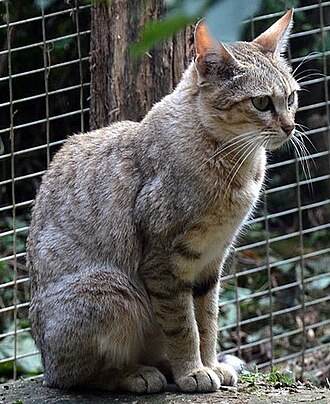
图:Vassil · CC BY-SA 4.0 · Wikimedia Commons
生命之树 › 真核生物 › 动物界 › 真后生动物亚界 › 两侧对称动物 › 后口动物总门 › 脊索动物门 › 脊椎动物亚门 › 有颌下门 › 肉鳍鱼总纲 › 四足形类 › 希望螈目 › 四足总纲 › 哺乳动物 › 食肉目 › 猫型亚目 › Aeluroidea › 猫总科 › 猫科 › 猫亚科 › 猫属
亚非野猫种
Felis lybica
亚非野猫 又称非洲野猫,是一种小型猫科动物,广泛分布于非洲大陆、西亚、中亚、印度西北和中国西北,栖息于草原、灌木丛、沙漠等多种生境。在中国称为草原斑猫,并被列为中国二级保护动物。学界曾将亚非野猫与欧洲野猫都归为野猫 的亚种,后将二者划为独立物种。
摘自维基百科「亚非野猫」,CC BY-SA 4.0
- 学名
- Felis lybica
- 分类等级
- 种
- 英文名
- African wildcat
- 上级类群
- 猫属
- 大类
- 哺乳动物
- 命名
- 格奥尔格·福斯特,1780 年
- 中文别名
- 野猫
- 保护状况(IUCN)
- 无危物种
- 异名
- Felis silvestris ocreata
- 数据库
- GBIF · IUCN 红色名录
百科正文
基因研究结果表明,亚非野猫约在 17.3–13.1 万年前分化为三支:近东野猫(分布地包含北非)、亚洲野猫和南非野猫,其中近东野猫为家猫的祖先。在人们的一般认知中,家猫约在 4000 年前的古埃及被驯化,然而根据美国学术期刊《Science》2004 年的报道,在塞浦路斯的新石器时代人类遗址希路诺坎博斯,一座 9500 年前的墓穴中,考古学家发现人类尸骨旁 40 厘米处的一只 8 个月大的近东野猫遗骸,这是已知最早的猫与人之间存在密切联系的证据,也表明猫可能早在 1 万年前的近东地区便已被驯养。至今家猫和亚非野猫之间的杂交仍相当普遍。
形态特征
亚非野猫体呈沙棕色到黄灰色,尾巴有黑色条纹。体毛短于欧洲野猫,体型也较小。头加躯干全长 45–75 厘米,尾长 20–38 厘米,体重 3–6.5 千克。
生活习性
夜间和黄昏是亚非野猫的主要活动时间,白天通常潜伏在草丛中,但若天色昏暗或多云,它们也会出来活动。多在洞穴居住并生育。怀孕期 56–69 天,每胎 2–6 崽,多为 3 只。多数小猫在雨季出生,因为雨季有充足的食物。
亚非野猫主要捕食小型啮齿类动物,有时也捕食鸟类、爬行类、两栖类和昆虫。捕猎方法是悄悄地接近猎物,到达距离猎物约 1 米时,迅速扑杀猎物。
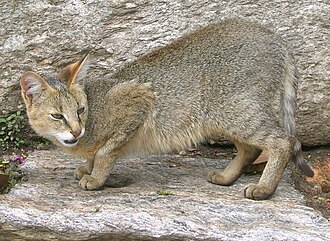
受到威胁时,亚非野猫会拱起脊背并会竖起体毛,使自身看上去更大,以震慑对手。
以上内容摘自维基百科「亚非野猫」,按 CC BY-SA 4.0 使用,去掉了参考文献、外部链接等尾部小节,公式改写成了纯文本。全文、配图和出处见原文。
英文维基百科补充中文条目比较短,下面是英文条目「African wildcat」的原文
The African wildcat (Felis lybica) is a small wildcat species with sandy grey fur, pale vertical stripes on the sides and around the face. It is native to Africa, West and Central Asia, and is distributed to Rajasthan in India and Xinjiang in China. It inhabits a broad variety of landscapes ranging from deserts to savannas, shrublands and grasslands.
The African wildcat is the ancestor of the domestic cat (F. catus). Some African wildcats were domesticated about 10,000 years ago in the Near East. Interspecific hybrids between both species are common where their ranges overlap.
Taxonomy
Felis lybica was the scientific name proposed in 1780 by Georg Forster who based his description on a specimen from Gafsa on the Barbary Coast that had the size of a domestic cat, but a reddish fur, short black tufts on the ears, and a ringed tail.
Between the late 18th and 20th centuries, several naturalists and curators of natural history museums described and proposed new names for wildcat holotypes from Africa and the Near East, including:
Felis ocreata by Johann Friedrich Gmelin in 1791 was based on a description of a wildcat encountered in northern Ethiopia by James Bruce.
Felis cafra by Anselme Gaëtan Desmarest in 1822 was based on two wildcat skins from South Africa's Eastern Cape.
Characteristics
The fur of the African wildcat is light sandy grey, and sometimes with a pale yellow or reddish hue, but almost whitish on the belly and on the throat. The ears have small tufts, are reddish to grey, with long light yellow hairs around the pinna. The stripes around the face are dark ochre to black: two run horizontally on the cheek from the outer corner of the eye to the jaw, a smaller one from the inner corner of the eye to the rhinarium, and four to six across the throat. Two dark rings encircle the forelegs, and hind legs are striped. A dark stripe runs along the back, the flanks are lighter. Pale vertical stripes on the sides often dissolve into spots. Its tail has two to three rings towards the end with a black tip. Its feet are dark brown to black below.
Distribution and habitat
The African wildcat occurs throughout Africa, as well as in the Middle East including parts of the Arabian Peninsula and most of Iran. Its range extends northeast into Central Asia, where it occurs along the eastern shores of the Caspian Sea, and through Kazakhstan to as far east as Xinjiang. It is also present in parts of India.
It tolerates a wide variety of habitats. In deserts such as the Sahara, it occurs at much lower densities and is most common in areas with rugged terrain such as the Hoggar Mountains. It ranges across the area north of the Sahara from Morocco to Egypt and inhabits the tropical and subtropical grasslands, savannas, and shrublands south of the Sahara from Mauritania to the Horn of Africa, including Somalia, Eritrea, Ethiopia, Djibouti and Sudan.
Ecology and behaviour
African wildcats are active mainly by night and search for prey. Their hearing is so fine that they can locate prey precisely. They approach prey by patiently crawling forward and using vegetation to hide. They rarely drink water. They hunt primarily mice, rats, birds, reptiles, and insects.
When confronted, the African wildcat raises its hair to make itself seem larger in order to intimidate its opponent. In the daytime it usually hides in the bushes, although it is sometimes active on dark, cloudy days. The territory of a male overlaps with that of up to three females.
Hunting and diet
In West Africa, the African wildcat preys on rats, mice, gerbils, hares, small to medium-sized birds, including francolins, and lizards.
Conservation
The African wildcat is included in CITES Appendix II.
Due to their physical similarity, hybridization produces less visible effects in Asian steppe-type wildcats than among European forest wildcats. It can thus be difficult to distinguish "pure" Asian wildcats from free-living domestic cats when these inhabit the same locations, and it is possible that some Asian populations derive primarily from feral cats.
It has been discovered that a domestic cat can serve as a surrogate mother for wildcat embryos. The numerous similarities between the two species mean that an embryo of an African wildcat may be carried and borne by a domestic cat.
以上节选摘自英文维基百科「African wildcat」,按 CC BY-SA 4.0 使用,去掉了参考文献、外部链接等尾部小节,公式改写成了纯文本。篇幅所限,较长的小节只摘了开头一部分,有的小节没有收;全文、配图和出处见原文。