 格物
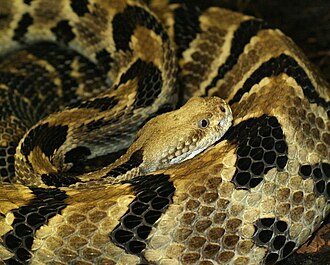
图:Tad Arensmeier from St. Louis, MO, USA · CC BY 2.0 · Wikimedia Commons
- 学名
- Crotalus
- 分类等级
- 属
- 上级类群
- 蝮亚科
- 大类
- 爬行动物
- 命名
- 卡尔·林奈,1758 年
- 数据库
- NCBI 分类 · GBIF
分类阶元
- 域真核生物
- 未标等级无定形生物 Amorphea
- 演化支后鞭毛生物 Opisthokonta
- 总界动物总界 Holozoa
- 未标等级蜷丝生物 Filozoa
- 未标等级领鞭毛动物 Choanozoa
- 界动物界 Animalia
- 亚界真后生动物亚界 Eumetazoa
- 未标等级副同源异形基因动物 Parahoxozoa
- 亚界两侧对称动物 Bilateria
- 总门后口动物总门 Deuterostomia
- 门脊索动物门 Chordata
- 亚门脊椎动物亚门 Vertebrata
- 下门有颌下门 Gnathostomata
- 未标等级正真口类 Euteleostomi
- 总纲肉鳍鱼总纲 Sarcopterygii
- 未标等级扇鳍鱼类 Rhipidistia
- 亚纲四足形类 Tetrapodomorpha
- 未标等级始四足目 Eotetrapodiformes
- 下纲希望螈目 Elpistostegalia
- 未标等级坚头类 Stegocephalia
- 总纲四足总纲 Tetrapoda
- 未标等级爬行形类 Reptiliomorpha
- 未标等级羊膜动物 Amniota
- 未标等级蜥形纲 Sauropsida
- 纲爬行动物 Reptilia
- 未标等级真爬行动物类 Eureptilia
- 未标等级卢默龙类 Romeriida
- 未标等级双孔亚纲 Diapsida
- 未标等级新双弓类 Neodiapsida
- 未标等级蜥蜴亚目 Sauria
- 下纲鳞龙形下纲 Lepidosauromorpha
- 总目鳞龙超目 Lepidosauria
- 目有鳞目 Squamata
- 科蝰蛇科 Viperidae
- 亚科蝮亚科 Crotalinae
- 属响尾蛇属 Crotalus
下级类群(23)
- 东部菱背响尾蛇 Crotalus adamanteus 种
- 西部菱背响尾蛇 Crotalus atrox 种
- 沙漠响尾蛇 Crotalus cerastes 种
- 南美响尾蛇 Crotalus durissus 种
- 木纹响尾蛇 Crotalus horridus 种
- 草原响尾蛇 Crotalus viridis 种
- Crotalus scutulatus 种
- Crotalus molossus 种
- 虎斑响尾蛇 Crotalus tigris 种
- Crotalus ruber 种
- 圣卡特里纳岛响尾蛇 Crotalus catalinensis 种
- Crotalus lepidus 种
- Crotalus basiliscus 种
- Crotalus willardi 种
- 孪斑响尾蛇 Crotalus pricei 种
- Crotalus oreganus 种
- Crotalus aquilus 种
- Crotalus mitchellii 种
- 女神响尾蛇 Crotalus enyo 种
- Crotalus pusillus 种
- Crotalus polystictus 种
- Crotalus simus 种
- Crotalus lannomi 种
百科正文
本条目暂无中文维基百科条目,下面是英文维基百科原文。
Crotalus is a genus of pit vipers, commonly known as rattlesnakes or rattlers, in the family Viperidae. The genus is found only in the Americas from southern Canada to northern Argentina. The generic name Crotalus is derived from the Greek word κρόταλον krótalοn, which means "rattle" or "castanet", and refers to the rattle on the end of the tail, which makes this group (genera Crotalus and Sistrurus) so distinctive. As of July 2023, 44 to 53 species are recognized as valid.
Description
Members of the genus Crotalus range in size from only 50–70 cm (20–28 in) (C. intermedius, C. pricei), to over 150 cm (59 in) (eastern and western diamondback rattlesnakes). In general, adult males are slightly larger than females. Compared to most snakes, they are heavy-bodied, although some African vipers are much thicker. Most forms are easily recognized by the characteristic rattle on the end of their tails, although a few island populations form exceptions to this rule: C. catalinensis has lost its rattle entirely, Crotalus lorenzoensis usually has no rattle, and both Crotalus ruber lucasensis and Crotalus estebanensis exhibit a tendency for rattle loss. The rattle may also be lacking in any species due to a congenital abnormality.
The rattle consists of a series of loosely interlocking hollow shells, each of which was at one point the scale covering the tip of the tail. In most other snakes, the tail tip, or terminal spine, is cone-shaped, hardly any thicker than the rest of the skin, and is shed along with it at each successive molt. In this case, the end scale, or "button", is much thicker and shaped like a bulb, with one or two annular constrictions to prevent it from falling off. Before each molt, a new button will have developed inside the last one and before the skin is shed off its body, the tip of the new button shrinks, then loosening the shell of the previous one. This process continues so the succession of molts produces an appendage consisting of a number of interlocking segments that make an audible noise when vibrated. Since younger specimens may shed several times in a year at a frequency that depends on their environment and how much they eat, every time adding a new segment to the rattle, the number of segments is a function of more than solely the age of the snake. In theory, the rattle could become very long indeed, but in practice, the older segments tend to wear out and fall off. How quickly this happens depends on the snake's environment, but end segments tend to break off after the rattle becomes about six or seven segments long; nonetheless, finding specimens with as many as a dozen segments is not uncommon— and in captive specimens, as many as 29 segments have been documented.
Distribution and habitat
The genus Crotalus is found in the Americas from southern Canada to central Argentina.
Behavior
No species of Crotalus is considered aggressive; when threatened, most retreat quickly, but most species defend themselves readily when cornered.
There is no consensus in the available literature about how far rattlesnakes can strike, with estimates ranging from one-third to the entire body length of the rattlesnake. Strike distance depends not just on the snake's size, but also on many other factors, including its species, the position of its body, and its degree of agitation. This is compounded by a further lack of consensus as to the location on the anchor coil of the snake from where a strike should be measured. They rarely strike further than half of their body length, and almost never more than three-fourths, but trusting such values is unwise if only because it is not feasible to accurately judge the length of a coiled snake.
Feeding
The diets of species of Crotalus generally consist of vertebrates, although many invertebrate species are also consumed. Smaller species feed mainly on lizards, while larger species start by feeding on lizards as juveniles and then switch to preying mainly on mammals as adults. Prey items more frequently taken include rabbits, ground squirrels such as prairie dogs, tree squirrels, chipmunks, gophers, and rats and mice, while those less frequently taken include birds, lizards, snakes and amphibians. Cannibalism has been reported in a number of different species. Individuals that feed on rodents usually release their prey after a strike to avoid their teeth, and these snakes evidently can discriminate between trails left by prey that has or has not been envenomated.
Predators
For all species of Crotalus, the most significant threats come from people, but they also face many natural enemies. These include other snakes, such as kingsnakes (Lampropeltis), coachwhips (Masticophis), indigo snakes (Drymarchon), and racers (Coluber); birds, such as hawks, eagles, owls, roadrunners and ravens; and mammals, such as cats, coyotes, foxes, wildcats, badgers, skunks and pigs. Certain species of birds frequently prey on these snakes, but this is not without risk. Two cases were reported in which dead hawks found near venomous snakes had suffered hemorrhage and gangrenous necrosis due to snakebite.
Reproduction
The genus Crotalus is ovoviviparous, giving birth to live young. The basic lifecycle of many Nearctic species has been known for quite some time. Females at an age of 26 months undergo vitellogenesis as they enter their third hibernation, mate the following spring, and give birth later in September or October.
Several variations to this basic cycle occur. In North America, the females of some species store sperm in their oviducts for at least eight months, and the males (all species of which undergo spermatogenesis during the summer) store sperm in the vas deferens for at least a year. Thus, species that store sperm for a shorter duration mate in the spring and store sperm in the vas deferens, while those that do so for a longer duration mate in the fall and store sperm in the oviduct over the winter, after which fertilization occurs the following spring. In addition, species that occur further north, where weather is colder during much of the year and the feeding and growing season is short, may reproduce only every other year or less. Those found in central and southern Mexico or the tropics have reproductive cycles that correspond mostly with the rainy season.
Venom
Two main hemotoxic effects are caused by rattlesnake venom. First, zinc-containing metalloproteases act upon capillary endothelial cells to inhibit platelet aggregation and hemorrhage. Second, the platelet antagonist crotalin creates a severe bleeding effect as it binds to the surface proteins, blocking aggregation.
Neurotoxic effects may also be caused by rattlesnake venom. These effects vary by species, and within species by population.
Species
*) Not including the nominate subspecies
T) Type species
以上内容摘自英文维基百科「Crotalus」,按 CC BY-SA 4.0 使用,去掉了参考文献、外部链接等尾部小节,公式改写成了纯文本。全文、配图和出处见原文。