格物
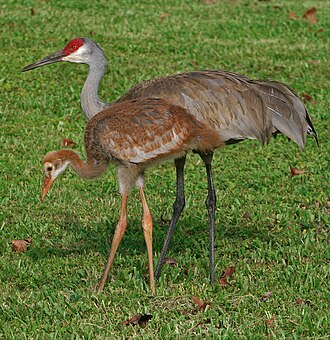
图:http://www.birdphotos.com · CC BY 3.0 · Wikimedia Commons
- 学名
- Grus canadensis
- 分类等级
- 种
- 上级类群
- 鹤属
- 大类
- 鸟类
- 命名
- 卡尔·林奈,1758 年
- 保护状况(IUCN)
- 无危物种
- 数据库
- NCBI 分类 · GBIF · IUCN 红色名录
百科正文
外形
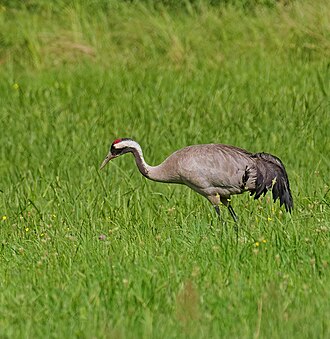
成年沙丘鹤外表为灰色;在繁殖期,特别是在迁徙的亚种中,它们的羽毛被磨损,变为赭色。体型较大的雄性平均体重为4.57千克,而雌性的平均体重为4.02千克。所有亚种的平均体重在2.7-6.7千克之间。
沙丘鹤的前额为红色,脸颊为白色,拥有长而黑的尖喙。在飞行时,他它们长而黑的双腿摆在后面,颈部和脖子保持伸直状态。幼鸟身体上部呈红棕色,下部呈灰色。不同亚种的体型差异很大;它们的平均高度在80-122厘米之间。它们的翼弦长度在42-60厘米之间,尾部长度在10-26厘米之间,暴露喙峰长6.9-16厘米,跗骨长15.5 -26.6厘米。
成年沙丘鹤的翼展在1.65至2.30米之间,大型的双翼有利于它们更好的飞翔,与鹰和雕的风格类似。它们利用上升的暖气流获得升力,可以在空中飞行数小时而不停歇。
分类学
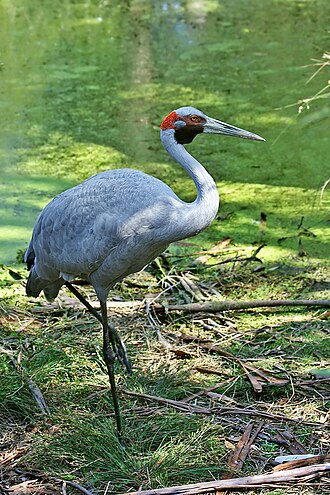
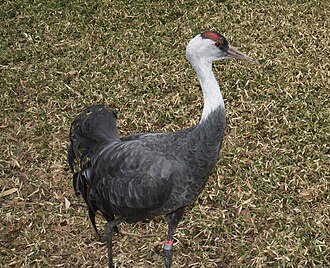
在之前的分类中,沙丘鹤属于鹤属。但2010年发表的一项分子系统发生学研究表明,鹤属是多系群的。所以,在之后对鹤科重新分类中,沙丘鹤、白枕鹤、赤颈鹤和澳洲鹤被移到了赤颈鹤属。赤颈鹤属这一分类最早由德国鸟类学家路德维希·赖兴巴赫于1853年提出。
亚种
沙丘鹤可以分为6个亚种,不同亚种之间的体型和习性差异较大。
以上内容摘自维基百科「沙丘鹤」,按 CC BY-SA 4.0 使用,去掉了参考文献、外部链接等尾部小节,公式改写成了纯文本。全文、配图和出处见原文。
英文维基百科补充中文条目比较短,下面是英文条目「Sandhill crane」的原文
The sandhill crane (Antigone canadensis) is a species of large crane of North America and extreme northeastern Siberia. The common name of this bird refers to its habitat, such as the Platte River, on the edge of Nebraska's Sandhills on the American Great Plains. Sandhill cranes are known to frequent the edges of bodies of water. The central Platte River Valley in Nebraska is the most important stopover area for the nominotypical subspecies, the lesser sandhill crane (A. c. canadensis), with up to 450,000 of these birds migrating through annually.
Taxonomy
In 1750, British naturalist George Edwards included an illustration and a description of the sandhill crane in the third volume of his A Natural History of Uncommon Birds, referring to the species as the 'Brown and Ash-colour'd Crane'. Edwards based his hand-colored etching on a preserved specimen that had been brought to London from the Hudson Bay area of Canada by James Isham. When in 1758, Swedish naturalist Carl Linnaeus updated his Systema Naturae for the 10th edition, he placed the sandhill crane with herons and cranes in the genus Ardea. Linnaeus included a brief description, coined the binomial name Ardea canadensis, and cited Edwards' work.
The sandhill crane was formerly placed in the genus Grus, but a molecular phylogenetic study published in 2010 found that the genus, as then defined, was polyphyletic.
Description
Adults are gray overall; during breeding, their plumage is usually much worn and stained, particularly in the migratory populations, and looks nearly ochre. The average weight of the larger males is 4.57 kg (10.1 lb), while the average weight of females is 4.02 kg (8.9 lb), with a range of 2.7 to 6.7 kg (6.0 to 14.8 lb) across the subspecies. Sandhill cranes have red foreheads, white cheeks, and long, dark, pointed bills. In flight, their long, dark legs trail behind, and their long necks keep straight.
Immature birds have reddish-brown upper parts and gray underparts. The juveniles do not have the characteristic red foreheads, making distinguishing the young from the parents possible, even when they are the same height.
The sexes look alike. Sizes vary among the different subspecies; the typical height of these birds is around 80 to 136 cm (2 ft 7 in to 4 ft 6 in).
Behavior
Sandhill cranes are fairly social birds that usually live in pairs or family groups through the year. During migration and winter, unrelated cranes come together to form "survival groups" that forage and roost together. Such groups often congregate at migration and winter sites, sometimes in the thousands.
Diet
Sandhill cranes are mainly herbivorous, but eat various types of food, depending on availability. They often feed with their bills down to the ground as they root around for seeds and other foods, in shallow wetlands with vegetation or various upland habitats. Cranes readily eat cultivated foods such as corn, wheat, cottonseed, and sorghum. Waste corn is useful to cranes preparing for migration, providing them with nutrients for the long journey. Among northern races of sandhill cranes, their diet is most varied, especially among breeding birds.
Status and conservation
Mainland North America
In the 1930s, sandhill cranes were generally extirpated east of the Mississippi River, but their populations have recovered, with an estimated 98,000 in the region in 2018, a substantial increase over the previous year. Although sandhill cranes are not considered threatened as a species, the three southernmost subspecies are quite rare. Resident populations, not migratory birds, cannot choose secure breeding habitat. Many subpopulations were destroyed by hunting or habitat change. The greater sandhill crane proper initially suffered most; by 1940, probably fewer than 1,000 birds remained. Populations have since increased greatly again. At nearly 100,000, they are still fewer than the lesser sandhill crane, which, at about 400,000 individuals continent-wide, is the most plentiful extant crane.
In popular culture
In 2023, the "Mississippi sandhill crane" was featured on a United States Postal Service forever stamp as part of the Endangered Species set, based on a photograph from Joel Sartore's Photo Ark. The stamp was dedicated at a ceremony at the National Grasslands Visitor Center in Wall, South Dakota.
以上节选摘自英文维基百科「Sandhill crane」,按 CC BY-SA 4.0 使用,去掉了参考文献、外部链接等尾部小节,公式改写成了纯文本。篇幅所限,较长的小节只摘了开头一部分,有的小节没有收;全文、配图和出处见原文。