格物
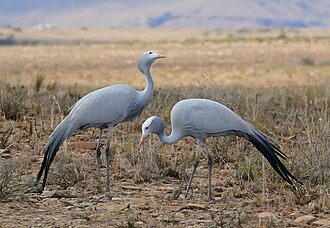
图:Bernard DUPONT from FRANCE · CC BY-SA 2.0 · Wikimedia Commons
- 学名
- Anthropoides paradiseus
- 分类等级
- 种
- 英文名
- blue crane
- 上级类群
- 鹤属
- 大类
- 鸟类
- 命名
- Anton August Heinrich Lichtenstein,1793 年
- 保护状况(IUCN)
- 易危物种
- 体重
- 5.1 千克(成年体重)
- 数据库
- GBIF · IUCN 红色名录
百科正文
栖息地
蓝鹤栖息在干旱的高地,只会花很少时间在湿地,主要吃种子及昆虫。它们是候鸟,一般会在高草原筑巢,并会到了冬天向低海拔迁徙。很多时它们会留在农地。
蓝鹤是鹤科中分布地最有限的物种。
衰落
蓝鹤在其分布地约有25700只,但于1980年开始,它们的数量大幅下降,并现已被列为易危。在过去20年,蓝鹤已大幅从东开普省、莱索托及斯威士兰消失。它们的数量在自由邦省、夸祖鲁-纳塔尔省、林波波省、豪登省、普马兰加省及西北省下降达90%。余下的群落只分布在南非东部及南部,与及在纳米比亚北部埃托沙盐湖有细小的群落。它们有时也会出没在邻近的国家。
蓝鹤大幅衰落的主因是人类的增长、草原转变成商业种植及中毒。南非政府已加强法律上对蓝鹤的保护。其他保育措施包括研究、栖息地管理及教育等。
文化
蓝鹤对于科萨人非常特别。当一个男人被定为具有勇气时,酋长会送上蓝鹤的羽毛。在战争后,酋长会举行英雄庆典,也会送上蓝鹤的羽毛。获赠羽毛的男人会将羽毛戴在发上,代表他们可以平定问题,带来和平及秩序。
蓝鹤是《非洲-欧亚大陆迁徙水鸟保护协定》所保护的物种之一。
以上内容摘自维基百科「藍鶴」,按 CC BY-SA 4.0 使用,去掉了参考文献、外部链接等尾部小节,公式改写成了纯文本。全文、配图和出处见原文。
英文维基百科补充中文条目比较短,下面是英文条目「Blue crane」的原文
The blue crane (Grus paradisea), also known as the Stanley crane and the paradise crane, is the national bird of South Africa. The species is listed as Vulnerable by the IUCN.
Description
The blue crane is a tall, ground-dwelling bird, but is fairly small by the standards of the crane family. It is 100–120 cm (3 ft 3 in – 3 ft 11 in) tall, with a wingspan of 180–200 cm (5 ft 11 in – 6 ft 7 in) and weighs 3.6–6.2 kg (7.9–13.7 lb). Among standard measurements, the wing chord measures 51.4–59 cm (20.2–23.2 in), the exposed culmen measures 8–10 cm (3.1–3.9 in) and the tarsus measures 20.5–25.2 cm (8.1–9.9 in). This crane is pale blue-gray in color becoming darker on the upper head, neck and nape. From the crown to the lores, the plumage is distinctly lighter, sometimes whitish. The bill is ochre to greyish, with a pink tinge.
Habitat
Blue cranes are birds of the dry grassy uplands, usually the pastured grasses of hills, valleys, and plains with a few scattered trees. They prefer areas in the nesting season that have access to both upland and wetland areas, though they feed almost entirely in dry areas. They are altitudinal migrants, generally nesting in the lower grasslands of an elevation of around 1,300 to 2,000 m and moving down to lower altitudes for winter.
Movements and behaviour
Of the 15 species of crane, the blue crane has the most restricted distribution of all. Even species with lower population numbers now (such as Siberian or whooping cranes) are found over a considerable range in their migratory movements. The blue crane is migratory, primarily altitudinal, but details are little known.
The blue crane is partially social, less so during the breeding season. There is a strict hierarchy in groups, with the larger adult males being dominant. They overlap in range with three other crane species but interactions with these species and other "large wader" type birds are not known.
Feeding
Blue cranes feed from the ground and appear to rarely feed near wetland areas. Most of their diet is comprised by grasses and sedges, with many types fed on based on their proximity to the nests. They are also regularly insectivorous, feeding on numerous, sizeable insects such as grasshoppers. Small animals such as crabs, snails, frogs, small lizards and snakes may supplement the diet, with such protein-rich food often being broken down and fed to the young.
Breeding
The breeding period is highly seasonal, with eggs being recorded between October and March. Pair-formation amongst groups often starts in October, beginning with both potential parents running in circles with each other. The male then engages in a "dance" flings various objects in the air and then jumps. Eventually, a female from the group and the male appear to "select" each other and both engage in the dance of throwing objects and jumping. After the dance, mating commences in around two weeks.
In a great majority of known nests, two eggs are laid (rarely one or three).
Decline
While it remains common in parts of its historic range, and approx. 26 000 individuals remain, it began a sudden population decline from around 1980 and is now classified as vulnerable.
In the last two decades, the blue crane has largely disappeared from the Eastern Cape, Lesotho, and Eswatini. The population in the northern Free State, Limpopo, Gauteng, Mpumalanga and North West Province has declined by up to 90%. The majority of the remaining population is in eastern and southern South Africa, with a small and separate population in the Etosha Pan of northern Namibia. Occasionally, isolated breeding pairs are found in five neighbouring countries.
Cultural references
The blue crane is culturally significant to the Xhosa people, who call it indwe (flag). Traditionally, when a man distinguished himself in battle or otherwise, he was often decorated by a chief with blue crane feathers in a ceremony called ukundzabela. Men so honoured, who would wear the feathers sticking out of their hair, were known as men of ugaba (trouble)—the implication being that if trouble arose, they would reinstate peace and order.
It is also of significance to the Zulu people, whose kings and warriors wore a single or many feathers as a headdress.
以上节选摘自英文维基百科「Blue crane」,按 CC BY-SA 4.0 使用,去掉了参考文献、外部链接等尾部小节,公式改写成了纯文本。篇幅所限,较长的小节只摘了开头一部分,有的小节没有收;全文、配图和出处见原文。