格物
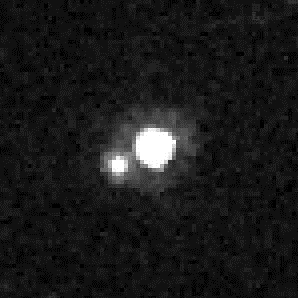
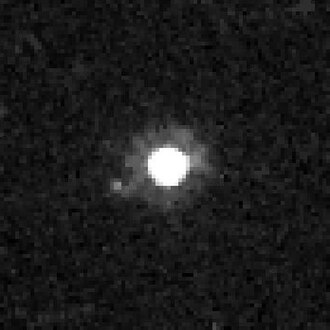
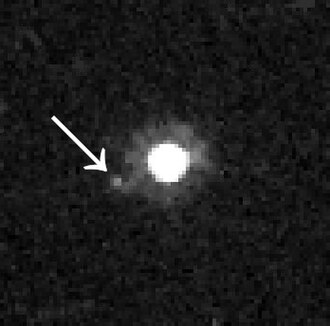
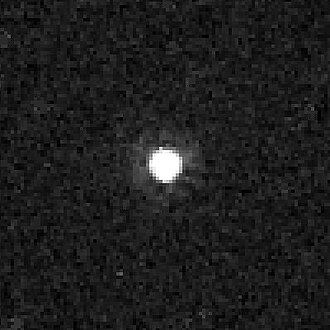
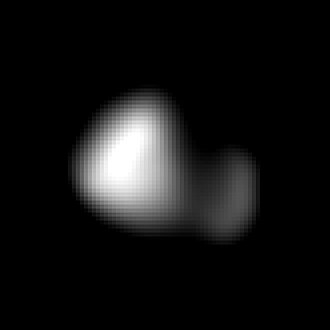
图:Hubble Space Telescope/Michael E. Brown · Public domain · Wikimedia Commons
- 类型
- 小行星卫星
- 发现 / 发明时间
- 2005 年
- 发现者 / 提出者
- 迈克尔·E·布朗、Terry-Ann Suer
- 命名来源
- 万特
- 学科
- 天文学
相关科学家

百科正文
特性
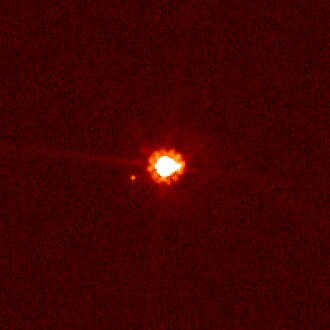
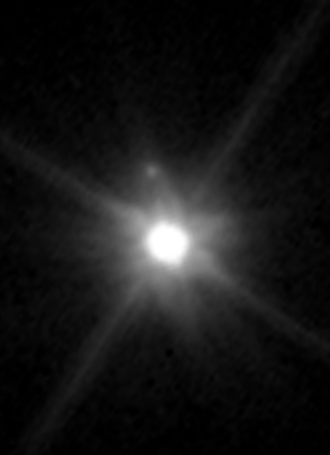
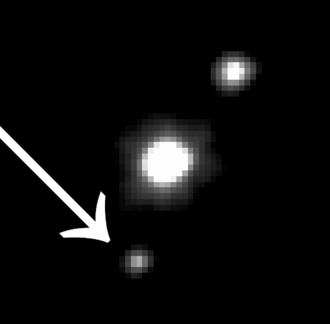
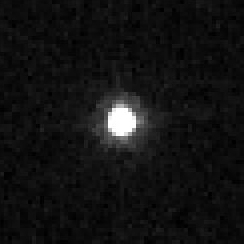
卫星在距离亡神星0.25秒的距离上被发现,亮度比亡神星低2.7等。布朗估计,假设两者的反照率相同,则卫星的直径大约是220公里,比亡神星细2.9倍。然而,亡神星与亡卫一有着不同的颜色(亡神星为灰色,而亡卫一则偏红),因此若亡卫一的反照率为0.12,则卫星的直径大约是380公里。亡卫一的质量亦取决于其反照率,变化范围为系统总质量的3至9%不等。
亡卫一与亡神星的光谱差别非常大,因此亡卫一并非与亡神星同一时间形成,且没有经历大型碰撞的迹象,而可能是被亡神星捕获的柯伊伯带天体。
名称
亡卫一原来的临时名称是S/2005 (90482) 1。2009年3月,发现者布朗通过他的专栏博客公开征集小行星90482卫星的名称,最终选定伊特鲁里亚(亚平宁半岛的原住民族)神话中引导亡魂进入地府的女神——万斯(Vanth)作为卫星的建议名称,并上报IAU。
轨道特性
卫星以近乎完美的圆形环绕亡神星公转,公转周期约10天。发现者布朗认为亡神星与其卫星可能互相被对方潮汐锁定,情况就如冥王星和卡戎一样。
以上内容摘自维基百科「亡卫一」,按 CC BY-SA 4.0 使用,去掉了参考文献、外部链接等尾部小节,公式改写成了纯文本。全文、配图和出处见原文。
英文维基百科补充中文条目比较短,下面是英文条目「Vanth (moon)」的原文
Vanth (formal designation (90482) Orcus I) is the only known moon of the large trans-Neptunian dwarf planet Orcus. It was discovered by Michael Brown and Terry-Ann Suer using images taken by the Hubble Space Telescope on 13 November 2005. The moon has a diameter of 443 km (275 mi), making it about half the size of Orcus and the third-largest moon of a trans-Neptunian object.
Vanth is massive enough that it shifts the barycenter of the Orcus–Vanth system outside of Orcus, forming a binary system in which the two bodies revolve around the barycenter, much like the Pluto–Charon system. It is hypothesized that both systems formed similarly, most likely by a giant impact early in the Solar System's history. Compared to Orcus, Vanth has a darker and slightly redder surface that supposedly lacks exposed water ice, resembling primordial Kuiper belt objects.
Discovery
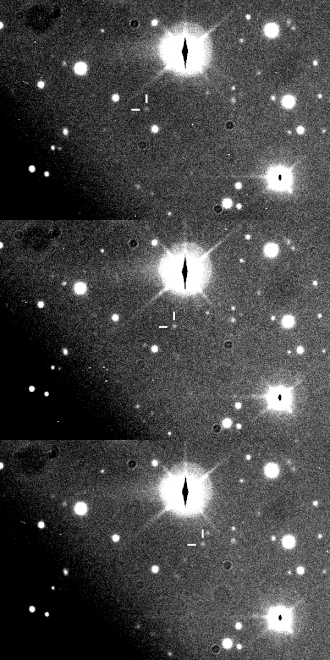
Vanth was discovered in Hubble Space Telescope images taken on 13 November 2005, during Michael Brown's survey for satellites around large trans-Neptunian objects (TNOs) using Hubble's high-resolution Advanced Camera for Surveys. After Brown's Hubble survey concluded in late 2006, he and his colleague Terry-Ann Suer reported their newly discovered TNO satellites to the Central Bureau for Astronomical Telegrams, which announced their discovery of Vanth alongside three other TNO satellites on 22 February 2007.
Name
Before Vanth was named, it did not have a provisional designation. On 23 March 2009, Brown asked readers of his blog to suggest possible names for the satellite, with the best one to be submitted to the International Astronomical Union (IAU) on 5 April. The name Vanth, the winged Etruscan psychopomp who guides the souls of the dead to the underworld, was first suggested by Sonya Taaffe—a fiction writer—and became the most popular name among the large pool of suggestions.
Observability
Visual
From Earth, Vanth appears very close to Orcus with an angular separation of up to 0.25 arcseconds. For this reason, Vanth can only be visually resolved in high-resolution imaging, which requires the use of large-aperture space telescopes or ground-based telescopes aided by adaptive optics or interferometry. In visible light, Vanth's apparent magnitude is about 22, which is 2.61 magnitudes fainter than Orcus or about 9% of Orcus's brightness. Orcus and Vanth will gradually brighten as the system draws closer to the Sun until perihelion in 2142.
Orbit
Vanth forms a binary system with Orcus, in which the two bodies revolve around the barycenter between them. Orcus and Vanth are 9,000 km (5,600 mi) from each other's centers and revolve around their barycenter in nearly circular orbits with a period of 9.54 days. Vanth is less massive than Orcus, so it is the secondary component of the binary system and it orbits farther out from the barycenter at an orbital radius of 7,770 km (4,830 mi; 86.3% of the Orcus–Vanth separation distance).
Physical characteristics
Size, mass, and density
As of 2023, the most accurate estimate for Vanth's diameter is 443 ± 10 km (275 ± 6 mi), determined from a stellar occultation in 2017. This estimate is consistent with the previous estimate of 475 ± 75 km (295 ± 47 mi) from thermal emission measurements by the Atacama Large Millimeter Array (ALMA) in 2016. Both estimates show that Vanth is roughly half of Orcus's diameter and is the third-largest known moon of a trans-Neptunian object, after Charon and Dysnomia.
Vanth is massive enough that it gravitationally forces Orcus into orbit around the system's barycenter.
Origin
The circular orbits and relative component sizes of the Orcus–Vanth system bear similarities to the Pluto–Charon binary system, which led astronomers to suspect that these two systems formed and evolved similarly. As hypothesized for Charon, Vanth is believed to be a captured fragment of a large body that impacted Orcus likely before the outward migration of Neptune 700 million years after the formation of the Solar System (about 4 billion years ago). Hydrodynamic simulations by researchers Sota Arakawa et al.
以上节选摘自英文维基百科「Vanth (moon)」,按 CC BY-SA 4.0 使用,去掉了参考文献、外部链接等尾部小节,公式改写成了纯文本。篇幅所限,较长的小节只摘了开头一部分,有的小节没有收;全文、配图和出处见原文。