格物
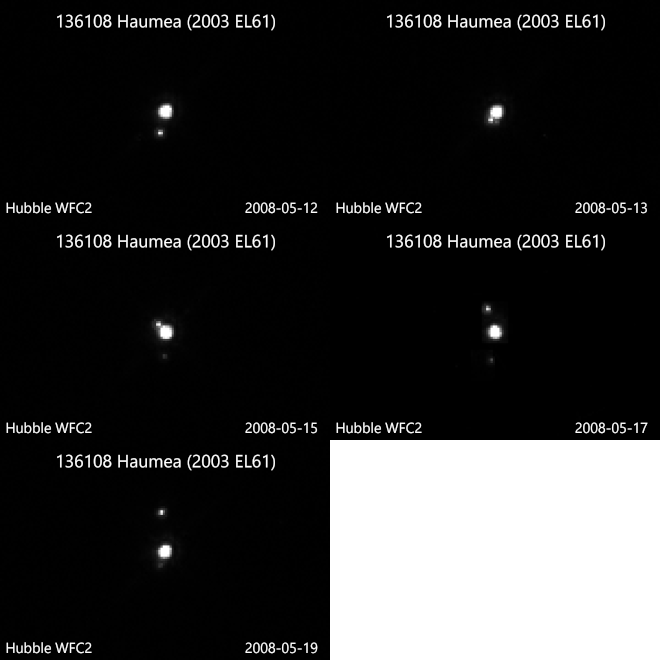
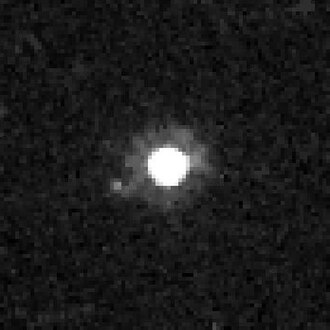
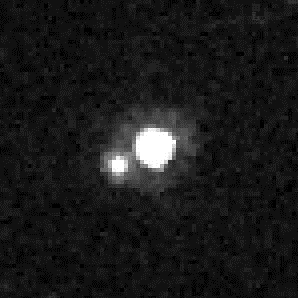
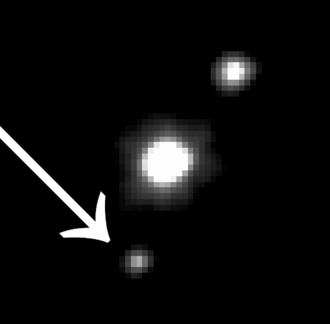
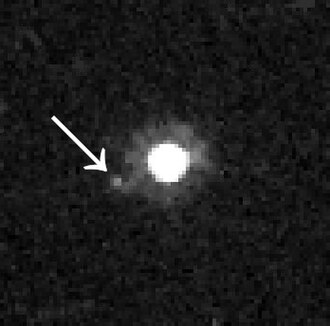
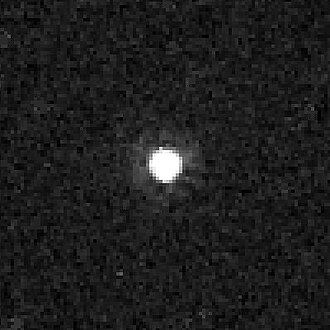
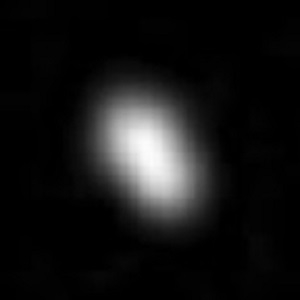
图:Hubble Space Telescope/Michael E. Brown (processing by Nrco0… · Public domain · Wikimedia Commons
- 类型
- 妊神星的卫星
- 发现 / 发明时间
- 2005 年
- 发现者 / 提出者
- 迈克尔·E·布朗、查德·特鲁希略、戴维·拉比诺维茨
- 命名来源
- Hiʻiaka
- 学科
- 天文学
相关科学家


百科正文
发现及命名
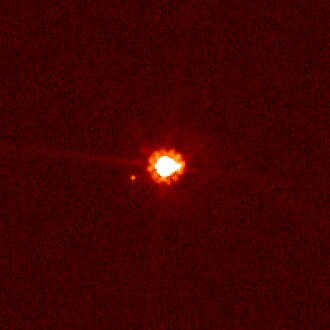
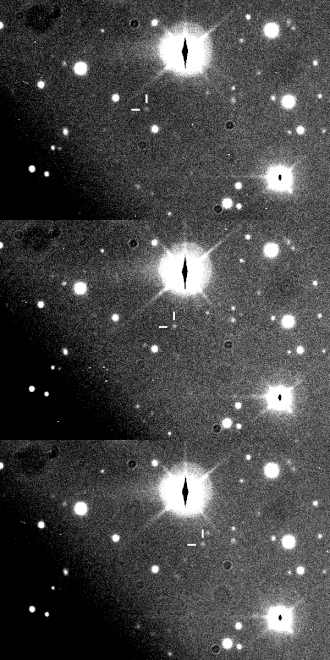
妊卫一于2005年1月26日发现,临时编号为S/2005 (2003 EL61) 1。希亚卡(妊卫一)是舞蹈女神及夏威夷岛的守护神,而夏威夷岛是毛纳基山天文台所在之地。
表面属性
妊卫一是较远、较大及较亮的卫星,直径大约为350公里。其红外线光谱中在1.5、1.65和2微米波长有强烈的吸收线,符合几乎完全由水冰晶体组成的卫星表面。这种奇特的光谱特性以及它和妊神星相似的吸收光谱,证明这个卫星系统并非是在古柏带中捕获而来的,而是来自妊神星本身的碎片。
轨道特性
妊卫一沿着几乎圆形的轨道每49天围绕妊神星一圈。妊卫一上一次掩食妊神星是发生在1999年,几年之后才被发现,而下一次掩食则要等到130年以后。
以上内容摘自维基百科「妊卫一」,按 CC BY-SA 4.0 使用,去掉了参考文献、外部链接等尾部小节,公式改写成了纯文本。全文、配图和出处见原文。
英文维基百科补充中文条目比较短,下面是英文条目「Hiʻiaka (moon)」的原文
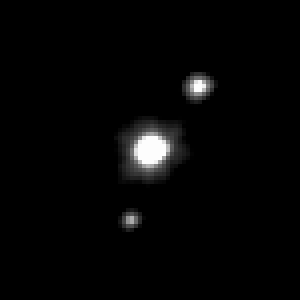
Hiʻiaka, formal designation (136108) Haumea I, is the larger, outer moon of the trans-Neptunian dwarf planet Haumea. Discovered by Michael E. Brown and the Keck Observatory adaptive optics team on 26 January 2005, it is named after Hiʻiaka, the patron goddess of the Big Island of Hawaii and one of the daughters of Haumea. The moon follows a slightly elliptical orbit around Haumea every 49.5 days, at a distance of 49,400 km (30,700 mi).
Hiʻiaka is an elongated and irregularly shaped body with a mean diameter of 370 km (230 mi), making it the sixth-largest known moon of a trans-Neptunian object. It has a very low bulk density of 0.64 g/cm3, which indicates it is mostly made of loosely-packed water ice and rock. Telescope observations have shown that Hiʻiaka has a highly reflective surface made of crystalline water ice, much like Haumea itself. Hiʻiaka rotates about its axis every 9.68 hours. Like its smaller sibling moon Namaka, Hiʻiaka is believed to be a fragment of Haumea that was ejected in the aftermath of a giant impact 4.4 billion years ago.
Discovery
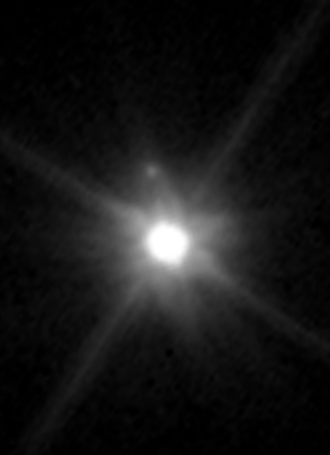
Hiʻiaka was the first satellite discovered around Haumea. It was discovered on 26 January 2005 by Michael E. Brown and the W. M. Keck Observatory adaptive optics team at Mauna Kea, Hawaii. The discovery of Haumea had not been made public at the time, so the discovery of Hiʻiaka was announced later on 29 July 2005. When Hiʻiaka was announced, it given the temporary provisional designation S/2005 (2003 EL61) 1, which indicates it is the first moon of Haumea (then known as 2003 EL61) discovered in 2005. At the time, Brown had been nicknaming Haumea "Santa," so he nicknamed Hiʻiaka "Rudolph," after one of Santa Claus's reindeer.
Haumea, Hiʻiaka, and Namaka were all officially named after Hawaiian deities by the International Astronomical Union (IAU) on 17 September 2008. In Hawaiian mythology, Hiʻiaka is the patron goddess of hula and is the daughter of the fertility goddess Haumea. These names were proposed to the IAU by Brown's team in September 2006, who wanted to pay tribute to the location where they discovered the moons of Haumea.
Physical characteristics
Size, mass, and density
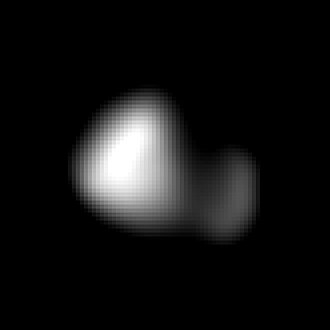
Stellar occultations by Hiʻiaka on 6 and 16 April 2021 reveal that the moon is an elongated object resembling an ellipsoid with dimensions of 480 km × 360 km × 286 km (298 mi × 224 mi × 178 mi). These correspond to a volume-equivalent diameter of 370 km (230 mi). Hiʻiaka is the sixth-largest known moon of a trans-Neptunian object, after Charon (1212 km), Dysnomia (615 km), Vanth (443 km), Ilmarë (403 km), and Actaea (393 km). Despite its relatively large size, Hiʻiaka is not in hydrostatic equilibrium because its elongated shape is inconsistent with that expected for its current rotation period. Hiʻiaka's lack of hydrostatic equilibrium is most likely due to high material strength.
Hubble Space Telescope measurements of gravitational perturbations in Hiʻiaka's orbital path show that the moon has a mass of 1.213+0.322−0.311×10¹⁹ kg. A simplified assumption of Haumea's oblateness suggests that Hiʻiaka has a mass of (1.6±0.2)×1019 kg. The latter mass estimate points to a very low density of 0.64 g/cm3, which indicates Hiʻiaka has a highly porous and icy interior. Hiʻiaka is too small for its interior to undergo differentiation, so it lacks a substantial core.
Origin
Namaka and Hiʻiaka are widely believed to be fragments of Haumea that were ejected in the aftermath of a giant impact 4.4 billion years ago (77–82 million years after the formation of the Solar System), when Neptune was migrating outward and gravitationally scattering objects in the Kuiper belt. This impact event is hypothesized to involve two large Kuiper belt objects of similar size, which obliquely collided with each other and merged into a single, rapidly rotating body that eventually deformed into an ellipsoidal body, becoming Haumea today. While this hypothesis explains Haumea's rapid rotation and high bulk density, it fails to explain the existence of Haumea's moons and family of icy KBOs on similar orbits, because such an energetic impact would have ejected fragments at speeds several times Haumea's escape velocity.
Rather than having formed directly from a giant impact, Haumea's family and moons are instead believed to have been ejected via rotational fissioning of Haumea roughly 80 million years after the impact (147–162 million years after the Solar System's formation).
以上节选摘自英文维基百科「Hiʻiaka (moon)」,按 CC BY-SA 4.0 使用,去掉了参考文献、外部链接等尾部小节,公式改写成了纯文本。篇幅所限,较长的小节只摘了开头一部分,有的小节没有收;全文、配图和出处见原文。