格物
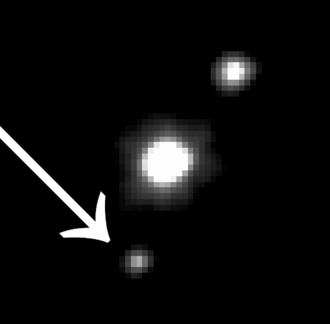
图:Kwamikagami · CC BY-SA 4.0 · Wikimedia Commons
- 类型
- 妊神星的卫星
- 发现 / 发明时间
- 2005 年
- 发现者 / 提出者
- 迈克尔·E·布朗、查德·特鲁希略、戴维·拉比诺维茨
- 命名来源
- Nāmaka
- 学科
- 天文学
相关科学家


百科正文
发现及命名
发现之初,这颗卫星被称作“布立增”(Blitzen,传说中为圣诞老人拉雪橇的一只驯鹿),2003 EL61改名做妊神星后,随之易名为妊卫二。
以上内容摘自维基百科「妊卫二」,按 CC BY-SA 4.0 使用,去掉了参考文献、外部链接等尾部小节,公式改写成了纯文本。全文、配图和出处见原文。
英文维基百科补充中文条目比较短,下面是英文条目「Namaka (moon)」的原文
Namaka (full designation (136108) Haumea II) is the smaller, inner moon of the trans-Neptunian dwarf planet Haumea. Discovered by Michael E. Brown and the Keck Observatory adaptive optics team in the fall of 2005, it is named after Nāmaka, a water spirit and one of the daughters of Haumea in Hawaiian mythology. Namaka follows a highly elliptical orbit that is highly tilted by roughly 13 degrees with respect to Haumea's equator. Namaka is heavily perturbed by both the gravitational influence of Haumea's larger, outer moon Hiʻiaka and the variable gravitational field of Haumea's elongated shape.
With a diameter of around 150 km (93 mi), Namaka is predicted to have an irregular shape and a chaotic rotation. It has a reflective surface made of fresh water ice, similar to that of Haumea and Hiʻiaka. Like Hiʻiaka, Namaka is believed to be a fragment of Haumea that was ejected in the aftermath of a giant impact 4.4 billion years ago.
Discovery and name
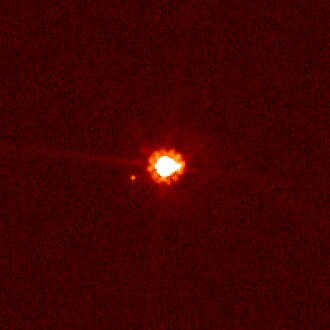
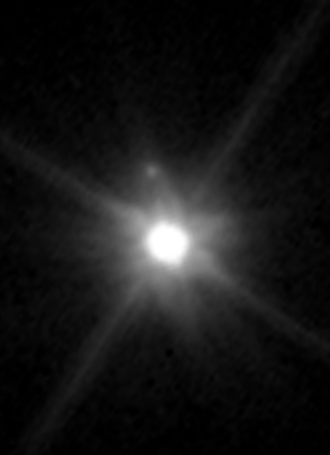
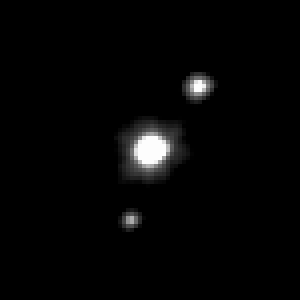
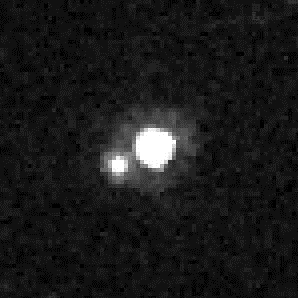
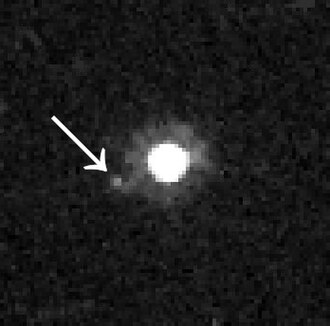
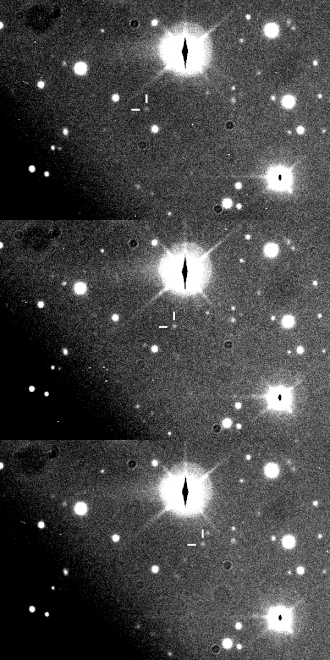
Namaka was discovered in the fall of 2005 by Michael E. Brown and the W. M. Keck Observatory adaptive optics team at Mauna Kea, Hawaii. It was noticed in high-resolution images of Haumea taken by the Keck II telescope on 1 March, 28 May, and 30 June 2005. Namaka was not recognized earlier because it was much fainter and closer to Haumea than its brighter sibling moon Hiʻiaka, which was discovered by Brown and his team back in January 2005. The discovery of Namaka was announced by the Central Bureau of Astronomical Telegrams on 1 December 2005.
Orbit
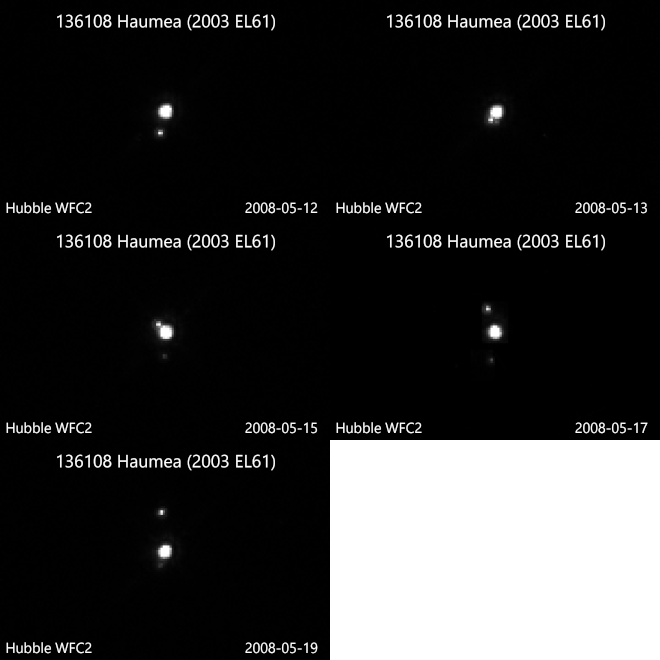
Namaka is the inner moon of Haumea, orbiting the dwarf planet in roughly 18.3 days at an average distance of 25,500 km (15,800 mi). Namaka follows a highly tilted elliptical orbit with an eccentricity of about 0.22 and an inclination of roughly 13° with respect to both Haumea's equator and Hiʻiaka's orbital plane. Namaka is heavily perturbed by both the gravitational influence of Hiʻiaka and the variable gravitational field of Haumea's elongated shape, which results in a time-varying eccentricity and inclination as well as nodal and apsidal precession of Namaka's orbit.
Observation
When viewed from Earth, Namaka is about 67 times fainter than Haumea (1.5% of Haumea's brightness) and 3.7 times fainter than Hiʻiaka (~27% of Hiʻiaka's brightness). Because Namaka orbits close to Haumea, its angular separation from Haumea is less than 1 arcsecond, so it cannot be resolved separately without the use of high-resolution telescopes like the Hubble Space Telescope.
Namaka was predicted to eclipse and occult Haumea in 2009–2011, but observations did not detect any during that time. Later recalculations showed that the predicted time frame of Namaka's eclipses and occultations of Haumea were generally accurate, but are somewhat offset in time compared to previous predictions.
Physical characteristics
Size, mass, and density
Although the diameter of Namaka is poorly constrained, it is most likely between 100 and 200 km (62 and 124 mi), according to visible light and thermal infrared observations with inferred values for its albedo and density. Assuming an average diameter of 150 km (93 mi), Namaka would be about half the diameter of Hiʻiaka. More accurate and precise measurements of Namaka's diameter can be made if it is observed occulting a background star.
Namaka has a mass of about 1×10¹⁸ kg, which is roughly ten times less massive than Hiʻiaka (~10% of Hiʻiaka's mass) and roughly 3,000 times less massive than Haumea (~0.03% of Haumea's mass).
Origin
Namaka and Hiʻiaka are widely believed to be fragments of Haumea that were ejected in the aftermath of a giant impact 4.4 billion years ago (77–82 million years after the formation of the Solar System), when Neptune was migrating outward and gravitationally scattering objects in the Kuiper belt. This impact event is hypothesized to involve two large Kuiper belt objects of similar size, which obliquely collided with each other and merged into a single, rapidly rotating body that eventually deformed into an ellipsoidal body, becoming Haumea today.
以上节选摘自英文维基百科「Namaka (moon)」,按 CC BY-SA 4.0 使用,去掉了参考文献、外部链接等尾部小节,公式改写成了纯文本。篇幅所限,较长的小节只摘了开头一部分,有的小节没有收;全文、配图和出处见原文。