格物
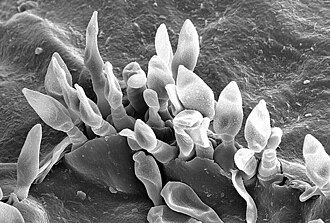
图:Public domain · Wikimedia Commons
- 类型
- 生物分类单元
- 发现 / 发明时间
- 1819 年
- 发现者 / 提出者
- 埃利亚斯·芒努斯·弗里斯
- 学科
- 生物学
- 带来的结果
- 苹果黑星病
相关科学家

百科正文
分类与演化
苹果黑星菌属于一个物种,或是许多物种形成的隐存种,为长期有所争议之处。近期的分子证据显示中亚、欧洲等地的苹果黑星菌之DNA序列虽有差异,可分为欧洲、中亚与哈萨克东部山区等三个族群,但差异选汰尚未到发生种化的程度,其中位于哈萨克东部山区、感染新疆野苹果的族群,可能是最接近原始苹果黑星菌的族群,另外两个族群则较晚出现,可能是随着2000-4000年前人类驯化苹果的过程逐渐分化而成。
以上内容摘自维基百科「苹果黑星菌」,按 CC BY-SA 4.0 使用,去掉了参考文献、外部链接等尾部小节,公式改写成了纯文本。全文、配图和出处见原文。
英文维基百科补充中文条目比较短,下面是英文条目「Venturia inaequalis」的原文
Venturia inaequalis is an ascomycete fungus that causes the apple scab disease.
Systematics
Venturia inaequalis anamorphs have been described under the names Fusicladium dendriticum and Spilocaea pomi. Whether V. inaequalis is a single species or contains several cryptic species has been a matter of debate for a long time. Recent genetic studies have revealed a considerable uniformity of the species. In addition, the fungus Spilocaea pyracanthae, a parasite of Pyracantha appeared not to genetically differ from V. inaequalis, being thus a special form of the latter.
Morphology
The fruiting bodies, ascocarps appear in the form of pseudothecia. They are solitary and embedded into the host plant tissue. A pseudothecium has small dark hairs around its opening, and contains pseudoparaphyses along with asci. The asci contain eight haploid ascospores. The haploid chromosome number of V. inaequalis is seven.
Life cycle
The infection cycle begins in the springtime, when suitable temperatures and moisture promote the release of V. inaequalis ascospores.
These spores rise into the air and land on the surface of a susceptible tree, where they germinate and form a germ tube that can directly penetrate the plant's waxy cuticle. A fungal mycelium forms between the cuticle and underlying epidermal tissue, developing asexually the conidia, that germinate on fresh areas of the host tree, which in turn produce another generation of conidial spores. This cycle of secondary infections continues throughout the summer, until the leaves and fruit fall from the tree at the onset of winter.
Effectors
Effectors are proteins encoded by pathogens, which act to effect a response from a host cell – often modulating the host immune response. Where a host variety is able to recognise and mount a resistance response to the presence of an effector, the effector is referred to as an Avirulence protein.
Presently, only one effector gene, AvrVg, eliciting a resistance response in Apple has been identified in V. inaequalis.
Hosts and symptoms
The Venturia inaequalis pathogen is a fungal organism that produces similar symptoms across a range of woody hosts. These include the common pear (Pyrus spp.), firethorn (Pyracantha spp.), mountain ash (Sorbus spp.), and most notably both commercial apples along with ornamental crabapples (Malus spp.). Symptoms of the infection occur on leaves, fruit, flowers, and young green shoots. Foliar symptoms begin to occur in the early spring around budbreak and mainly present as light green lesions that progress to an olive-brown color with a velvety texture due to conidia formation as time passes. These large scab-like lesions can warp the leaf's shape and can eventually lead to defoliation.
Importance
Economic losses due to apple scab over an extended period of time far outweigh the impact of any other apple pathogen. Historically one can find examples of the symptoms of V. inaequalis in paintings as far back as the fifteenth century. Fruit production can be limited due to defoliation while limiting fruit bud creation in the following year. While the disease can cause total crop loss in optimal conditions without management, the main economic impact is due to the reduction in both size and marketable quality of the fruit. This issue is further compounded by the fact that apple cultivars with a high market share, Pink Lady for example, are susceptible to the pathogen while more resistant varieties are less well known or desired by consumers.
Management
Protection from initial inoculation, either via sexual ascospores or asexual conidia, with fungicide is the main form of pathogen management. Spray schedules should be created with plant and pathogen development timings in mind and thus should begin with an initial spray at budswell and repeated in 10 to 14 day intervals. Specifics of the spray intervals should also be determined by considering what spray is used, weather patterns (mainly rain and moisture), host species, host growth patterns, and the amount of fungal inoculum present. Cultural practices can also be used to limit or prevent apple scab infection. Orchard design and planting patterns focusing on increased aeration are important in ensuring that susceptible tissues dry prior to initial infection.
以上节选摘自英文维基百科「Venturia inaequalis」,按 CC BY-SA 4.0 使用,去掉了参考文献、外部链接等尾部小节,公式改写成了纯文本。篇幅所限,较长的小节只摘了开头一部分,有的小节没有收;全文、配图和出处见原文。