格物
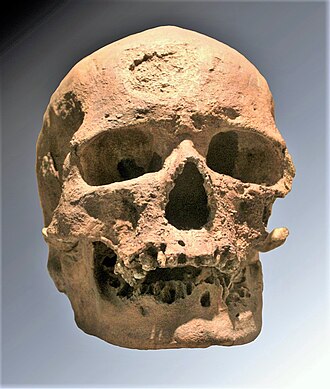
图:120 · CC BY 2.5 · Wikimedia Commons
- 类型
- 生物特定俗名
- 发现 / 发明时间
- 1868 年
- 发现者 / 提出者
- Louis Lartet
- 命名来源
- Cro-Magnon rock shelter
- 学科
- 生物学
- 上级概念
- 早期现代人
相关科学家
百科正文
背景
1868年,在法国西南部多尔多涅省莱塞济德塔亚克-锡勒伊镇附近Cro-Magnon的一个浅洞穴中,发现一些古老的人类骨骼。法国地质学家 Édouard Lartet 对该洞穴进行调查,发现五个考古层;最上层发现的人类骨骼被证明距当时有10,000至35,000年的历史。这些骨骼所属的史前人类被称为克罗马侬人,与尼安德特人(学名:Homo neanderthalensis)一起被认为是史前人类的代表。现代研究显示克罗马侬人的出现年代甚至更早。 根据遗传学研究,克罗马侬人可能源自非洲东部,扩散至南亚、中亚、中东,北非,还有欧洲。
克罗马侬人体格健壮,体力强大;据推测大多个体身高约落在166公分至171公分之间。他们的身体普遍沉重而坚固,且肌肉发达。他们的额头笔直,眉骨微翘,脸型短而宽。克罗马侬人拥有突出的下颔。他们的大脑容量约1,600立方公分,略大于现代人类的平均容量。
他们制作出各种复杂的工具,例如经修饰过的刀片、刮刀、凿子状工具、精细的骨器(参见奥瑞纳文化)等。
克罗马侬人的住所最常见于由岩石悬垂形成的洞穴中,尽管也发现原始的小屋,无论是靠岩壁的单坡屋顶,还是完全由石头建造的小屋。岩棚被全年使用。
与尼安德特人一样,克罗马侬人也埋葬死去的同类。
克罗马侬人制作人类和动物造型的小型雕刻物和浮雕。人类造型雕塑经常描绘大乳房、宽臀的成年女性。 在拉斯科洞窟、莱塞济德塔亚克-锡勒伊、阿尔塔米拉洞等处的克罗马侬人洞穴壁画中,发现大量以动物为主题的绘画,其中一些极其生动;由其精细程度推测,创作者可能经过许多练习和尝试。
目前的考古证据等难以据以推断克罗马侬人持续存在时间的长度,以及他们的完整遭遇。
以上内容摘自维基百科「克羅馬儂人」,按 CC BY-SA 4.0 使用,去掉了参考文献、外部链接等尾部小节,公式改写成了纯文本。全文、配图和出处见原文。
英文维基百科补充中文条目比较短,下面是英文条目「Cro-Magnon」的原文
Cro-Magnons or European early modern humans (EEMH) were the first surviving expansion of early modern humans (Homo sapiens) found in Europe and Siberia, continuously occupying the continent possibly from as early as 56,800 years ago. They interacted and interbred with the indigenous Neanderthals (H. neanderthalensis) of Europe and Western Asia, who went extinct 35,000 to 40,000 years ago. At the time of this admixture, those Neanderthals already possessed about 6% Homo sapiens ancestry, from admixture with an earlier, extinct sapiens population in Eurasia earlier than 240kya. Ancient DNA research indicates that the earliest modern humans in Europe during the Initial Upper Paleolithic (~45–40 kya) were part of the broader early expansion of Homo sapiens from Eurasia.
Genetic data show that some early European individuals, such as those associated with the Lincombian-Ranisian-Jerzmanowician technocomplex, represent lineages that left little or no detectable ancestry in later European populations. However, other lineages present in Europe by ~38–37 kya are genetically closer to later Upper Paleolithic Europeans. These surviving Upper Paleolithic populations contributed ancestry to Mesolithic European hunter-gatherers, including Western Hunter-Gatherers (WHG), who in turn form one of the principal ancestral components of present-day Europeans. Rather than reflecting a separate later migration into Europe prior to the Neolithic, current evidence supports a model of early population structure followed by lineage extinction and survival within the initial Homo sapiens expansion from the continent. Cro-Magnons produced Upper Palaeolithic cultures, the first major one being the Aurignacian, which was succeeded by the Gravettian by 30,000 years ago. The Gravettian split into the Epi-Gravettian in the east and Solutrean in the west, due to major climatic degradation during the Last Glacial Maximum (LGM), peaking 21,000 years ago. As Europe warmed, the Solutrean evolved into the Magdalenian by 20,000 years ago, and these peoples recolonised Europe. The Magdalenian and Epi-Gravettian gave way to Mesolithic cultures as big game animals were dying out, and the Last Glacial Period drew to a close. Upper Paleolithic West Eurasian populations contributed ancestry to later European hunter-gatherers and share deep genetic affinities with ancient Near Eastern populations, some of whose descendants later contributed to populations in West Asia and North Africa.
Cro-Magnons were generally more robust than most living populations, having larger brains, broader faces, more prominent brow ridges, and bigger teeth. The earliest Cro-Magnon specimens also exhibit some features that are reminiscent of those found in Neanderthals. The first Cro-Magnons would have generally had darker skin tones than most modern Europeans and some West Asians and North Africans; natural selection for lighter skin would not have begun until 30,000 years ago. Before the LGM, Cro-Magnons had overall low population density, tall stature similar to post-industrial humans, and expansive trade routes stretching as long as 900 km (560 mi), and hunted big game animals. Cro-Magnons had much higher populations than the Neanderthals, possibly due to higher fertility rates; life expectancy for both species was typically under 40 years.
以上节选摘自英文维基百科「Cro-Magnon」,按 CC BY-SA 4.0 使用,去掉了参考文献、外部链接等尾部小节,公式改写成了纯文本。篇幅所限,较长的小节只摘了开头一部分,有的小节没有收;全文、配图和出处见原文。