格物

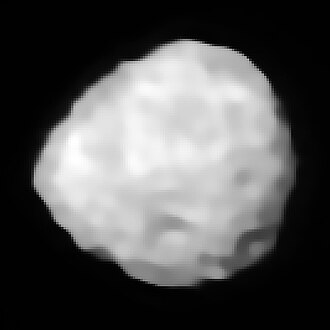
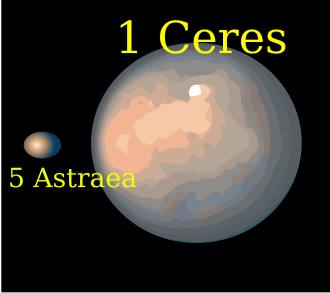
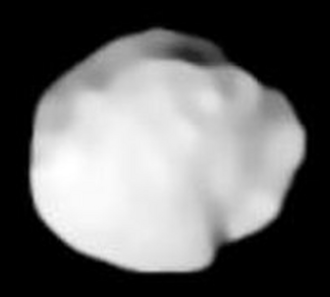
图:VSO Very Large Telescope SPHERE/ZIMPOL team · CC BY 4.0 · Wikimedia Commons
- 类型
- 小行星
- 发现 / 发明时间
- 1847 年
- 发现者 / 提出者
- 约翰·罗素·欣德
- 命名来源
- 佛洛拉
- 学科
- 天文学
- 前一项
- 虹神星
- 后一项
- 颖神星
相关科学家
百科正文
发现与命名
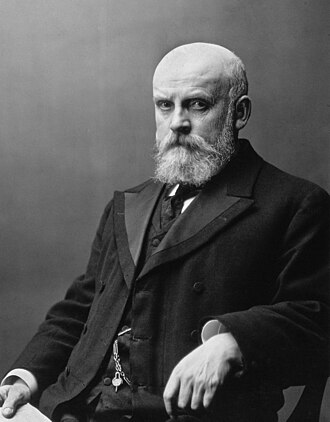
花神星是第八颗被人类发现的小行星,由英国天文学家约翰·罗素·欣德于1847年10月18日发现,是他发现的第二颗小行星。
他发现的第一颗小行星是虹神星(7 Iris)。
这颗小行星是由发现者约翰·罗素·欣德命名的,其来源是罗马神话中的花神、春之女神佛洛拉(对应希腊神话中的春与花之仙女克洛里斯)。
特征
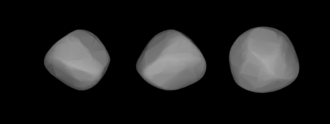
光度曲线的分析指出花神星的自转轴指向黄道坐标(β,λ)= (16°,160°)± 10°。这使得轴向倾斜为78° ± 10°。
花神星是花神星族小行星的母体,而且显然是族群中最大的成员,占有家族总质量的80%。然而,形成家族的冲击显然相当巨大,而且大多数的碎片是靠重力才能聚集在一起。
花神星的光谱指出表面由硅酸盐的混合物(包括辉石和橄榄石)和镍、铁金属构成。花神星和家族中的成员都是L球粒陨石来源的良好后选者。这类陨石占了撞击地球陨石总数的38%。
琐事
在1917年3月25日的观测中,花神星被错认为狮子座 TU,导致该颗恒星被分类为双子座U型激变变星,这个错误一直延续到1995年。
以上内容摘自维基百科「花神星」,按 CC BY-SA 4.0 使用,去掉了参考文献、外部链接等尾部小节,公式改写成了纯文本。全文、配图和出处见原文。
英文维基百科补充中文条目比较短,下面是英文条目「8 Flora」的原文
8 Flora is a large, bright main-belt asteroid. It is the innermost large asteroid: no asteroid closer to the Sun has a diameter above 25 kilometers (20% that of Flora), and not until 20-km 149 Medusa was discovered was an asteroid known to orbit at a closer mean distance. It is the seventh-brightest asteroid with a mean opposition magnitude of +8.7. Flora can reach a magnitude of +8.1 at a favorable opposition near perihelion, such as occurred in November 2020 when it was 0.88 AU (132 million km; 340 LD) from Earth.
Discovery and naming
Flora was discovered by J. R. Hind on 18 October 1847. It was his second asteroid discovery after 7 Iris.
The name Flora was proposed by John Herschel, from Flora, the Latin goddess of flowers and gardens, wife of Zephyrus (the personification of the West wind), and mother of Spring. The Greek equivalent is Chloris, who has her own asteroid, 410 Chloris, but in Greek 8 Flora is also called 8 Chloris (8 Χλωρίς).
The old iconic symbol for 8 Flora has been variously rendered as,, etc. It was added to Unicode 17.0 as U+1CEC2 . The original description for the symbol described it as a flower, but later authors per Schmadel (2012) identified it as the Rose of England.
Characteristics
Flora's rotation pole points towards ecliptic coordinates (β, λ) = (−1°, 337°), giving an axial tilt of 87°.
Flora is the parent body of the Flora family of asteroids, and by far the largest member, comprising about 80% of the total mass of this family. Nevertheless, Flora was almost certainly disrupted by the impact(s) that formed the family, and is probably a gravitational aggregate of most of the pieces.
Flora's spectrum indicates that its surface composition is a mixture of silicate rock (including pyroxene and olivine) and nickel-iron metal. Flora, and the whole Flora family generally, are good candidates for being the parent bodies of the L chondrite meteorites. This meteorite type comprises 35% of meteorites impacting the Earth.
Observational history
During an observation on 25 March 1917, 8 Flora was mistaken for the 15th-magnitude star TU Leonis, which led to that star's classification as a U Geminorum cataclysmic variable star. Flora had come to opposition on 1917 February 13, 40 days earlier. This mistake was uncovered only in 1995.
On 26 July 2013, Flora at magnitude 8.8 occulted the star 2UCAC 22807162 over parts of South America, Africa, and Asia.
以上内容摘自英文维基百科「8 Flora」,按 CC BY-SA 4.0 使用,去掉了参考文献、外部链接等尾部小节,公式改写成了纯文本。全文、配图和出处见原文。