格物
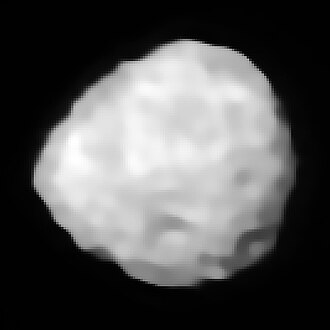
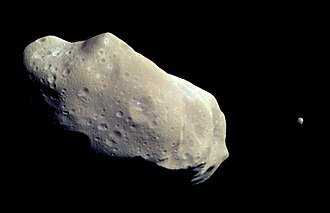
图:ESO/Vernazza et al. · CC BY 4.0 · Wikimedia Commons
- 类型
- 小行星
- 发现 / 发明时间
- 1847 年
- 发现者 / 提出者
- 约翰·罗素·欣德
- 命名来源
- 伊里斯
- 学科
- 天文学
- 前一项
- 韶神星
- 后一项
- 花神星
相关科学家
百科正文
发现
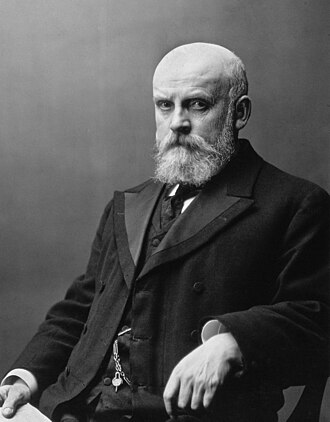
虹神星是第七颗被发现的小行星,由英国天文学家约翰·罗素·辛德于1847年8月13日发现,亦是他发现的第一颗小行星。他还发现了8号小行星花神星。
命名
Iris(伊里斯),希腊神话中彩虹的化身和诸神的使者。代表希腊神话中的彩虹女神,中文则译作虹神星。
特征
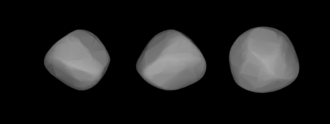
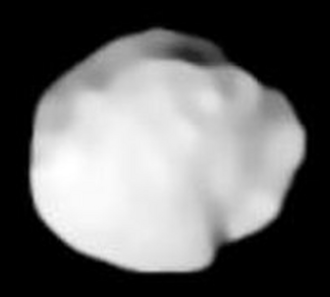
测光观测表明,虹神星的外形带有棱角,而自转轴倾角约为85°(约有10°的误差)[4],因此天体的两个半球长时间受日照或黑夜,对于没有大气层的天体,这会造成很大的温差。
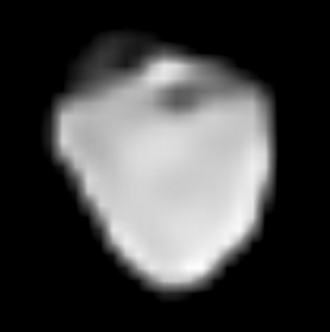
虹神星表面的反照率并不均匀,北半球可能具有较明亮的区域[5]。整体来说,虹神星的反照率较其他小行星高,因此可能由铁-镍、硅酸镁、硅酸铁的混合物组成。它的光谱与经过太阳风风化的L和LL球粒陨石类似[6],故此它可能是此类陨石的主要来源[7]。
虹神星曾于1995年5月26日及1997年7月25日掩蔽恒星,两次观测结果显示虹神星直径为200千米左右。
以上内容摘自维基百科「虹神星」,按 CC BY-SA 4.0 使用,去掉了参考文献、外部链接等尾部小节,公式改写成了纯文本。全文、配图和出处见原文。
英文维基百科补充中文条目比较短,下面是英文条目「7 Iris」的原文
7 Iris is a large main-belt asteroid and possible remnant planetesimal orbiting the Sun between Mars and Jupiter. It is the fourth-brightest object in the asteroid belt. 7 Iris is classified as an S-type asteroid, meaning that it has a stony composition.
Discovery and name
Iris was discovered on 13 August 1847, by John R. Hind from London, England. It was Hind's first asteroid discovery and the seventh asteroid to be discovered overall. It was named after the rainbow goddess Iris in Greek mythology, who was a messenger to the gods, especially Hera. Her quality of attendant of Hera was particularly appropriate to the circumstances of discovery, as Iris was spotted following 3 Juno by less than an hour of right ascension (Juno is the Roman equivalent of Hera).
Iris's original symbol was a rainbow and a star: or more simply. It was encoded in Unicode 17.0 as U+1CEC1 .
Characteristics
Geology
Iris is an S-type asteroid. The surface is bright and is probably a mixture of nickel-iron metals and magnesium- and iron-silicates. Its spectrum is similar to that of L and LL chondrites with corrections for space weathering, so it may be an important contributor of these meteorites. Planetary dynamics also indicates that it should be a significant source of meteorites.
Among the S-type asteroids, Iris ranks fifth in mean diameter after Eunomia, Juno, Amphitrite and Herculina. Its shape is consistent with an oblate spheroid with a large equatorial excavation, suggesting it is a remnant planetesimal. No collisional family can be associated with Iris, likely because the excavating impact occurred early in the history of the Solar System, and the debris has since dispersed.
Brightness
Iris's bright surface and small distance from the Sun make it the fourth-brightest object in the asteroid belt after Vesta, Ceres, and Pallas. It has a mean opposition magnitude of +7.8, comparable to that of Neptune, and can easily be seen with binoculars at most oppositions. At typical oppositions it marginally outshines the larger though darker Pallas. But at rare oppositions near perihelion Iris can reach a magnitude of +6.7 (last time on 31 October 2017, reaching a magnitude of +6.9), which is as bright as Ceres ever gets.
Surface features
A study by Hanus et al. using data from the VLT's SPHERE instrument names eight craters 20 to 40 km in diameter, and seven recurring features of unknown nature that remain nameless due to a lack of consistency and their occurrence on the edge of Iris. The names are Greek names of colors, corresponding to the rainbow as the sign of Iris. It is unknown whether these names are under consideration by the IAU. The other 7 features are labeled A through G.
Rotation
Iris has a rotational period of 7.14 hours. Iris's north pole points towards the ecliptic coordinates (λ, β) estimated to be (20°, +23°) with a 3° uncertainty. This gives an axial tilt of 72°, so that on much of each hemisphere, the sun does not set during summer, and does not rise during winter. On an airless body this gives rise to very large temperature differences.
Observations
Iris was observed occulting a star on 26 May 1995, and later on 25 July 1997. Both observations gave a diameter of about 200 km.
In February 2024, water molecules were discovered on 7 Iris, alongside 20 Massalia, marking the first time water molecules were detected on asteroids.
以上内容摘自英文维基百科「7 Iris」,按 CC BY-SA 4.0 使用,去掉了参考文献、外部链接等尾部小节,公式改写成了纯文本。全文、配图和出处见原文。