格物
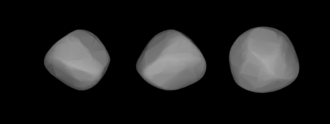
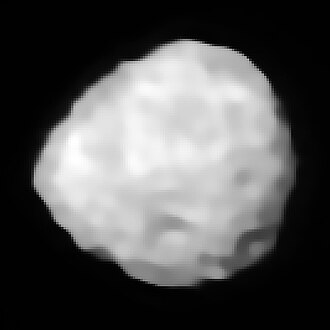
图:Astronomical Institute of the Charles University: Josef Ďure… · CC BY 4.0 · Wikimedia Commons
- 类型
- 小行星
- 发现 / 发明时间
- 1851 年
- 发现者 / 提出者
- 约翰·罗素·欣德
- 命名来源
- 厄瑞涅
- 学科
- 天文学
- 前一项
- 芙女星
- 后一项
- 司法星
相关科学家
百科正文
司宁星的名字来自希腊神话中的和平女神厄瑞涅。
以上内容摘自维基百科「司宁星」,按 CC BY-SA 4.0 使用,去掉了参考文献、外部链接等尾部小节,公式改写成了纯文本。全文、配图和出处见原文。
英文维基百科补充中文条目比较短,下面是英文条目「14 Irene」的原文
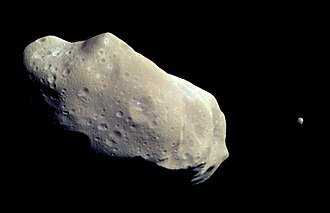
14 Irene is a large main-belt asteroid, discovered by the English astronomer John Russell Hind on 20 May 1851. It is orbiting the Sun at a distance of 2.585 AU with a period of 4.16 yr and an eccentricity of 0.168. The orbital plane is tilted at an angle of 9.1° to the plane of the ecliptic.
Observation
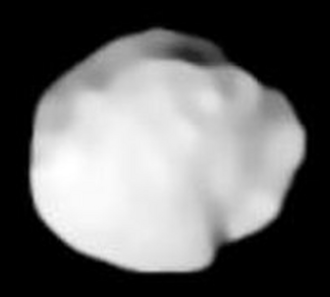
Observations from 2007 indicate that the rotation pole of 14 Irene lies close to the plane of the ecliptic, indicating it has an obliquity close to 90°. The fairly flat Irenian lightcurves indicate somewhat spherical proportions. This is a stony S-type asteroid with a mean diameter of around 155 km. It is spinning with a rotation period of 15 hours.
There have been seven reported stellar occultation events by Irene. The best is a three chord event observed in 2013.
History
Irene was discovered by English astronomer John R. Hind on the very early morning of 20 May 1851 from George Bishop's Observatory in London, England. At that time, he was observing near the star Lalande 29490, around the 16th hour of right ascension and 10–15°S of declination in the constellation of Scorpius. For several years prior, he had examined this region of the sky as a nearby star had been erroneously omitted from Wölfer's star charts. Near Lalande 29490, Xi Scorpii, and 50 Librae, he noticed a pale blue object of about the ninth magnitude that had not been recorded before. Since such an object was unlikely to have gone unnoticed in prior sweeps of the area, he quickly suspected its non-stellar nature. This was confirmed by follow-up observations throughout that morning, and Hind announced his discovery of a new planet through The London Times on 21 May 1851. Further announcements of the discovery were published by journals such as Astronomische Nachrichten and The Astronomical Journal in the following months. Irene was the fourth asteroid discovered by Hind and the fourteenth discovered in history. Hind would go on to discover a further six asteroids.
Naming
Irene was named after Irēnē, a personification of peace in Greek mythology. She was one of the Horae, daughter of Zeus and Themis. The name was suggested by Sir John Herschel. Hind wrote,
"You will readily discover that this name [...] has some relation to this event (the Great Industrial Exhibition) which is now filling our metropolis [London] with the talent of all civilised nations, with those of Peace, the productions of Art and Science, in which all mankind must feel an interest."
The Great Exhibition of the Works of Industry of All Nations in the Crystal Palace of Hyde Park, London, ran from 1 May until 18 October 1851.
Symbol
Hind suggested that the symbol for the asteroid should be "A dove carrying an olive-branch, with a star on its head", but it was hardly drawn before the use of graphical symbols to represent asteroids was dropped entirely. It was included in Unicode 17.0 as U+1CEC7 .
Orbit
Irene orbits the Sun at an average distance, or semi-major axis, of 2.59 astronomical units (AU), placing it in the main asteroid belt. Along its 4.16 year long orbit, its distance from the Sun varies from 2.17 AU at perihelion to 3.01 AU at aphelion due to its orbital eccentricity of 0.16. Its orbit is inclined by 9° with respect to the ecliptic plane, and it does not belong to any known asteroid family, classifying it as a background asteroid.
以上内容摘自英文维基百科「14 Irene」,按 CC BY-SA 4.0 使用,去掉了参考文献、外部链接等尾部小节,公式改写成了纯文本。全文、配图和出处见原文。