格物

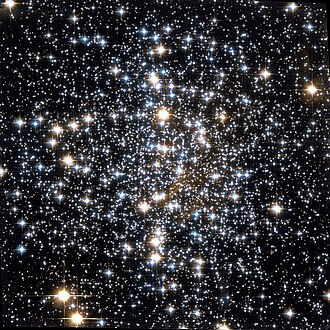
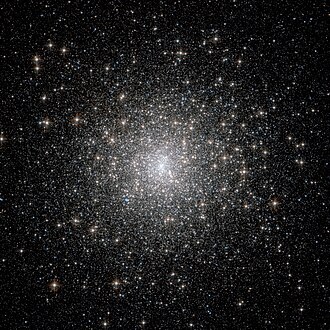
图:Sloan Digital Sky Survey · CC BY 4.0 · Wikimedia Commons
- 类型
- 球状星团
- 发现 / 发明时间
- 1702 年
- 发现者 / 提出者
- 戈特弗里德·基尔希、玛丽亚·玛格丽塔·基希
- 属于
- 银河系
- 学科
- 天文学
相关科学家
百科正文
发现和可见性
在极端良好的条件下,M5是可以用肉眼直接看见的一颗微弱的"恒星",他的位置靠近巨蛇 5。双筒望远镜或小望远镜就可以看出他不是一颗恒星,大望远镜则能看见一些视星等约为12.2等的单独恒星。
M 5 是在1702年被德国天文学家戈特弗里德·基尔希在搜寻彗星时发现的,梅西耶在1764年再发现时,认为他是没有恒星的星云。威廉·赫协尔在1791年分解出其中的恒星,大约计数出200颗左右。
虽然在天空中的位置和帕罗马 5很接近,但 M 5不会和光度暗淡且遥远的帕罗马 5混淆不清。
科学的数据
M 5是已知的球状星团中体积最大的,直径达到165光年,但重力可以影响到的半径达到200光年。(这是说在半径200光年以内的球状空间中,恒星就不会被银河系的引力剥离。)
在银河系内,年龄为130亿岁的M 5也是最老的球状星团之一,与地球的距离约为24,500光年,拥有10万或者多达50万颗的恒星。
变星
在M 5内,已经发现105颗明亮的变星,其中97颗是天琴座RR型变星,以光度和周期之间的关连性而著名。这种变星有时也称为"星团变星",有许多性质与造父变星相似,也可以作为在太空中测量距离的工具。在M 5中最亮、最容易观测的变星是光度在10.6~12.1等之间,变化周期25.6天的一颗。也曾经有一颗矮新星在星团内被观测过。
以上内容摘自维基百科「M5 (球狀星團)」,按 CC BY-SA 4.0 使用,去掉了参考文献、外部链接等尾部小节,公式改写成了纯文本。全文、配图和出处见原文。
英文维基百科补充中文条目比较短,下面是英文条目「Messier 5」的原文
Messier 5 or M5 (also designated NGC 5904) is a globular cluster in the constellation Serpens. It was discovered by Gottfried Kirch in 1702.
Discovery and visibility
M5 is, under extremely good conditions, just visible to the naked eye as a faint "star" 0.37 of a degree (22' (arcmin)) north-west of star 5 Serpentis. Binoculars and/or small telescopes resolve the object as non-stellar; larger telescopes will show some individual stars, some of which are as bright as apparent magnitude 10.6.
M5 was discovered by German astronomer Gottfried Kirch in 1702 when he was observing a comet. Charles Messier noted it in 1764 and—a studier of comets—cast it as one of his nebulae. William Herschel was the first to resolve individual stars in the cluster in 1791, counting roughly 200. Messier 5 is receding from the Solar System at a speed over 50 km/s.
Notable features
Within M5, there are 105 known variable stars, 97 of them belonging to the RR Lyrae type. RR Lyrae stars, sometimes referred to as "Cluster Variables", are somewhat similar to Cepheid type variables and as such can be used as a tool to measure distances in outer space since the relation between their luminosities and periods are well known. The brightest and most easily observed variable in M5 varies from magnitude 10.6 to 12.1 in a period of just under 26.5 days.
The cluster contains two millisecond pulsars, one of which is in a binary, allowing the proper motion of the cluster to be measured. The binary could help our understanding of neutron degenerate matter; the current median mass, if confirmed, would exclude any "soft" equation of state for such matter. The cluster has been used to test for magnetic dipole moments in neutrinos, which could shed light on some hypothetical particles such as the axion.
A dwarf nova has also been observed in this cluster.
以上内容摘自英文维基百科「Messier 5」,按 CC BY-SA 4.0 使用,去掉了参考文献、外部链接等尾部小节,公式改写成了纯文本。全文、配图和出处见原文。