格物
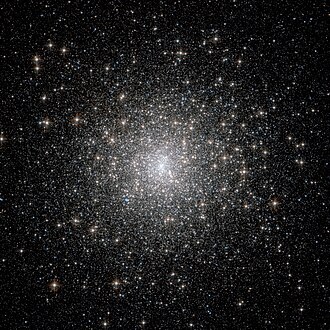
图:ESA/Hubble & NASA · Public domain · Wikimedia Commons
- 类型
- 球状星团
- 发现 / 发明时间
- 1746 年
- 发现者 / 提出者
- 乔瓦尼·多梅尼科·马拉迪
- 属于
- 银河系
- 学科
- 数学
相关科学家
百科正文
特性
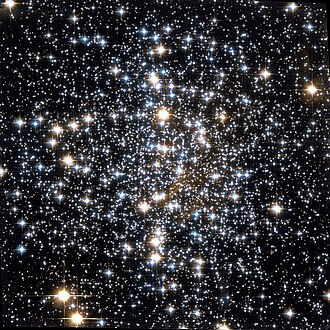
M15距离地球大约33,600 光年,直径约175光年。它的绝对星等是-9.2,转换成总光度是太阳的360,000倍。M15是银河系中已知最密集的球状星团之一。其核心经历过称为核心崩溃,并且在它的中心有一个密度尖点,可能有大量的恒星围绕着可能存在中心的黑洞。
超过100,000颗恒星的家,这个星团拥有大量的变星(112)和脉冲星(8),包括一对双中子星系统,M15 C。M15也包含一个行星状星云豌豆1,因是在球状星团中发现的第一个而著称。从1928年迄今,只在球状星团中另外发现三个。
业余天文学
M15的视星等为6.2,接近在良好情况下裸眼可见的极限,用双筒望远镜或小望远镜观察,可以看见像是一颗模糊的恒星。使用口径较大(至少是6英寸/15公分的口径)可以开始解析出一些恒星,其中最亮的视星等为+12.6。星团的视直径为18角分。
X射线源
地球轨道卫星乌呼鲁和CXO检测到这个星团内有两个明亮的X射线源:M15 X-1(4U 2129+12)和M15 X-2。前者似乎是在飞马座检测到的第一个天文X射线源。
以上内容摘自维基百科「梅西耶15」,按 CC BY-SA 4.0 使用,去掉了参考文献、外部链接等尾部小节,公式改写成了纯文本。全文、配图和出处见原文。
英文维基百科补充中文条目比较短,下面是英文条目「Messier 15」的原文
Messier 15 or M15 (also designated NGC 7078 and sometimes known as the Great Pegasus Cluster) is a globular cluster in the constellation Pegasus. It was discovered by Jean-Dominique Maraldi in 1746 and included in Charles Messier's catalogue of comet-like objects in 1764. At an estimated 12.5±1.3 billion years old, it is one of the oldest known globular clusters.
Characteristics
M 15 is about 35,700 light-years from Earth, and 175 light-years in diameter. It has an absolute magnitude of −9.2, which translates to a total luminosity of 360,000 times that of the Sun. Messier 15 is one of the most densely packed globulars known in the Milky Way galaxy. Its core has undergone a contraction known as "core collapse" and it has a central density cusp with an enormous number of stars surrounding what may be a central black hole.
Home to over 100,000 stars, the cluster is notable for containing a large number of variable stars (112) and pulsars (8), including one double neutron star system, M15-C. It also contains Pease 1, the first planetary nebula discovered within a globular cluster in 1928. Just three others have been found in globular clusters since then.
Amateur astronomy
At magnitude 6.2, M15 approaches naked eye visibility under good conditions and can be observed with binoculars or a small telescope, appearing as a fuzzy star. Telescopes with a larger aperture (at least 6 in. (150 mm)) will start to reveal individual stars, the brightest of which are of magnitude +12.6. The cluster appears 18 arc minutes in size (three tenths of a degree across). M15 is around 4° WNW of the brightest star of Pegasus, Epsilon Pegasi.
X-ray sources
Earth-orbiting satellites Uhuru and Chandra X-ray Observatory have detected two bright X-ray sources in this cluster: Messier 15 X-1 (4U 2129+12) and Messier 15 X-2. The former appears to be the first astronomical X-ray source detected in Pegasus.
以上内容摘自英文维基百科「Messier 15」,按 CC BY-SA 4.0 使用,去掉了参考文献、外部链接等尾部小节,公式改写成了纯文本。全文、配图和出处见原文。