格物
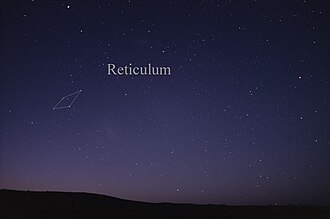
图:Till Credner · CC BY-SA 4.0 · Wikimedia Commons
- 类型
- 星座
- 发现 / 发明时间
- 约 1750 年代
- 发现者 / 提出者
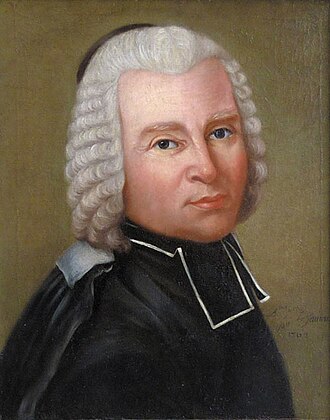
- 尼可拉·路易·拉卡伊
- 命名来源
- 十字线
- 属于
- 南天 (天球)
- 学科
- 数学
相关科学家
百科正文
历史
网罟座是法国天文学家拉卡伊创造的一个星座。它的名称是为了纪念在目镜中加上了精密观测用的网,即十字丝。这个很小的远南天星座最突出的特点是几个有趣的双星和相对明亮的星系。该星座的最佳观测时间为10月至12月,同时,北纬30度以北地区只能在理想条件下观测到其一颗主星。
有趣的星
网罟座ζ 1和网罟座ζ 2:这是一对用双筒望远镜可见的双星。两星星等分别为+5和+5.5,距离地球39光年。从地球看相距130弧秒。两星组成成分与太阳相似。
网罟座θ星:这是由两颗星等分别为+6和+8的恒星组成是双星系统。从地球看两星相距4.1弧秒。
深空天体
NGC 1313:这是一个明亮的漩涡星系。从地球看它由一个明亮的南北向的棒和暗而带斑点的旋臂,其星等为+9.4。
以上内容摘自维基百科「网罟座」,按 CC BY-SA 4.0 使用,去掉了参考文献、外部链接等尾部小节,公式改写成了纯文本。全文、配图和出处见原文。
英文维基百科补充中文条目比较短,下面是英文条目「Reticulum」的原文
Reticulum is a small, faint constellation in the southern sky. Its name is Latin for a small net, or reticle—a net of crosshairs at the focus of a telescope eyepiece that is used to measure star positions. The constellation is best viewed between October and December, and save for one main star visible in ideal conditions, cannot be seen from north of the 30th parallel north.
History
A constellation in this area was introduced by Isaac Habrecht II in his celestial globe in 1621, who named it Rhombus. It was replaced with a somewhat different constellation by the French astronomer Nicolas Louis de Lacaille in the eighteenth century; during his stay at the Cape of Good Hope, he named the constellation le Réticule Rhomboide to commemorate the reticle in his telescope eyepiece. The name was later Latinized to Reticulum in his star catalogue Coelum Australe Stelliferum. In 1810, the stars of Reticulum were used by William Croswell to produce the constellation Marmor Sculptile, which represented the bust of Christopher Columbus, but this did not catch on among astronomers.
The constellation Reticulum became officially recognized during the First General Assembly of the International Astronomical Union in 1922. The boundary for this and other constellations was drawn up by Belgian astronomer Eugène Delporte along arcs of right ascension and declination for epoch 1875. These were published in 1930 in the Delimination Scientifique des Constellations at the behest of the IAU.
Features
Lacaille gave 10 stars Bayer designations Alpha through Iota in 1756 and labelled two stars as Zeta. In 1879, Benjamin Gould added Kappa Reticuli as he felt the star was bright enough to warrant a name.
Only two of the stars in this constellation are brighter than visual magnitude 5: Alpha (α) (the proper name is Rhombus since 19 September 2024) and Beta (β) reticuli. The reddish star R Reticuli is a Mira variable. This variable was discovered by C. Ragoonatha Chary at the Madras Observatory in India.
The binary star system Epsilon Reticuli consists of a spectral class K2IV star being orbited by a white dwarf. Based on parallax measurements, this system is located about 50 light years from the Sun. In 2000, a planetary companion was announced, orbiting the star ε Reticuli A.
Zeta Reticuli is a wide binary star system, with both members being similar to the Sun. It is located at a distance of about 39 light years. This system gained some notoriety in ufology when the alleged alien abductees Betty and Barney Hill named it as the home of their abductors.
In 2005, a type Ia supernova was discovered in the spiral galaxy NGC 1559, located in the constellation.
The dwarf galaxy Reticulum II is enriched in r-process heavy elements.
The Horologium-Reticulum Supercluster is a galaxy supercluster that ranges from 700 million to 1.2 billion light-years from Earth.
以上内容摘自英文维基百科「Reticulum」,按 CC BY-SA 4.0 使用,去掉了参考文献、外部链接等尾部小节,公式改写成了纯文本。全文、配图和出处见原文。