格物
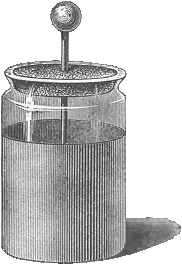
图:The original uploader was WHell at German Wikipedia. · Public domain · Wikimedia Commons
- 类型
- 电力元件
- 发现 / 发明时间
- 1745 年
- 发现者 / 提出者
- 克拉斯特主教
- 命名来源
- 莱顿大学
- 学科
- 物理学
- 上级概念
- 电容器
相关科学家
百科正文
说明
典型的莱顿瓶是一个玻璃容器,内外包覆着导电金属箔作为极板。瓶口上端接一个球形电极,下端利用导体(通常是金属锁链)与内侧金属箔或是水连接。莱顿瓶的充电方式是将电极接上静电发电机或起电盘等来源,外部金属箔接地;内部与外部的金属将会携带相等但极性相反的电荷。
以上内容摘自维基百科「莱顿瓶」,按 CC BY-SA 4.0 使用,去掉了参考文献、外部链接等尾部小节,公式改写成了纯文本。全文、配图和出处见原文。
英文维基百科补充中文条目比较短,下面是英文条目「Leyden jar」的原文
A Leyden jar (or Leiden jar, or archaically, Kleistian jar) is an electrical component that stores a high-voltage electric charge (from an external source) between electrical conductors on the inside and outside of a glass jar. It typically comprises a glass jar with metal foil cemented to the inside and the outside surfaces, and a metal terminal projecting vertically through the jar lid to make contact with the inner foil. It was the original form of the capacitor (also called a condenser).
Its invention was a discovery made independently by German cleric Ewald Georg von Kleist on 11 October 1745 and by Dutch scientist Pieter van Musschenbroek of Leiden (Leyden), Netherlands, in 1745–1746.
The Leyden jar was used to conduct many early experiments in electricity, and its discovery was of fundamental importance in the study of electrostatics. It was the first means of accumulating and preserving electric charge in large quantities that could be discharged at the experimenter's will, thus overcoming a significant limit to early research into electrical conduction. Leyden jars are still used in education to demonstrate the principles of electrostatics.
Previous work
The Ancient Greeks already knew that pieces of amber could attract lightweight particles after being rubbed. The amber becomes electrified by the triboelectric effect, mechanical separation of charge in a dielectric material. The Greek word for amber is ἤλεκτρον (ēlektron) and is the origin of the word "electricity".
Discovery
The Leyden jar was effectively discovered independently by two parties: German dean Ewald Georg von Kleist, who made the first discovery, and Dutch scientists Pieter van Musschenbroek and Andreas Cunaeus, who figured out why it only worked when held in the hand.
Von Kleist
Ewald Georg von Kleist was the dean at the cathedral of Cammin in Pomerania, a region now divided between Germany and Poland.
Further developments
Within months after Musschenbroek's report about how to reliably create a Leyden jar, other electrical researchers were making and experimenting with their own Leyden jars. One of his expressed original interests was to see if the total possible charge could be increased.
Design
A typical design consists of a glass jar with conducting tin foil coating the inner and outer surfaces. The foil coatings stop short of the mouth of the jar, to prevent the charge from arcing between the foils. A metal rod electrode projects through the nonconductive stopper at the mouth of the jar, electrically connected by some means (usually a hanging chain) to the inner foil, to allow it to be charged.
Storage of the charge
It was initially believed that the charge was stored in the water in early Leyden jars. In the 1700s American statesman and scientist Benjamin Franklin performed extensive investigations of both water-filled and foil Leyden jars, which led him to conclude that the charge was stored in the glass, not in the water.
Capacitance
The Leyden jar is a high-voltage device; it is estimated that at a maximum the early Leyden jars could be charged to 20000 to 60000 volts. The center rod electrode has a metal ball on the end to prevent leakage of the charge into the air by corona discharge. It was first used in electrostatics experiments, and later in high-voltage equipment such as spark-gap radio transmitters and electrotherapy machines.
Uses
Beginning in the late 18th century it was used in the medical field of electrotherapy to treat a variety of diseases by electric shock. By the middle of the 19th century, the Leyden jar had become common enough for writers to assume their readers knew of and understood its basic operation. Around the turn of the century it began to be widely used in spark-gap transmitters and medical electrotherapy equipment.
以上节选摘自英文维基百科「Leyden jar」,按 CC BY-SA 4.0 使用,去掉了参考文献、外部链接等尾部小节,公式改写成了纯文本。篇幅所限,较长的小节只摘了开头一部分,有的小节没有收;全文、配图和出处见原文。