格物
- 发现 / 发明时间
- 1952 年
- 发现者 / 提出者
- 戴维·派因斯、戴维·玻姆
- 学科
- 物理学
- 上级概念
- 准粒子、量子
相关科学家

百科正文
由于等离体子是经典等离子体振荡的量子化,它们的大多数性质可以直接从麦克斯韦方程中导出。
解释
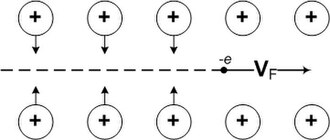
等离体子可以被描述在经典图像中,如和金属中的固定正离子有关的一个自由电子密度的振荡。设想一个等离子体振荡,想像一个金属块放置在指向右方的外部电场中。电子将会向左侧移动(正离子则在右侧)直到它们消除了金属内部的电场。若电场被移除了,电子被右侧的正离子所吸引而移向右方。它们以等离子体频率来回振荡直到能量在某些阻力与阻尼中流失掉。等离体子则是这种振荡的量子化。
等离体子的角色
等离体子在金属的光学性质中扮演了很大的角色。光的频率若是在等离子体频率之下,则会被反射,因为金属中的电子屏蔽了光的电场。光的频率若是高于等离子体频率则会透射,因为电子回应得不够快而不能屏蔽它。在大多数的金属中,等离子体频率接近紫外线的频率,反射了可见光让它们看起来很闪亮。一些金属如铜和金,在可见区中有电子带间过渡,借此吸收某些能量的(某些颜色的)光,让它们拥有独特的颜色。在半导体中,价带等离子体频率通常是深紫外线的频率,这也是为什么它们那么反光。
等离体子能量通常可以自由电子模型来估计 (公式略)
这里的 n 是导电子密度, e 是基本电荷, m 是电子质量, ε ₀ 是自由空间电容率, ħ 是普朗克定数, ω ₚ 是等离体子频率。
以上内容摘自维基百科「電漿子」,按 CC BY-SA 4.0 使用,去掉了参考文献、外部链接等尾部小节,公式改写成了纯文本。全文、配图和出处见原文。
英文维基百科补充中文条目比较短,下面是英文条目「Plasmon」的原文
In physics, a plasmon is a quantum of plasma oscillation. Just as light (an optical oscillation) consists of photons, the plasma oscillation consists of plasmons. The plasmon can be considered as a quasiparticle since it arises from the quantization of plasma oscillations, just like phonons are quantizations of mechanical vibrations. Thus, plasmons are collective (a discrete number) oscillations of the free electron gas density. For example, at optical frequencies, plasmons can couple with a photon to create another quasiparticle called a plasmon polariton.
The field of study and manipulation of plasmons is called plasmonics.
Introduction
Derivation
The plasmon was initially proposed in 1952 by David Pines and David Bohm and was shown to arise from a Hamiltonian for the long-range electron-electron correlations.
Since plasmons are the quantization of classical plasma oscillations, most of their properties can be derived directly from Maxwell's equations.
Explanation
Plasmons can be described in the classical picture as an oscillation of electron density with respect to the fixed positive ions in a metal. To visualize a plasma oscillation, imagine a cube of metal placed in an external electric field pointing to the right. Electrons will move to the left side (uncovering positive ions on the right side) until they cancel the field inside the metal. If the electric field is removed, the electrons move to the right, repelled by each other and attracted to the positive ions left bare on the right side. They oscillate back and forth at the plasma frequency until the energy is lost in some kind of resistance or damping.
Surface plasmons
Surface plasmons are those plasmons that are confined to surfaces and that interact strongly with light resulting in a polariton. They occur at the interface of a material exhibiting positive real part of their relative permittivity, i.e. dielectric constant, (e.g. vacuum, air, glass and other dielectrics) and a material whose real part of permittivity is negative at the given frequency of light, typically a metal or heavily doped semiconductors. In addition to opposite sign of the real part of the permittivity, the magnitude of the real part of the permittivity in the negative permittivity region should typically be larger than the magnitude of the permittivity in the positive permittivity region, otherwise the light is not bound to the surface (i.e. the surface plasmons do not exist) as shown in the famous book by Heinz Raether. At visible wavelengths of light, e.g.
Possible applications
The position and intensity of plasmon absorption and emission peaks are affected by molecular adsorption, which can be used in molecular sensors. For example, a fully operational device detecting casein in milk has been prototyped, based on detecting a change in absorption of a gold layer. Localized surface plasmons of metal nanoparticles can be used for sensing different types of molecules, proteins, etc.
Plasmons are being considered as a means of transmitting information on computer chips, since plasmons can support much higher frequencies (into the 100 THz range, whereas conventional wires become very lossy in the tens of GHz). However, for plasmon-based electronics to be practical, a plasmon-based amplifier analogous to the transistor, called a plasmonstor, needs to be created.
Plasmon-soliton
Plasmon-soliton mathematically refers to the hybrid solution of nonlinear amplitude equation e.g. for a metal-nonlinear media considering both the plasmon mode and solitary solution. A soliplasmon resonance is on the other hand considered as a quasiparticle combining the surface plasmon mode with spatial soliton as a
result of a resonant interaction. To achieve one dimensional solitary propagation in a plasmonic waveguide while the surface plasmons should be localized at the interface, the lateral distribution of the field envelope should also be unchanged.
A graphene-based waveguide is a suitable platform for supporting hybrid plasmon-solitons due to the large effective area and huge nonlinearity. For example, the propagation of solitary waves in a graphene-dielectric heterostructure may appear as in the form of higher order solitons or discrete solitons resulting from the competition between diffraction and nonlinearity.
以上节选摘自英文维基百科「Plasmon」,按 CC BY-SA 4.0 使用,去掉了参考文献、外部链接等尾部小节,公式改写成了纯文本。篇幅所限,较长的小节只摘了开头一部分,有的小节没有收;全文、配图和出处见原文。