格物
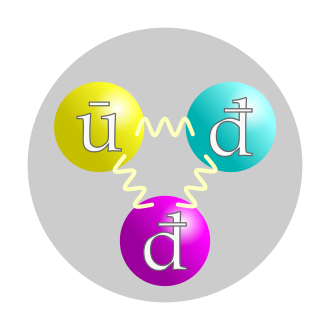
图:en real life identity: SHA-1 commitment ba62ca25da3fee2f8f36… · CC BY-SA 3.0 · Wikimedia Commons
- 类型
- 量子粒子种类
- 发现 / 发明时间
- 1956 年
- 发现者 / 提出者
- 布鲁斯·考克
- 学科
- 物理学
- 上级概念
- 反核子
相关科学家
百科正文
反中子的磁矩也与中子相反,一般中子的数值为-1.91 µN,而反中子则为+1.91 µN,当中 µN 是磁矩中的常数。
由于反中子与中子一样不带电荷,因此要直接观测反中子并不容易,但可看到它与中子湮灭成能量。
现时有人认为,中子与反中子互相振动是存在的,并在一种未知的物理定律下发生,并违反重子数量守恒的定律。
请参阅
粒子目录
反物质
以上内容摘自维基百科「反中子」,按 CC BY-SA 4.0 使用,去掉了参考文献、外部链接等尾部小节,公式改写成了纯文本。全文、配图和出处见原文。
英文维基百科补充中文条目比较短,下面是英文条目「Antineutron」的原文
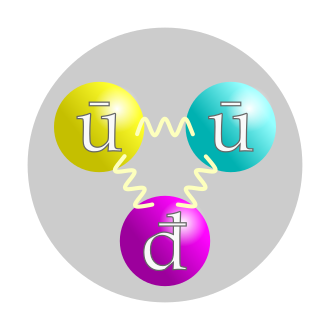
The antineutron is the antiparticle of the neutron with symbol n. It differs from the neutron only in that some of its properties have equal magnitude but opposite sign. It has the same mass as the neutron, and no net electric charge, but has opposite baryon number (+1 for neutron, −1 for the antineutron). This is because the antineutron is composed of antiquarks, while neutrons are composed of quarks. The antineutron consists of one up antiquark and two down antiquarks.
Background
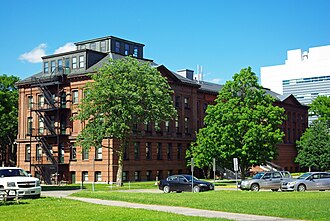
The antineutron was discovered in proton–antiproton collisions at the Bevatron (Lawrence Berkeley National Laboratory) by the team of Bruce Cork, Glen Lambertson, Oreste Piccioni, and William Wenzel in 1956, one year after the antiproton was discovered.
Since the antineutron is electrically neutral, it cannot easily be observed directly. Instead, the products of its annihilation with ordinary matter are observed. In theory, a free antineutron should decay into an antiproton, a positron, and a neutrino in a process analogous to the beta decay of free neutrons. There are theoretical proposals of neutron–antineutron oscillations, a process that implies the violation of the baryon number conservation. There is a project to search for neutron-antineutron oscillations using ultracold neutrons.
Magnetic moment
The magnetic moment of the antineutron is the opposite of that of the neutron. It is +1.91 μN for the antineutron but −1.91 μN for the neutron (relative to the direction of the spin). Here μN is the nuclear magneton.
以上内容摘自英文维基百科「Antineutron」,按 CC BY-SA 4.0 使用,去掉了参考文献、外部链接等尾部小节,公式改写成了纯文本。全文、配图和出处见原文。