格物
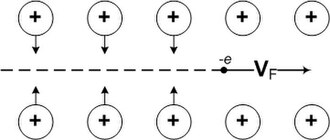
图:User:Pasha An · CC BY-SA 3.0 · Wikimedia Commons
库柏对1956
Cooper pair
pair of electrons or other fermions bound together at low temperature allowing for superconductivity
库柏对 是指电子结合在一起的状态。一般来说,电子之间都有微小的引力,由此使得电子的能量低于费米能时,电子就会结合在一起,这一能量降低大约是1meV的量级,一般的温度对应热运动能量相对很大,因此库柏对的现象通常要在低温下超导状态才会出现。库柏对这个概念是的基础是由BCS理论建立,而这个理论是约翰·巴丁、利昂·库珀和约翰·施里弗这三人提出的,这也让他们三个人得到诺贝尔奖。
摘自维基百科「庫柏對」,CC BY-SA 4.0
- 类型
- 物理现象
- 发现 / 发明时间
- 1956 年
- 发现者 / 提出者
- 利昂·库珀
- 命名来源
- 利昂·库珀
- 学科
- 物理学
- 上级概念
- group of 2、准粒子、玻色子
- 组成部分
- 费米子
相关科学家

百科正文
英文维基百科补充中文条目比较短,下面是英文条目「Cooper pair」的原文
In condensed matter physics, a Cooper pair or Bardeen–Cooper–Schrieffer (BCS) pair is a pair of electrons (or other fermions) bound together at low temperatures in a certain manner first described in 1956 by American physicist Leon Cooper. The Cooper pairing of electrons in certain materials at low temperatures is responsible for the phenomenon of superconductivity.
Description
Cooper showed that an arbitrarily small attraction between electrons in a metal can cause a paired state of electrons to have a lower energy than the Fermi energy, which implies that the pair is bound. In conventional superconductors, this attraction is due to Bardeen–Pines interaction, a type of electron–phonon interaction. The Cooper pair state is responsible for superconductivity, as described in the BCS theory developed by John Bardeen, Leon Cooper, and John Schrieffer for which they shared the 1972 Nobel Prize in Physics.
Although Cooper pairing is a quantum effect, the reason for the pairing can be seen from a simplified classical explanation. An electron in a metal normally behaves as a free particle. The electron is repelled from other electrons due to their negative charge, but it also attracts the positive ions that make up the rigid lattice of the metal. This attraction distorts the ion lattice, moving the ions slightly toward the electron, increasing the positive charge density of the lattice in the vicinity. This positive charge can attract other electrons. At long distances, this attraction between electrons due to the displaced ions can overcome the electrons' repulsion due to their negative charge, and cause them to pair up. The rigorous quantum mechanical explanation shows that the effect is due to electron–phonon interactions, with the phonon being the collective motion of the positively-charged lattice.
The energy of the pairing interaction is quite weak, of the order of 10−3 eV, and thermal energy can easily break the pairs. So only at low temperatures, in metal and other substrates, are a significant number of the electrons bound in Cooper pairs.
The electrons in a pair are not necessarily close together; because the interaction is long range, paired electrons may still be many hundreds of nanometers apart. This distance is usually greater than the average interelectron distance so that many Cooper pairs can occupy the same space.
Relationship to superconductivity
The tendency for all the Cooper pairs in a body to "condense" into the same ground quantum state is responsible for the peculiar properties of superconductivity.
Cooper originally considered only the case of an isolated pair's formation in a metal. When one considers the more realistic state of many electronic pair formations, as is elucidated in the full BCS theory, one finds that the pairing opens a gap in the continuous spectrum of allowed energy states of the electrons, meaning that all excitations of the system must possess some minimum amount of energy. This gap to excitations leads to superconductivity, since small excitations such as scattering of electrons are forbidden.
The gap appears due to many-body effects between electrons feeling the attraction.
R. A. Ogg Jr., was first to suggest that electrons might act as pairs coupled by lattice vibrations in the material. This was indicated by the isotope effect observed in superconductors. The isotope effect showed that materials with heavier ions (different nuclear isotopes) had lower superconducting transition temperatures. This can be explained by the theory of Cooper pairing: heavier ions are harder for the electrons to attract and move (how Cooper pairs are formed), which results in smaller binding energy for the pairs.
The theory of Cooper pairs is quite general and does not depend on the specific electron-phonon interaction. Condensed matter theorists have proposed pairing mechanisms based on other attractive interactions such as electron–exciton interactions or electron–plasmon interactions. Currently, none of these other pairing interactions has been observed in any material.
Although the term Cooper pairs is commonly used, it is more accurate to speak of Cooper pairing, as superconductivity does not arise from individual electrons binding into localized "quasi-bosons" that would follow Bose–Einstein statistics. Rather, by forming a coherent many-body ground state, electrons make optimal use of the available phase space under the Pauli exclusion principle.
以上节选摘自英文维基百科「Cooper pair」,按 CC BY-SA 4.0 使用,去掉了参考文献、外部链接等尾部小节,公式改写成了纯文本。篇幅所限,较长的小节只摘了开头一部分,有的小节没有收;全文、配图和出处见原文。