格物
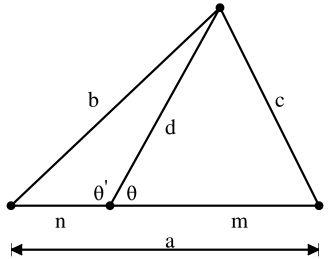
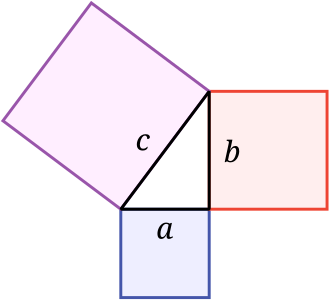
图:Krishnavedala · CC0 · Wikimedia Commons
- 类型
- 定理
- 命名来源
- 马修·斯图尔特
- 属于
- 数学定理列表
- 学科
- 数学
相关科学家
百科正文
在三角形 ABC 的边 BC 上任意取一点 P,则: PC AB²+PB AC²=(PB+PC)(PA²+PB PC)。
该定理由苏格兰数学家马修·斯图尔特在1746年发表。这个定理以他的名字命名,来纪念他的贡献。
证明
设 a 与 p 的交点为 P。对互补角 ∠ APB 和 ∠ APC 应用余弦定理,可得: b²=p²+y²-2pycos θ,
c²=p²+x²+2pxcos θ.
把第一个等式乘以x,把第二个等式乘以 y: xb²=xp²+xy²-2pxycos θ,
yc²=yp²+yx²+2pxycos θ.
两式相加,得: xb²+yc²=(x+y)p²+xy(x+y)=(x+y)(p²+xy),
证毕。
历史
据 Hutton & Gregory (1843,p.220) 所述,Stewart 于 1746 年发表这一结果,当时他正竞选爱丁堡大学数学教授之职。Coxeter & Greitzer (1967,p.6) 指出,这一定理可能在公元前300年左右就已经为阿基米德所知。他们接着说(错误地),第一个已知的证明是由 R. Simson 于 1751 年提供。Hutton & Gregory (1843 年) 指出,这一定理在 1748 年被 Simson 使用,1752 年被 Simpson 使用,并且它在欧洲的首次出现是由 Lazare Carnot 于1803 年给出。
以上内容摘自维基百科「斯图尔特定理」,按 CC BY-SA 4.0 使用,去掉了参考文献、外部链接等尾部小节,公式改写成了纯文本。全文、配图和出处见原文。
英文维基百科补充中文条目比较短,下面是英文条目「Stewart's theorem」的原文
In geometry, Stewart's theorem yields a relation between the lengths of the sides and the length of a cevian in a triangle. Its name is in honour of the Scottish mathematician Matthew Stewart, who published the theorem in 1746.
Statement
Let a, b, c be the lengths of the sides of a triangle. Let d be the length of a cevian to the side of length a. If the cevian divides the side of length a into two segments of length m and n, with m adjacent to c and n adjacent to b, then Stewart's theorem states that b²m+c²n=a(d²+mn).
A common mnemonic used by students to memorize this equation (after rearranging the terms) is: (公式略)
The theorem may be written more symmetrically using signed lengths of segments. That is, take the length AB to be positive or negative according to whether A is to the left or right of B in some fixed orientation of the line. In this formulation, the theorem states that if A, B, C are collinear points, and P is any point, then (PA²· BC)+(PB²· CA)+(PC²· AB)+(AB· BC· CA)=0.
In the special case where the cevian is a median (meaning it divides the opposite side into two segments of equal length), the result is known as Apollonius' theorem.
Proof
The theorem can be proved as an application of the law of cosines.
Let θ be the angle between m and d and θ' the angle between n and d. Then θ' is the supplement of θ, and so cos θ' = −cos θ. Applying the law of cosines in the two small triangles using angles θ and θ' produces (公式略)
Multiplying the first equation by n and the third equation by m and adding them eliminates cos θ. One obtains (公式略)
which is the required equation.
Alternatively, the theorem can be proved by drawing a perpendicular from the vertex of the triangle to the base and using the Pythagorean theorem to write the distances b, c, d in terms of the altitude. The left and right hand sides of the equation then reduce algebraically to the same expression.
History
According to Hutton & Gregory (1843, p. 220), Stewart published the result in 1746 when he was a candidate to replace Colin Maclaurin as Professor of Mathematics at the University of Edinburgh. Coxeter & Greitzer (1967, p. 6) state that the result was probably known to Archimedes around 300 B.C.E. They go on to say (mistakenly) that the first known proof was provided by R. Simson in 1751. Hutton & Gregory (1843) state that the result is used by Simson in 1748 and by Simpson in 1752, and its first appearance in Europe given by Lazare Carnot in 1803.
以上内容摘自英文维基百科「Stewart's theorem」,按 CC BY-SA 4.0 使用,去掉了参考文献、外部链接等尾部小节,公式改写成了纯文本。全文、配图和出处见原文。