格物
- 类型
- 物理定律
- 命名来源
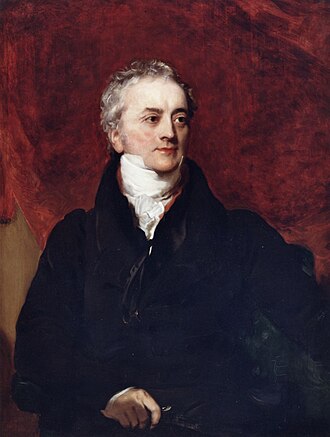
- 托马斯·杨、皮埃尔·西蒙·拉普拉斯
- 学科
- 物理学
相关科学家

百科正文
Δ Δ p:界面间的压力差、
γ:表面张力系数、 n:往界面外的单位法向量、 H:平均曲率、 R₁ 与 R₂:主要曲率半径
在此只考虑正向压力,因切线方向压力存在会导致界面的不稳定。
以上内容摘自维基百科「杨-拉普拉斯公式」,按 CC BY-SA 4.0 使用,去掉了参考文献、外部链接等尾部小节,公式改写成了纯文本。全文、配图和出处见原文。
英文维基百科补充中文条目比较短,下面是英文条目「Young–Laplace equation」的原文
In physics, the Young–Laplace equation is an equation that describes the capillary pressure difference sustained across the interface between two static fluids, such as water and air, due to the phenomenon of surface tension or wall tension acting against the curvature of the surface (although use of the latter is only applicable if assuming that the wall is very thin).
The Young–Laplace equation relates the pressure difference to the shape of the surface or wall and it is fundamentally important in the study of static capillary surfaces. It is a statement of normal stress balance for static fluids meeting at an interface, where the interface is treated as a surface (zero thickness): (公式略)
where Δ p is the Laplace pressure, the pressure difference across the fluid interface (the exterior pressure minus the interior pressure), γ is the surface tension (or wall tension), n is the unit normal pointing out of the surface, H_(f) is the mean curvature, and R₁ and R₂ are the principal radii of curvature. Note that only normal stress is considered, because a static interface is possible only in the absence of tangential stress.
The equation is named after Thomas Young, who developed the qualitative theory of surface tension in 1805, and Pierre-Simon Laplace who completed the mathematical description in the following year. It is sometimes also called the Young–Laplace–Gauss equation, as Carl Friedrich Gauss unified the work of Young and Laplace in 1830, deriving both the differential equation and boundary conditions using Johann Bernoulli's virtual work principles.
Soap films
If the pressure difference is zero, as in a soap film without gravity, the interface will assume the shape of a minimal surface.
Emulsions
The equation also explains the energy required to create an emulsion. To form the small, highly curved droplets of an emulsion, extra energy is required to overcome the large pressure that results from their small radius.
The Laplace pressure, which is greater for smaller droplets, causes the diffusion of molecules out of the smallest droplets in an emulsion and drives emulsion coarsening via Ostwald ripening.
Capillary pressure in a tube
In a sufficiently narrow (i.e., low Bond number) tube of circular cross-section (radius a), the interface between two fluids forms a meniscus that is a portion of the surface of a sphere with radius R. The pressure jump across this surface is related to the radius and the surface tension γ by Δ p=(2γ)/R.
This may be shown by writing the Young–Laplace equation in spherical form with a contact angle boundary condition and also a prescribed height boundary condition at, say, the bottom of the meniscus. The solution is a portion of a sphere, and the solution will exist only for the pressure difference shown above.
Capillary action and gravity
When including also the effects of gravity, for a free surface and for a pressure difference between the fluids equal to Δp at the level h=0, there is a balance, when the interface is in equilibrium, between Δp, the hydrostatic pressure and the effects of surface tension. The Young–Laplace equation becomes: (公式略)
Note that the mean curvature of the fluid-fluid interface now depends on h.
The equation can be non-dimensionalised in terms of its characteristic length-scale, the capillary length: L_(c)=√((γ)/(ρ g)),
and characteristic pressure (公式略)
For clean water at standard temperature and pressure, the capillary length is ~2 mm.
The non-dimensional equation then becomes: (公式略)
Application in medicine
In medicine it is often referred to as the Law of Laplace, used in the context of cardiovascular physiology, and also respiratory physiology, though the latter use is often erroneous.
History
Francis Hauksbee performed some of the earliest observations and experiments in 1709 and these were repeated in 1718 by James Jurin who observed that the height of fluid in a capillary column was a function only of the cross-sectional area at the surface, not of any other dimensions of the column.
Thomas Young laid the foundations of the equation in his 1804 paper An Essay on the Cohesion of Fluids where he set out in descriptive terms the principles governing contact between fluids (along with many other aspects of fluid behaviour). Pierre Simon Laplace followed this up in Mécanique Céleste with the formal mathematical description given above, which reproduced in symbolic terms the relationship described earlier by Young.
以上节选摘自英文维基百科「Young–Laplace equation」,按 CC BY-SA 4.0 使用,去掉了参考文献、外部链接等尾部小节,公式改写成了纯文本。篇幅所限,较长的小节只摘了开头一部分,有的小节没有收;全文、配图和出处见原文。