 格物
- 学名
- Hominini
- 分类等级
- 族
- 上级类群
- 人亚科
- 大类
- 哺乳动物
- 命名
- 约翰·爱德华·格雷,1825 年
下级类群(2)
百科正文
演化与分类
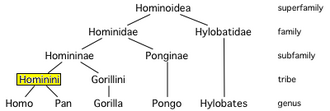
本族可分为两个亚族——人亚族与黑猩猩亚族。由于本族其他已灭绝的史前物种都归类于人亚族,因此黑猩猩属是黑猩猩亚族的唯一成员。根据DNA比对,人属与黑猩猩属经过了超过400万年的物种形成时间,大约于540万到630万年前分开演化。在现存物种之中,黑猩猩和倭黑猩猩与人类的演化关系最密切,三者的共同祖先大约生活在700万年前。美国科学家在1973年发现人与黑猩猩有99%DNA相似度。
史前属
- 傍人属 Paranthropus
- 南猿属 Australopithecus
- 沙赫人属 Sahelanthropus
- 千年人属 Orrorin
- 地猿属 Ardipithecus
- 肯尼亚人属 Kenyanthropus
- 希腊古猿属 Graecopithecus
以上内容摘自维基百科「人族」,按 CC BY-SA 4.0 使用,去掉了参考文献、外部链接等尾部小节,公式改写成了纯文本。全文、配图和出处见原文。
英文维基百科补充中文条目比较短,下面是英文条目「Hominini」的原文
The Hominini (hominins) form a taxonomic tribe of the subfamily Homininae (hominines). They comprise two extant genera: Homo (humans) and Pan (chimpanzees and bonobos), and in standard usage exclude the genus Gorilla (gorillas), which is grouped separately within the subfamily Homininae.
The term Hominini was originally introduced by Camille Arambourg (1948), who combined the categories of Hominina and Simiina pursuant to Gray's classifications (1825).
Traditionally, chimpanzees, gorillas and orangutans were grouped together, excluding humans, as pongids. Since Gray's classifications, evidence accumulating from genetic phylogeny confirmed that humans, chimpanzees, and gorillas are more closely related to each other than to the orangutan. The orangutans were reassigned to the family Hominidae (great apes), which already included humans; and the gorillas were grouped as a separate tribe (Gorillini) of the subfamily Homininae. Still, details of this reassignment remain contested, and of publishing since (on tribe Hominini), not every source excludes gorillas and not every source includes chimpanzees.
Humans are the only extant species in the Australopithecine branch (subtribe), which also contains many extinct close relatives of humans.
Terminology and definition
Concerning membership, when Hominini is taken to exclude Pan, Panini ("panins") may refer to the tribe containing Pan as its only genus. Or perhaps place Pan with other dryopithecine genera, making the whole tribe or subtribe of Panini or Panina together. Minority dissenting nomenclatures include Gorilla in Hominini and Pan in Homo (Goodman et al. 1998), or both Pan and Gorilla in Homo (Watson et al. 2001).
By convention, the adjectival term "hominin" (or nominalized "hominins") refers to the tribe Hominini, whereas the members of the subtribe Hominina (and thus all archaic human species) are referred to as "homininan" ("homininans"). This follows the proposal by Mann and Weiss (1996), which presents tribe Hominini as including both Pan and Homo, placed in separate subtribes. The genus Pan is referred to subtribe Panina, and genus Homo is included in the subtribe Hominina (see below).
The alternative convention uses "hominin" to exclude members of Panina: for Homo; or for human and australopithecine species. This alternative convention is referenced in e.g.
Cladogram
This cladogram shows the clade of superfamily Hominoidea and its descendant clades, focused on the division of Hominini (omitting detail on clades not ancestral to Hominini). The family Hominidae ("hominids") comprises the subfamily Ponginae (which includes orangutans) and the tribes Gorillini (including gorillas) and Hominini, the latter two forming the subfamily of Homininae. Hominini is divided into Panina (chimpanzees) and Australopithecina (australopithecines). The Hominina (humans) are usually held to have emerged within the Australopithecina (which would roughly correspond to the alternative definition of Hominini according to the alternative definition that excludes Pan).
Genetic analysis combined with fossil evidence indicates that hominoids diverged from the Old World monkeys about 25 million years ago (Mya), near the Oligocene-Miocene boundary. The most recent common ancestors (MRCA) of the subfamilies Homininae and Ponginae lived about 15 million years ago.
Evolutionary history
Both Sahelanthropus and Orrorin existed during the estimated duration of the ancestral chimpanzee–human speciation events, within the range of eight to four million years ago (Mya). Very few fossil specimens have been found that can be considered directly ancestral to genus Pan. News of the first fossil chimpanzee, found in Kenya, was published in 2005. However, it is dated to very recent times—between 545 and 284 thousand years ago. The divergence of a "proto-human" or "pre-human" lineage separate from Pan appears to have been a process of complex speciation-hybridization rather than a clean split, taking place over the period of anywhere between 13 Mya (close to the age of the tribe Hominini itself) and some 4 Mya. Different chromosomes appear to have split at different times, with broad-scale hybridization activity occurring between the two emerging lineages as late as the period 6.3 to 5.4 Mya, according to Patterson et al.
以上节选摘自英文维基百科「Hominini」,按 CC BY-SA 4.0 使用,去掉了参考文献、外部链接等尾部小节,公式改写成了纯文本。篇幅所限,较长的小节只摘了开头一部分,有的小节没有收;全文、配图和出处见原文。