 格物
图:作者不详 · Public domain · Wikimedia Commons
- 学名
- Homininae
- 分类等级
- 亚科
- 上级类群
- 人科
- 大类
- 哺乳动物
- 命名
- 约翰·爱德华·格雷,1825 年
- 数据库
- NCBI 分类
下级类群(4)
百科正文
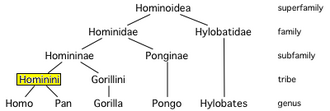
直至1980年前,人科都只有人类一种,而其他的都是属于猩猩科。但不同的发现迫使重新检讨这个分类,人科之下再分为猩猩亚科及人亚科。后来却发现大猩猩及黑猩猩较接近人类,故它们亦被包含在人亚科中。人猿总科的分类亦不断的有所改变。
人亚科可以再细分为大猩猩族及人族,大猩猩族就只有大猩猩,而人族则包含人类及黑猩猩。中新世晚期的纳卡里猿仲山种与同期的欧兰猿可能就是这个分支的基底成员,并不属于其下的两个族。人亚科估计在800万年前才开始分开演化。
以上内容摘自维基百科「人亞科」,按 CC BY-SA 4.0 使用,去掉了参考文献、外部链接等尾部小节,公式改写成了纯文本。全文、配图和出处见原文。
英文维基百科补充中文条目比较短,下面是英文条目「Homininae」的原文
The Homininae (; hominines) is a subfamily of the family Hominidae (hominids). The Homininae encompass humans, and are also called "African hominids" or "African apes". This subfamily includes two tribes, Hominini and Gorillini, both having extant species as well as extinct species.
Tribe Hominini includes: the extant genus Homo, which comprises only one extant species — modern human (Homo sapiens), and numerous extinct human species; and the extant genus Pan, which includes two extant species, chimpanzees and bonobos. Tribe Gorillini (gorillas) contains one extant genus, Gorilla, with two extant species, with variants, and one known extinct genus. Alternatively, the genus Pan is considered by some to belong, instead of to a subtribe Panina, to its own separate tribe, (so-called) "Panini," which would be a third tribe for Homininae.
Some classification schemes provide a more comprehensive account of extinct groups (see section "Taxonomic Classification" below). For example, tribe Hominini shows two subtribes: subtribe Hominina, which contains at least two extinct genera; and subtribe Panina, which presents only the extant genus, Pan (chimpanzees/bonobos), as fossils of extinct chimpanzees/bonobos are very rarely found.
The Homininae comprise all hominids that arose after the subfamily Ponginae (orangutans) split from the line of the great apes. The Homininae cladogram has three main branches leading to gorillas (via the tribe Gorillini), to humans, and to chimpanzees (via the tribe Hominini and subtribes Hominina and Panina, see graphic "Evolutionary tree" below). There are two living species each of Panina, chimpanzees and bonobos, and two living and one extinct species of gorillas. Traces of extinct Homo species, including Homo floresiensis, have been found with dates as recent as 40,000 years ago. Individual members of this subfamily are called hominine or hominines — not to be confused with the terms hominins or Hominini.
History of discoveries and classification
Until 1970, the family (and term) Hominidae meant humans only; the non-human great apes were assigned to the then-family Pongidae. Later discoveries led to revised classifications, with the great apes then united with humans (now in subfamily Homininae) as members of family Hominidae
By 1990, it was recognized that gorillas and chimpanzees are more closely related to humans than they are to orangutans, leading to their (gorillas' and chimpanzees') placement in subfamily Homininae as well.
The subfamily Homininae can be further subdivided into three branches, the tribe Gorillini (gorillas), the tribe Hominini with subtribes Panina (chimpanzees/bonobos) and Hominina (humans and their extinct relatives), and the extinct tribe Dryopithecini.
Taxonomic classification
- Homininae
- Tribe Dryopithecini† (?)
- Kenyapithecus (?)
- Kenyapitheus wickeri
- Ouranopithecus
- Ouranopithecus macedoniensis
- Otavipithecus
- Otavipithecus namibiensis
- Oreopithecus (?)
- Oreopithecus bambolii
- Nakalipithecus
- Nakalipithecus nakayamai
- Anoiapithecus
- Anoiapithecus brevirostris
- Dryopithecus
- Dryopithecus fontani
- Hispanopithecus (?)
- Hispanopithecus laietanus
- Hispanopithecus crusafonti
- Pierolapithecus
- Pierolapithecus catalaunicus
- Rudapithecus (?)
- Rudapithecus hungaricus
- Samburupithecus
- Samburupithecus kiptalami
- Danuvius
- Danuvius guggenmosi
- Tribe Gorillini
- Chororapithecus †
- Chororapithecus abyssinicus
- Genus Gorilla
- Western gorilla, Gorilla gorilla
- Western lowland gorilla, Gorilla gorilla gorilla
- Cross River gorilla, Gorilla gorilla diehli
- Eastern gorilla, Gorilla beringei
- Mountain gorilla, Gorilla beringei beringei
- Eastern lowland gorilla, Gorilla beringei graueri
Evolution
The age of the subfamily Homininae (of the Homininae–Ponginae last common ancestor) is estimated at some 14 to 12.5 million years (Sivapithecus).
Its separation into Gorillini and Hominini (the "gorilla–human last common ancestor", GHLCA) is estimated to have occurred at about 8 to 10 million years ago (TGHLCA) during the late Miocene, close to the age of Nakalipithecus nakayamai.
There is evidence there was interbreeding of Gorillas and the Pan–Homo ancestors until right up to the Pan–Homo split.
Evolution of bipedalism
Recent studies of Ardipithecus ramidus (4.4 million years old) and Orrorin tugenensis (6 million years old) suggest some degree of bipedalism. Australopithecus and early Paranthropus may have been bipedal. Very early hominins such as Ardipithecus ramidus may have possessed an arboreal type of bipedalism.
以上节选摘自英文维基百科「Homininae」,按 CC BY-SA 4.0 使用,去掉了参考文献、外部链接等尾部小节,公式改写成了纯文本。篇幅所限,较长的小节只摘了开头一部分,有的小节没有收;全文、配图和出处见原文。