 格物
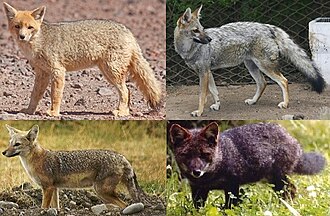
图:Culpeo_MC2.jpg: *Culpeo_MC.jpg: Christian Mehlführer, User:C… · CC BY-SA 3.0 · Wikimedia Commons
- 学名
- Lycalopex
- 分类等级
- 属
- 英文名
- South American foxes
- 上级类群
- 犬科
- 大类
- 哺乳动物
- 命名
- 赫尔曼·布尔迈斯特,1854 年
- 数据库
- NCBI 分类 · GBIF
下级类群(6)


百科正文
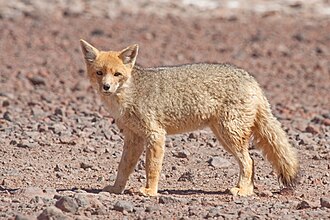
- 山狐(Lycalopex culpaeus)
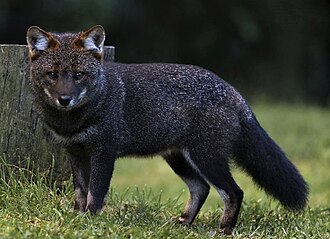
- 达尔文狐(Lycalopex fulvipes)
- 阿根廷狐(Lycalopex griseus)
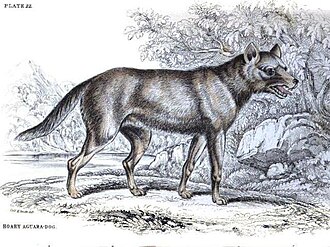
- 河狐(Lycalopex gymnocercus)
- 秘鲁狐(Lycalopex sechurae)
- 高地狐(Lycalopex vetulus)
- †南方伪狐 Lycalopex australis
种系发生学
伪狐属的系统发生学如下
以上内容摘自维基百科「伪狐属」,按 CC BY-SA 4.0 使用,去掉了参考文献、外部链接等尾部小节,公式改写成了纯文本。全文、配图和出处见原文。
英文维基百科补充中文条目比较短,下面是英文条目「South American fox」的原文
The South American foxes (Lycalopex), commonly called raposa in Portuguese, or zorro in Spanish, are a genus inhabiting South America. Despite their name, they are not true foxes, but are a unique canid genus more closely related to wolves and jackals than to true foxes; some of them resemble foxes due to convergent evolution. The South American gray fox, Lycalopex griseus, is the most common species, and is known for its large ears and a highly marketable, russet-fringed pelt.
The second-oldest known fossils belonging to the genus were discovered in Chile, and date from 2.0 to 2.5 million years ago, in the mid- to late Pliocene. The Vorohué Formation of Argentina has provided older fossils, dating to the Uquian to Ensenadan (Late Pliocene).
Names
The common English word "zorro" is a loan word from Spanish, with the word originally meaning "fox". Current usage lists Pseudalopex (literally: "false fox") as synonymous with Lycalopex ("wolf fox"), with the latter taking precedence. In 1895, Allen classified Pseudalopex as a subgenus of Canis, establishing the combination Canis (Pseudalopex), a name still used in the fossil record.
Species
Species currently included in this genus include:
In 1914, Oldfield Thomas established the genus Dusicyon, in which he included these zorros. They were later reclassified to Lycalopex (via Pseudalopex) by Langguth in 1975.
Phylogeny
The following phylogenetic tree shows the evolutionary relationships between the Lycalopex species, based on molecular analysis of mitochondrial DNA control region sequences by a study in 2016.
A 2005 study based on genome sequence and a comparative analysis and haplotype structure revealed the following cladogram of Lycalopex species.
Relationship with humans
The zorros are hunted in Argentina for their durable, soft pelts. They are also often labelled 'lamb-killers'.
In his diary of his well-known 1952 traveling with the young Che Guevara, Alberto Granado mentions talking with seasonal workers employed on vast sheep farms, who told him of a successful campaign by the ranch owners to exterminate the foxes who were preying on lambs. The ranchers offered a reward of one Argentinian peso for the body of a dead male fox and as much as five pesos for a female fox; to impoverished workers in the early 1950s, five pesos were a significant sum. Within a few years, foxes became virtually extinct in a large part of Argentina.
The Fuegian dog (Spanish: perro yagán, perro fueguino), also known as the Yaghan dog, was a domesticated form of the culpeo (Lycalopex culpaeus), unlike other domesticated canids which were dogs and silver foxes. This means different canid species have been domesticated multiple times by humans independently.
以上内容摘自英文维基百科「South American fox」,按 CC BY-SA 4.0 使用,去掉了参考文献、外部链接等尾部小节,公式改写成了纯文本。全文、配图和出处见原文。