格物
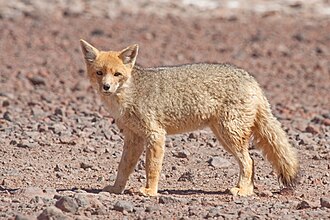
图:Christian Mehlführer, User:Chmehl · CC BY-SA 3.0 · Wikimedia Commons
- 学名
- Lycalopex culpaeus
- 分类等级
- 种
- 英文名
- Culpeo
- 上级类群
- 伪狐属
- 大类
- 哺乳动物
- 命名
- 胡安·伊格纳西奥·莫利纳,1782 年
- 保护状况(IUCN)
- 无危物种
- 数据库
- NCBI 分类 · GBIF · IUCN 红色名录
百科正文
山狐分布在厄瓜多尔及秘鲁至巴塔哥尼亚及火地群岛。在安地斯山脉以西最为普遍,栖息在开放辽阔的地区及落叶林。在福克兰群岛上也见到它们的踪影,可以由人类所引入。已灭绝的福克兰狼可能是其近亲。
山狐主要吃啮齿目、兔、鸟类及蜥蜴,有时也会吃植物及腐尸。它们有时会攻击羊,故会被猎杀或毒杀。在一些地区,它们的数量已很少,但整体却未受威胁。
山狐曾被塞尔克南人驯化成雅加犬(Fuegian dog),但它们在1880年至1919年间灭绝。
以上内容摘自维基百科「山狐」,按 CC BY-SA 4.0 使用,去掉了参考文献、外部链接等尾部小节,公式改写成了纯文本。全文、配图和出处见原文。
英文维基百科补充中文条目比较短,下面是英文条目「Culpeo」的原文
The culpeo (Lycalopex culpaeus), also known as Culpeo zorro, Andean zorro, Andean fox, Paramo wolf, Andean wolf, and colpeo fox, is a species of South American fox. Despite the name, it is not in the Vulpes, but more closely related to wolves and jackals. Its appearance resembles that of foxes due to convergent evolution.
The culpeo's diet consists largely of rodents, rabbits, birds and lizards, and to a lesser extent, plant material and carrion. They may prey on Andean flamingos and baby vicuña. The culpeo sometimes attacks farm animals, among them sheep, goats and poultry; for this, it is hunted in rural Chile and Argentina. In some regions, it has become rare, but overall the species is not threatened with extinction.
The culpeo was domesticated by the Selkʼnam people of Tierra del Fuego, producing the Fuegian dog which became extinct in the late 19th or early 20th century.
Description
The culpeo is a canid intermediate in size between a red fox and a coyote. It is the second-largest native canid on the continent after the maned wolf. In appearance, it bears many similarities to the widely recognized red fox. It has grey and reddish fur, a white chin, reddish legs and a stripe on its back that may be barely visible. The average weight of the male is 11.4 kg (25 lb), while the typically smaller females average 8.4 kg (19 lb). Overall, a weight range of 5 to 13.5 kg (11 to 30 lb) has been reported. Total length can range from 94 to 133 cm (37 to 52 in), including a tail of 32 to 44 cm (13 to 17 in) in length. The pelt has a grizzled appearance. The neck and shoulders are often tawny to rufous in color, while the upper back is dark. The bushy tail has a black tip.
Range
The culpeo's range extends from the southern regions of Patagonia and Tierra del Fuego in the south to Ecuador and Peru in the north, with some populations extending into southern Colombia. It is also found in the Sierras Grandes mountain range in Córdoba, Argentina. It is most common on the western slopes of the Andes, where it inhabits open country and deciduous forests.
Habitat
The culpeo lives in a wide variety of habitats of western South America. They are found in broadleaf Nothofagus temperate rainforest, sclerophyllous matorral, deserts, chaparrals, and plateaus, like the Altiplano, up to the tree line (4,800 metres (15,700 ft)).
Diet
The culpeo is an opportunistic predator that will take any variety of prey. It mainly feeds on rodents (including common degus) and lagomorphs (especially the introduced European rabbit and European hare); however, it occasionally feeds on domestic livestock and young guanacos. They will also feed on insects, birds, lizards, fruit, and carrion of llamas and vicuñas. Culpeos are considered beneficial because they are significant predators of the rabbits introduced in 1915; such introduced rabbit populations are believed to have allowed culpeos to spread from the Andean foothills across the Patagonian plain. They sometimes take young lambs up to 1 week old. In limited studies, the larger culpeo appears to dominate potential competitors, including South American gray foxes, Geoffroy's cats, pampas cats, grisons and various raptorial birds.
Reproduction
The typical mating period is between August and October. After a gestation period of 55–60 days, the female gives birth usually to between two and five pups.
Classification
Taxonomy
The taxonomy of the culpeo has been the topic of debate due to their high phenetic variability and the scarcity of research, among other things. Over the past three decades, they have been placed variably in the genera Dusicyon (Clutton-Brock, et al., 1976; Wozencraft, 1989), Canis (Langguth, 1975; Van Gelder, 1978), Pseudalopex (Berta, 1987; Wozencraft, 1993; Tedford et al., 1995) and Lycalopex (Zunino, 1995; Wozencraft, 2005).
This canid, like other South American foxes, is still sometimes classified as a member of the genus Pseudalopex. As Pseudalopex and Lycalopex have largely come to describe the same genus, either classification is acceptable, although the modern practice is to give Lycalopex prominence.
Domestication
The culpeo was domesticated by the Selkʼnam people of Tierra del Fuego, producing the Fuegian dog. They were used in hunting, fishing, and as a source of warmth in shelters. They became extinct in the late 19th or early 20th century as part of the Selknam genocide.
以上节选摘自英文维基百科「Culpeo」,按 CC BY-SA 4.0 使用,去掉了参考文献、外部链接等尾部小节,公式改写成了纯文本。篇幅所限,较长的小节只摘了开头一部分,有的小节没有收;全文、配图和出处见原文。