格物

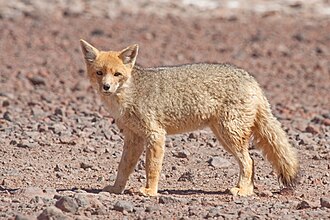
图:Antony King Photography · CC BY-SA 4.0 · Wikimedia Commons
- 学名
- Lycalopex griseus
- 分类等级
- 种
- 英文名
- South American gray fox
- 上级类群
- 伪狐属
- 大类
- 哺乳动物
- 命名
- 约翰·爱德华·格雷,1837 年
- 保护状况(IUCN)
- 无危物种
- 数据库
- NCBI 分类 · GBIF · IUCN 红色名录
百科正文
分布
生活在南美洲南部,阿根廷(大概有六万只阿根廷狐)、智利,也可能生活在秘鲁和大西洋岛屿,包括福克兰群岛。
身体特征
阿根廷狐是一种小型南美洲犬科动物,只有2.5–4千克重,43–70厘米长。
食物
以啮齿类动物、鸟类,和兔子为食。
繁殖
每年3月交配。母兽怀孕2个月, 每次生产2-4个幼崽。对于其他的繁殖行为了解并不多。
以上内容摘自维基百科「阿根廷狐」,按 CC BY-SA 4.0 使用,去掉了参考文献、外部链接等尾部小节,公式改写成了纯文本。全文、配图和出处见原文。
英文维基百科补充中文条目比较短,下面是英文条目「South American gray fox」的原文
The South American gray fox (Lycalopex griseus), also known as the Patagonian fox, the chilla or zorro gris (gray fox or gray zorro), is a South American species of Lycalopex (the "false" or lesser foxes) in the Canidae family, which includes dogs, wolves, jackals, coyotes and foxes, among other canids. It is endemic to the southern parts of Argentina and Chile, primarily Patagonia.
Description
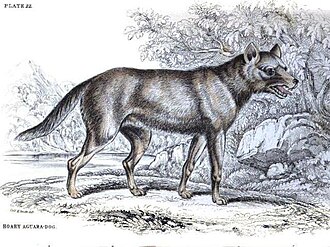
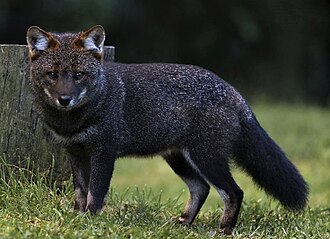
The South American gray fox is a small fox-like canid, weighing 2.5 to 5.45 kilograms (5.5 to 12.0 lb), and measuring 65 to 110 centimetres (26 to 43 in) in length including a tail of 20 to 43 cm (8 to 17 in). The head is reddish-brown flecked with white. The ears are large and there is a distinct black spot on the chin. The pelage is brindled, with agouti guard hairs and a short, dense, pale undercoat. The underparts are pale grey. The limbs are tawny and the thighs are crossed by a dark bar. The long, bushy tail has a dark dorsal stripe and dark tip with a paler, mottled underside.
The South American gray fox breeds in early austral autumn, around March. After a gestation period of two months, two to four kits are born in a den. Not much else is recorded about its lifestyle.
Range and habitat
The South American gray fox is found in Argentina and Chile in the Southern Cone of South America. Its range comprises stripes on both sides of the Andes mountain range between parallels 17ºS (northernmost Chile) and 54ºS (Tierra del Fuego).
In Argentina, this species inhabits the western semiarid region of the country, from the Andean spurs (ca. 69ºW) to meridian 66ºW. South from the Río Grande, the distribution of the fox widens reaching the Atlantic coast. In Chile, it is present throughout the country. Its presence in Peru has been mentioned; to date, however, there has been no confirmation of it. The South American gray fox was introduced to the Falkland Islands in the late 1920s early 1930s and is still present in quite large numbers on Beaver and Weddell Islands plus several smaller islands. It was also introduced to Tierra del Fuego in 1951 to control European rabbit populations. The South American gray fox occurs in a variety of habitats, from the warm, arid scrublands of the Argentine uplands and the cold, arid Patagonian steppe to the forests of southernmost Chile.
Diet
The diet varies in different parts of its range and at different times of year. It consists mainly of mammals, birds, arthropods, bird eggs, reptiles, fruit and carrion. The main prey items seem to be small mammals, especially rodents. Fruits eaten include Cryptocarya alba, Lithraea caustica and Prosopanche spp.
Phylogeny
The following phylogenetic tree shows the evolutionary relationships between the Lycalopex species, based on molecular analysis of mitochondrial DNA control region sequences by a study in 2016.
Interaction with environment
The South American gray fox is a largely solitary animal that has long been hunted for its pelt. The foxes sometimes go near human habitations in search of food, such as chickens and sheep, but tend to avoid areas visited by dogs. They are useful in their role as scavengers of carrion and as dispersers of the seeds of the fruit they eat.
Where their ranges overlap, the South American gray fox is in competition with the larger culpeo fox. The former consumes a greater proportion of rodents, and arthropods make a significant portion of its diet, while the culpeo tends to consume larger prey, including the non-native European hare which has been introduced into Chile. These prey animals are partitioned between these two species, with the gray fox being excluded from the best prey territories by the larger culpeo.
以上内容摘自英文维基百科「South American gray fox」,按 CC BY-SA 4.0 使用,去掉了参考文献、外部链接等尾部小节,公式改写成了纯文本。全文、配图和出处见原文。