格物

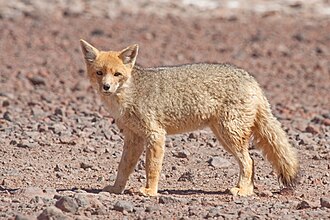
图:Frank Thomas Sautter · CC0 · Wikimedia Commons
- 学名
- Lycalopex gymnocercus
- 分类等级
- 种
- 上级类群
- 伪狐属
- 大类
- 哺乳动物
- 命名
- 戈特黑尔夫·菲舍尔·冯·瓦尔德海姆,1814 年
- 保护状况(IUCN)
- 无危物种
- 数据库
- NCBI 分类 · GBIF · IUCN 红色名录
百科正文
特征
河狐像山狐,但较为细小,毛色呈灰色,吻有黑色斑纹。它们的毛短而密,背部及腹部呈灰色。头部及颈部都是红色,耳朵呈三角形、阔而且大,外面红色,内面白色。在北部的河狐毛色较为鲜艳。
河狐重9-12磅。雄狐约较雌狐重10%。
分布及栖息地
河狐分布在阿根廷、乌拉圭、巴拉圭及巴西的南锥草原。它们喜欢栖息在草原、森林及河谷。
行为
河狐是独居的,只在繁殖季节及照顾幼狐时才会一起生活。若受到威胁,它们会装死直至威胁离去。它们主要是夜间活动的,在有人居住的地方有时日间也会活动。
河狐大部分时间栖息在草原追捕猎物。
繁殖
虽然河狐是独居的,有时也会一夫一妻制的生活。怀孕的母狐会躲在树底或丛林的巢穴中。妊娠期为55-60日,每胎会产3-5只幼狐。幼狐3个月大就会与父母一同狩猎。母狐照顾幼狐的时候,雄狐会带食物给它们。
食性
河狐主要吃植物、鸟类、啮齿目、果实、兔、青蛙及蜥蜴,有时也会吃小羊、腐尸、蛋及无脊椎动物。啮齿目、兔及鸟类占了它们的食物75%。它们是杂食性的,有时会袭击家畜。
威胁
河狐的主要威胁是人类狩猎其毛皮,亦会为了保护家畜而杀死它们。
以上内容摘自维基百科「河狐」,按 CC BY-SA 4.0 使用,去掉了参考文献、外部链接等尾部小节,公式改写成了纯文本。全文、配图和出处见原文。
英文维基百科补充中文条目比较短,下面是英文条目「Pampas fox」的原文
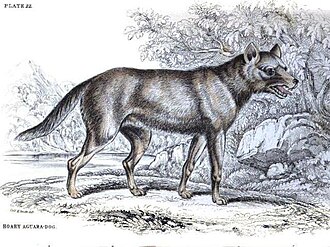
The Pampas fox (Lycalopex gymnocercus), also known as the grey pampean fox, Pampas zorro, Azara's fox, or Azara's zorro (in Guaraní also called aguará chaí, anglicized as aguarachay, in Portuguese also called graxaim ([ɡɾaʃaˈĩ]), is a medium-sized zorro, or "false" fox, native to the South American Pampas. Azara in some of its alternative common names is a reference to Spanish naturalist Félix de Azara. In the Spanish-speaking areas of its habitat, the Pampas fox is known by the common names of zorro de las pampas or zorro gris pampeano. In Portuguese-speaking Brazil, it is called by the common names of graxaim or sorro.
Description
The Pampas fox resembles the culpeo or Andean fox in appearance and size, but has a proportionately wider snout, reddish fur on the head and neck, and a black mark on the muzzle. Its short, dense fur is grey over most of the body, with a black line running down the back and onto the tail, and pale, almost white, underparts. The ears are triangular, broad, and relatively large, and are reddish on the outer surface and white on the inner surface. The inner surfaces of the legs are similar in color to the underparts, while the outer surface is reddish on the fore limbs, and grey on the hind limbs; the lower hind limb also bears a distinctive black spot.
Taxonomy
Five subspecies of L. gymnocercus are generally recognized as of 2005:
L. g. antiquus (Ameghino, 1889:298); Found in the Pampas grasslands, Monte shrublands and Espinal open woodlands of central Argentina, from Córdoba and San Luis Provinces to the Río Negro and the Atlantic coast.
L. g. domeykoanus (Philippi, 1901:168); Found in Copiapó Province, Chile.
L. g. gracilis (Burmeister, 1861:406); Found in the Pampas surrounding Mendoza, Argentina.
L. g. gymnocercus (Fischer, 1814:178); Found in the subtropical grasslands of northeastern Argentina, Uruguay, Paraguay, Bolivia and eastern Brazil.
L. g. maullinicus (Philippi, 1903:158); Found in Llanquihue Province, Chile, east of Llanquihue Lake
Distribution
The Pampas fox can be found primarily in northern and central Argentina, Uruguay, eastern Bolivia, Paraguay, and southern Brazil. It prefers open pampas habitats, often close to agricultural land, but can also be found in montane or chaco forest, dry scrubland, and wetland habitats. It is most common below 1,000 m (3,300 ft) elevation, but can inhabit puna grasslands up to 3,500 m (11,500 ft).
Behavior and diet
The Pampas foxes mostly live a solitary life, but come together as monogamous pairs in the breeding season to raise their young. They are mainly nocturnal, becoming active at dusk, although may also be active during the day. They den in any available cavity, including caves, hollow trees, and the burrows of viscachas or armadillos. Even when raising young together, adult foxes generally hunt alone, marking their territory by defecating at specific latrine sites. Although considerable variation is seen, the home range of a typical Pampas fox has been estimated to be around 260 hectares (640 acres).
Pampas foxes are more omnivorous than most other canids, and have a varied and opportunistic diet.
Reproduction
Pampas foxes breed in the early spring, with the female coming into heat just once each year. After a gestation period of 55 to 60 days, the mother gives birth to a litter of up to eight kits. The young are born between September and December, and are weaned around two months of age. Females reach sexual maturity in their first year, and animals have lived for up to 14 years in captivity.
Pups remain in dens until at least the age of 3 months, when they start hunting with parents. The males bring food to their females who stay at the den with kits.
Threats
The main threats to the Pampas fox comes from humans hunting them for their fur or to prevent them from attacking livestock; they may be affected by the loss of their natural habitat. However, because they remain common in most areas where they have been studied, the Pampas fox is not presently considered a threatened species.
Hybridisation with dog
Crossings between canids of different genera are extremely rare. In 2021, a female canid with unusual phenotypic characteristics was found in Vacaria, Rio Grande do Sul, Brazil. DNA analysis indicates that the canid was a hybrid between a Pampas fox and a domestic dog. Dubbed a 'Dogxim' or 'graxorra', this finding is the first documented case of hybridisation detected between these two species.
以上节选摘自英文维基百科「Pampas fox」,按 CC BY-SA 4.0 使用,去掉了参考文献、外部链接等尾部小节,公式改写成了纯文本。篇幅所限,较长的小节只摘了开头一部分,有的小节没有收;全文、配图和出处见原文。