格物
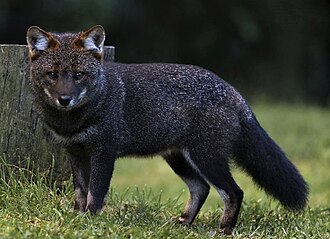
图:Parque Tepuhueico · CC BY-SA 4.0 · Wikimedia Commons
- 学名
- Lycalopex fulvipes
- 分类等级
- 种
- 英文名
- Darwin's fox
- 上级类群
- 伪狐属
- 大类
- 哺乳动物
- 命名
- William Charles Linnaeus Martin,1837 年
- 保护状况(IUCN)
- 濒危 (保育状况)
- 特有于
- 智利
- 数据库
- NCBI 分类 · GBIF · IUCN 红色名录
百科正文
身体结构
有黑色、灰色、白色的混合毛皮。腿部较短,体长约48-59厘米,体重约1.8-3.95公斤。
生活方式
他们在白天和夜晚都很活跃,除了繁殖季节以外,他们大多单独生活和狩猎,并且也没有领地意识。杂食性,主要生活在森林、灌木丛中。
以上内容摘自维基百科「达尔文狐」,按 CC BY-SA 4.0 使用,去掉了参考文献、外部链接等尾部小节,公式改写成了纯文本。全文、配图和出处见原文。
英文维基百科补充中文条目比较短,下面是英文条目「Darwin's fox」的原文
Darwin's fox or Darwin's zorro (Lycalopex fulvipes) is an endangered canid from the genus Lycalopex, which is distantly related to wolves and whose members are not true foxes. It is also known as the zorro chilote or zorro de Darwin in Spanish and is endemic to Chile, where it lives in the temperate rainforests of Nahuelbuta National Park, the Cordillera de Oncol, Cordillera Pelada, and Chiloé Island. It is a small, dark-colored species that is distinguished from other Lycalopex by its shorter legs, broader head, and darker pelage.
Darwin's fox was first collected from San Pedro Island off the coast of Chile by the naturalist Charles Darwin in 1834, after whom the species is named. It was long held that Darwin's fox was a subspecies of the South American gray fox (Lycalopex griseus); however, in 1990, a small population of Darwin's fox was discovered on the mainland in Nahuelbuta National Park and subsequent genetic analysis confirmed that the fox is a distinct species.
The species is thought to number under 1,000 mature individuals, with most found on Chiloé Island and smaller populations on the mainland. Once considered Critically Endangered, it was reclassified as Endangered in 2016. Its main threats come from domestic and feral dogs, which spread diseases and attack foxes, along with human disturbance and ongoing habitat loss from agriculture and forestry activity. Conservation efforts focus on managing disease risk through vaccination and establish protected area. Future conservation strategies may involve using genetic tools.
Description
Darwin's Fox is a small, dark canine weighing 1.8 to 3.95 kg (4.0 to 8.7 lb), has a head-and-body length of 48 to 59 cm (19 to 23 in) and a tail that is 17.5 to 25.5 cm (7 to 10 in). There are no major external differences between male and female apart from the broader muzzle observed in males.
The species is restricted to forest habitats and does not interbreed with the other Lycalopex species.
Taxonomy and evolution
Initial Discovery and Naming
Lycalopex is a South American genus of canine, which is distantly related to wolves and is technically not a fox. One of the first descriptions of Darwin’s fox came from Charles Darwin during a stop at San Pedro Island in Chiloé Archipelago during the Beagle survey expedition in December 1834. In his journal he wrote that he killed one with a geological hammer while it was watching his group conduct survey work.
Diet
Darwin's fox is an opportunistic omnivore and has a varied diet. In general, most of its diet is believed to come from insects, however, it also feeds on small mammals, birds, reptiles, fruits and seeds.
Scat analysis of Darwin's fox populations in Nahuelbuta National Park consisted mostly of mammals, including Akodon, Monito del monte, Southern big-eared mouse, and long-clawed mole mouse, although it also contained birds, reptiles, insects, arachnids, and plants.
Ecology
Habitat and Behaviour
Darwin's fox inhabits temperate rainforest ecosystems of southern Chile. The species occurs in distinct habitats from other Chilean canines, such as South American gray foxes and Culpeos. On Chiloé Island and the mainland, habitat use includes primary and second-growth forest and shrubland, with occasional use of coastal dune systems. In the Valdivian Coastal Range, the species has been recorded in old-growth and secondary evergreen forests as well as unmanaged eucalyptus plantations.
Conservation status
In 2016, the IUCN classified Darwin's fox as Endangered. Current estimates of the total population are low and protecting the species remains challenging due to multiple threats.
Protection against Domestic Dogs
One of the major threats is domestic dogs. In both mainland regions and Chiloé Island, attacks by domestic dogs have been documented as a source of mortality for Darwin’s foxes.
Diseases
Disease spread from rural, domestic dogs is considered a threat in Darwin's fox populations. Rural dogs often roam free in Chile and are not provided with any veterinary care. Interactions with these dogs is thought to lead to pathogen transmission.
以上节选摘自英文维基百科「Darwin's fox」,按 CC BY-SA 4.0 使用,去掉了参考文献、外部链接等尾部小节,公式改写成了纯文本。篇幅所限,较长的小节只摘了开头一部分,有的小节没有收;全文、配图和出处见原文。