格物
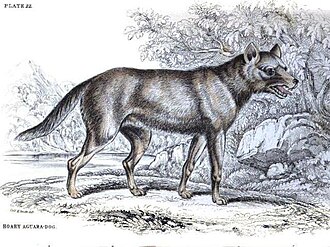
图:Charles Hamilton Smith · Public domain · Wikimedia Commons
- 学名
- Lycalopex vetulus
- 分类等级
- 种
- 英文名
- Hoary fox
- 上级类群
- 伪狐属
- 大类
- 哺乳动物
- 命名
- 彼得·威廉·隆德,1842 年
- 保护状况(IUCN)
- 近危物种
- 数据库
- NCBI 分类 · GBIF · IUCN 红色名录
百科正文
形态描述
高地狐的嘴巴较短、牙齿小、毛髪较短、四肢纤细。其身体的上半部分呈灰色,下侧则是奶油色或黄褐色。高地狐尾巴的尖端呈黑色,尾上方有明显的深色条纹,雄性个体的条纹可能从背部一直延伸至颈部。它们的耳朵和腿外侧为红色或黄褐色,下颚黑色。据报道,还有一些高地狐的黑化物种。
高地狐体型较小,体重只有3至4千克(6.6至8.8磅),头部加身体的总长度为58至72厘米(23至28英寸),尾长25至36厘米。得益于小巧纤细的体型,高地狐可快速而敏捷地奔跑。但因其牙齿相对脆弱,所以只适应以体型较小的无脊椎动物为食。
行为和饮食
高地狐是夜行性动物,繁殖季节之外主要独居生活。它们主要以昆虫为食,特别是白蚁、蜣螂和蝗虫,但偶尔也捕食啮齿动物、小鸟,或取食水果。个体活动范围因环境不同有很大差异,据研究记录:在巴伊亚州南部,平均每385公顷(950英亩)生活有一只雌性高地狐,而在米纳斯吉拉斯州牧场上,平均每456公顷(950英亩)有一个由成年繁殖对和5只幼崽组成的群体,在马托格罗索州东部牧场则每48公顷(120英亩)有2个繁殖对。
分布范围
高地狐原产于巴西中南部,但在该国北部亦记录了一些目击事件,在阿根廷曾发掘出更新世时期的化石。高地狐主要生活在海拔90至1100米(300至3,610英尺)之间的塞拉多地区,该处的开阔林地、灌木丛和草原为其提供了理想的栖息场所。目前暂未发现高地狐的亚种。
繁殖
雌性高地狐妊娠期约50天,通常在8月至9月生下两到四只幼崽,雄性和雌性幼崽的比例相等。雌性高地狐通常会准备一个巢穴用于分娩,但有时亦借用其他动物的洞穴。幼崽通常与4个月左右断奶,由雌雄双方共同扶养。
以上内容摘自维基百科「高地狐」,按 CC BY-SA 4.0 使用,去掉了参考文献、外部链接等尾部小节,公式改写成了纯文本。全文、配图和出处见原文。
英文维基百科补充中文条目比较短,下面是英文条目「Hoary fox」的原文
The hoary fox or hoary zorro (Lycalopex vetulus), also known as raposinha-do-campo in Brazil (Portuguese for "little fox of the meadow"), is a species of zorro or "false" fox endemic to Brazil. Unlike many other foxes, it feeds primarily on small invertebrates such as insects.
Description
The hoary fox has a short muzzle, small teeth, a short coat, and slender limbs. The upper part of the body is grey, and the underside of the body is cream or fawn. The tail is black on the tip with a marked dark stripe along the upper surface, which in male animals may extend all the way along the back to the nape of the neck. The ears and outside part of the legs are reddish or tawny, and the lower jaw is black. Some melanistic individuals have also been reported.
It is small for a fox, weighing only 3 to 4 kg (6.6 to 8.8 lb), with a head and body length of 58 to 72 cm (23 to 28 in), and a tail 25 to 36 cm (9.8 to 14.2 in). Together with its slender form, the small size of the hoary fox makes it an agile and fast-running animal, while its relatively weak teeth adapt it to feeding on invertebrates, rather than larger prey.
The following phylogenetic tree shows the evolutionary relationships between the Lycalopex species, based on molecular analysis of mitochondrial DNA control region sequences by a study in 2016.
Behaviour and diet
Hoary foxes are nocturnal, and largely solitary outside of the breeding season. They mainly eat insects, especially termites, dung beetles, and grasshoppers, but also may eat rodents, small birds, and fruit. Individuals have widely varying home ranges, depending on the local environment and reported examples are as follows: 385 ha (950 acres) for 1 adult female in southern Bahia, 456 ha (1,130 acres) for a group consisting of an adult breeding pair and 5 juvenile offspring in a pasture of Minas Gerais, and 48 ha (120 acres) for 2 breeding pairs out of 3 study groups from pastures in eastern Mato Grosso.
Range
The hoary fox is endemic to Brazil and its geographic distribution is associated with the limits of the Cerrado ecosystem, in an altitude range of 90–1,100 m. However, it can also be found in transition zones, including open habitats in the Pantanal. The occurrence of the hoary fox in areas of the Atlantic Forest is in a matrix of anthropogenic pastures, regionally interspersed by remnants of semideciduous forest and small patches of Cerrado.
The current extension extends from the northeast and west of São Paulo to the north of Piauí, passing through the states of Ceará, Mato Grosso do Sul, Mato Grosso, Goiás, Distrito Federal, Minas Gerais, Tocantins, Bahia and probably open regions in the south of the states of Rondônia.
Reproduction
Females usually give birth to two to four pups in August to September, after a gestation period around 50 days. The sex ratio of the pups is equal between males and females. The female prepares a den in which to give birth, sometimes using the burrows of other animals. Weaning occurs around 4 months of age. Both parents participate in rearing of the pups.
以上内容摘自英文维基百科「Hoary fox」,按 CC BY-SA 4.0 使用,去掉了参考文献、外部链接等尾部小节,公式改写成了纯文本。全文、配图和出处见原文。