格物
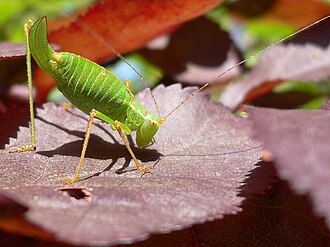
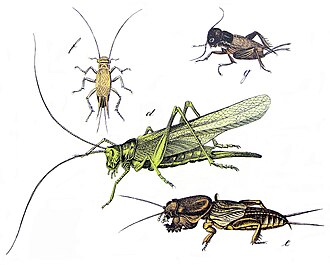
图:Georg Slickers · CC BY-SA 4.0 · Wikimedia Commons
- 学名
- Orthoptera
- 分类等级
- 目
- 上级类群
- 多新翅类
- 大类
- 昆虫
- 命名
- 纪尧姆-安托万·奥利维耶,1789 年
- 数据库
- NCBI 分类 · GBIF
分类阶元
- 域真核生物
- 未标等级无定形生物 Amorphea
- 演化支后鞭毛生物 Opisthokonta
- 总界动物总界 Holozoa
- 未标等级蜷丝生物 Filozoa
- 未标等级领鞭毛动物 Choanozoa
- 界动物界 Animalia
- 亚界真后生动物亚界 Eumetazoa
- 未标等级副同源异形基因动物 Parahoxozoa
- 亚界两侧对称动物 Bilateria
- 下界原口动物 Protostomia
- 总门蜕皮动物总门 Ecdysozoa
- 门节肢动物门 Arthropoda
- 未标等级有颚类 Mandibulata
- 未标等级泛甲壳类 Pancrustacea
- 亚门六足亚门 Hexapoda
- 纲昆虫纲 Insecta
- 未标等级双髁类 Dicondylia
- 亚纲有翅亚纲 Pterygota
- 未标等级伴翅类 Metapterygota
- 下纲新翅下纲 Neoptera
- 未标等级多新翅类 Polyneoptera
- 目直翅目 Orthoptera
下级类群(2)

百科正文
分类
全世界已知有效种为3万多种,分隶64科3500属。中国已知800余种,分隶28科。
剑尾亚目 Ensifera
又名长角亚目,中文同名于另一双翅目下亚目
蟋蟀总科 Grylloidea
- 蟋蟀科 Gryllidae
- 蝼蛄科 Gryllotalpidae
- 癞蟋科 Mogoplistidae
- 蚁蟋科 Myrmecophilidae
驼螽总科 Rhaphidophoroidea
驼螽科(灶马) Rhaphidophoridae
螽蟴下目 Tettigonioidea
- 螽蟴总科 Tettigonioidea
- 硕螽科 Bradyporidae
- Haglidae
- 露螽科 Phaneropteridae
- 螽蟴科 Tettigoniidae
- 沙螽总科 Stenopelmatoidea
- 丑螽科 Anostostomatidae Saussure, 1859
- 怪螽科 Cooloolidae Rentz, 1980
- 蟋螽科 Gryllacrididae Blanchard, 1845
- 沙螽科 Stenopelmatidae Burmeister, 1838
裂趾蟋总科 Schizodactyloidea
裂趾蟋科 Schizodactylidae
锥尾亚目 Caelifera
Acrididea
Acridomorpha
短角蝗总科(蜢总科) Eumastacoidea
短角蝗科(蜢科)Eumastacidae
锥头蝗科 Pyrgomorphidae
瘤锥蝗科 Chrotogonidae
蝗总科 Acridoidea
- 蝗科 Acrididae
- 网翅蝗科 Arcypteridae
- 斑腿蝗科 Catantopidae
- 沙蝗科 Lathiceridae
- 小蝻蝗科 Lentulidae
- 癞蝗科 Pamphagidae
- Charilaidae
- 枝蝗科 Proscopiidae
蚱总科(菱蝗总科) Tetrigoidea
股沟蚱科 Batrachididae
蚱科(菱蝗科)Tetrigidae
蚤蝼总科 Tridactyloidea
- 短足蝼科 Cylindrachetidae
- 泽蚤蝼科 Rhipipterygidae
- 蚤蝼科 Tridactylidae
以上内容摘自维基百科「直翅目」,按 CC BY-SA 4.0 使用,去掉了参考文献、外部链接等尾部小节,公式改写成了纯文本。全文、配图和出处见原文。
英文维基百科补充中文条目比较短,下面是英文条目「Orthoptera」的原文
Orthoptera (from Ancient Greek ὀρθός (orthós) 'straight' and πτερά (pterá) 'wings') is an order of insects that comprises the grasshoppers, locusts, and crickets, including closely related insects, such as the bush crickets or katydids and wētā. The order is subdivided into two suborders: Caelifera – grasshoppers, locusts, and close relatives; and Ensifera – crickets and close relatives.
More than 20,000 species are distributed worldwide. The insects in the order have incomplete metamorphosis, and produce sound (known as a "stridulation") by rubbing their wings against each other or their legs, the wings or legs containing rows of corrugated bumps. The tympanum, or ear, is located in the front tibia in crickets, mole crickets, and bush crickets or katydids, and on the first abdominal segment in the grasshoppers and locusts. These organisms use vibrations to locate other individuals.
Grasshoppers and other orthopterans are able to fold their wings (i.e. they are members of Neoptera).
Etymology
The name is derived from the Greek ὀρθός orthos meaning "straight" and πτερόν pteron meaning "wing".
Characteristics
Orthopterans have a generally cylindrical body, with elongated hindlegs and musculature adapted for jumping. They have mandibulate mouthparts for biting and chewing and large compound eyes, and may or may not have ocelli, depending on the species. The antennae have multiple joints and filiform type, and are of variable length.
The first and third segments on the thorax are larger, while the second segment is much smaller. They have two pairs of wings, which are held overlapping the abdomen at rest. The forewings, or tegmina, are narrower than the hindwings and hardened at the base, while the hindwings are membranous, with straight veins and numerous cross-veins. At rest, the hindwings are held folded fan-like under the forewings. The final two to three segments of the abdomen are reduced, and have single-segmented cerci.
Life cycle
Orthopterans have a paurometabolous lifecycle or incomplete metamorphosis. The use of sound is generally crucial in courtship, and most species have distinct songs. Most grasshoppers lay their eggs in the ground or on vegetation. The eggs hatch and the young nymphs resemble adults, but lack wings and at this stage are often called 'hoppers'. They may often also have a radically different coloration from the adults. Through successive moults, the nymphs develop wings until their final moult into a mature adult with fully developed wings.
The number of moults varies between species; growth is also very variable and may take a few weeks to some months depending on food availability and weather conditions.
Evolution
This order evolved 300 million years ago with a division into two suborders – Caelifera and Ensifera – occurring 256 million years ago.
Phylogeny
The Orthoptera are divided into two suborders, Caelifera and Ensifera, that have been shown to be monophyletic. A recent comprehensive phylogeny based on analyses of data from transcriptomes and mitochondrial genomes found the following relationships within Orthoptera.
Notes
Taxonomy
Taxonomists classify members of the Caelifera and Ensifera into infraorders and superfamilies as follows:
- Suborder Caelifera – grasshoppers, pygmy mole crickets and allies
- Infraorder Acrididea
- Superfamily Acridoidea – grasshoppers, locusts
- Superfamily Eumastacoidea – monkey or matchstick grasshoppers and allies
- Superfamily Locustopsoidea†
- Superfamily Pneumoroidea – bladder grasshoppers
- Superfamily Pyrgomorphoidea – gaudy grasshoppers
- Superfamily Tanaoceroidea – desert long-horned grasshoppers
Relationships with humans
As pests
Several species of Orthoptera are considered pests of crops and rangelands or seeking warmth in homes by humans. The two groups of Orthoptera that cause the most damage are grasshoppers and locusts. Locusts are historically known for wiping out fields of crops in a day. Locusts have the ability to eat up to their own body weight in a single day. Individuals gather in large groups called swarms, consisting of up to 80 million individuals and spanning as much as 460 square miles. Grasshoppers can cause major agricultural damage but not to the documented extent as locusts historically have. These insects mainly feed on weeds and grasses, however, during times of drought and high population density they will feed on crops. They are a known pest in soybean fields and will likely feed on these crops once preferred food sources have become scarce.
以上节选摘自英文维基百科「Orthoptera」,按 CC BY-SA 4.0 使用,去掉了参考文献、外部链接等尾部小节,公式改写成了纯文本。篇幅所限,较长的小节只摘了开头一部分,有的小节没有收;全文、配图和出处见原文。