 格物
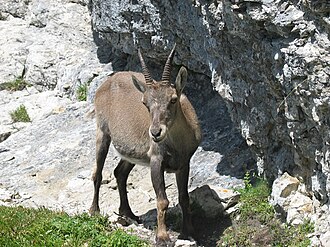
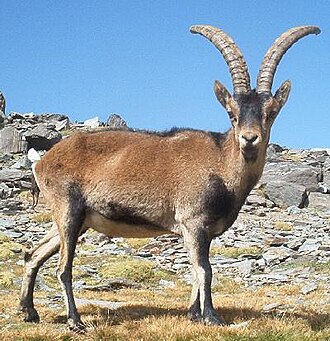
图:No machine-readable author provided. Julio~commonswiki assum… · CC BY-SA 2.5 · Wikimedia Commons
生命之树 › 真核生物 › 动物界 › 真后生动物亚界 › 两侧对称动物 › 后口动物总门 › 脊索动物门 › 脊椎动物亚门 › 有颌下门 › 肉鳍鱼总纲 › 四足形类 › 希望螈目 › 四足总纲 › 哺乳动物 › 兽型类 › 全兽类 › 兽亚纲 › 有胎盘类 › 北方真兽高目 › 劳亚兽总目 › 偶蹄目 › 牛科 › 羊亚科 › 羊族
山羊属属
Capra
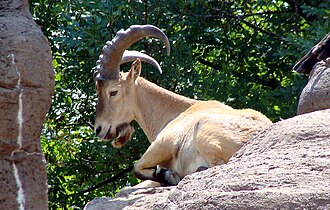
山羊属(学名Capra),是牛科动物的一个属,共有7种:野山羊、高加索羱羊、东高加索羱羊、捻角山羊、西敏羱羊、羱羊、西班牙羱羊。平时被称为“山羊”的动物实际上是家畜山羊,即野山羊的家畜亚种。山羊与牛和羚羊有亲属关系,在亚欧内陆和非洲有较广分布。
摘自维基百科「山羊屬」,CC BY-SA 4.0
- 学名
- Capra
- 分类等级
- 属
- 上级类群
- 羊族
- 大类
- 哺乳动物
- 命名
- 卡尔·林奈,1758 年
- 数据库
- NCBI 分类 · GBIF
下级类群(9)




百科正文
在英语中,雄性山羊被称为"buck"或"billy",雌性被称为"doe"或"nanny",山羊幼仔则被称为"kids"。
洛矶山羊尽管叫做“山羊”,但是一般不被科学家认为是山羊,因为它属于雪羊属。
种和亚种
- 野山羊 Capra aegagrus
- 家山羊 Capra aegagrus hircus
- 长角山羊 Capra aegagrus creticus
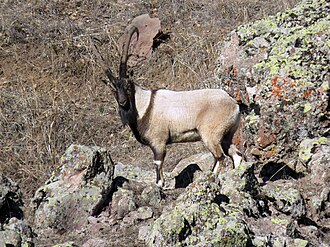
- 西高加索羱羊 Capra caucasia
- 东高加索羱羊 Capra cylindricornis
- 捻角山羊 Capra falconeri
- 布哈拉捻角山羊 Capra falconeri heptneri
- 普通捻角山羊 Capra falconeri chialtanensis
- 阿富汗捻角山羊 Capra falconeri megaceros
- 苏利曼捻角山羊 Capra falconeri jerdoni
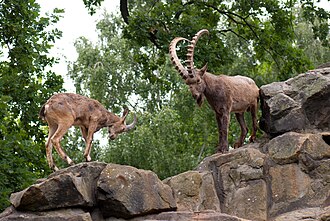
- 羱羊 Capra ibex
- 普通羱羊 Capra ibex ibex
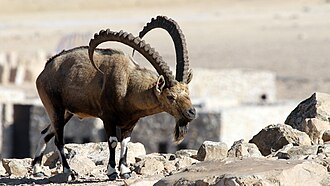
- 努比亚羱羊 Capra ibex nubiana¹
- 西伯利亚羱羊 Capra ibex sibirica²
- 西班牙羱羊 Capra pyrenaica
- 普通西班牙羱羊 Capra pyrenaica pyrenaica†
- 葡萄牙羱羊 Capra pyrenaica lusitanica†
- 西敏羱羊 Capra walie
- ¹ 也作Capra nubiana
- ² 也作Capra sibirica
家养和使用
参见:家山羊
以上内容摘自维基百科「山羊屬」,按 CC BY-SA 4.0 使用,去掉了参考文献、外部链接等尾部小节,公式改写成了纯文本。全文、配图和出处见原文。
英文维基百科补充中文条目比较短,下面是英文条目「Capra (genus)」的原文
Capra is a genus of mammals, the goats, comprising ten species, including the markhor and several species known as ibexes. The domestic goat (Capra hircus) is a domesticated species derived from the bezoar ibex (Capra aegagrus aegagrus), a subspecies of the wild goat. It is one of the oldest domesticated species of animal—according to archaeological evidence its earliest domestication occurred in Iran at 10,000 calibrated calendar years ago.
Wild goats are animals of mountain habitats. They are very agile and hardy, able to climb on bare rock and survive on sparse vegetation. They can be distinguished from the genus Ovis, which includes sheep, by the presence of scent glands close to the feet, in the groin, and in front of the eyes, and the absence of other facial glands, and by the presence of a beard in some specimens, and of hairless calluses on the knees of the forelegs.
Taxonomy
All members of the genus Capra are bovids (members of the family Bovidae), and more specifically caprines (subfamily Caprinae). As such they are ruminants, meaning they chew the cud, and have four-chambered stomachs which play a vital role in digesting, regurgitating, and redigesting their food.
The genus has sometimes been taken to include Ovis (sheep) and Ammotragus (Barbary sheep), but these are usually regarded as distinct genera, leaving Capra for ibexes. In this smaller genus, some authors have recognized only two species, the markhor on one side and all other forms included in one species on the other side. Today, nine wild species are usually accepted along with the domestic goat:
- West Asian ibex also known as the wild goat (Capra aegagrus)
- Bezoar ibex (Capra aegagrus aegagrus)
- Sindh ibex (Capra aegagrus blythi)
Domestic goat (Capra hircus; includes feral goat; domesticated from C. aegagrus and sometimes considered a subspecies of it)
- Asian ibex also known as the Siberian ibex (Capra sibirica)
- Markhor (Capra falconeri)
- West Caucasian tur (Capra caucasica)
- East Caucasian tur (Capra cylindricornis)
- Alpine ibex (Capra ibex)
- Iberian ibex also known as the Spanish ibex (Capra pyrenaica)
- Nubian ibex (Capra nubiana)
- Walia ibex (Capra walie)
The goats of the genus Capra have complex systematic relationships, which are still not completely resolved. Recent studies based on mitochondrial DNA suggest that the Asian ibex and the Nubian ibex represent distinct species, which are not very closely related to the physically similar Alpine ibex. The Alpine ibex forms a group with the Iberian ibex. The West Caucasian tur appears to be more closely related to the wild goat than to the East Caucasian tur. The markhor is relatively little separated from other forms—previously it had been considered to be a separate branch of the genus.
The following cladogram of seven Capra species is based on 2022 mitochondrial evidence:
Almost all wild goat species are allopatric (geographically separated)—the only geographical overlaps are the wild goat (Capra aegagrus) with the East Caucasian tur (Capra cylindricornis), and the markhor (Capra falconeri) with the Asian ibex (Capra sibirica). In both cases, the overlapping species do not usually interbreed in the wild, but in captivity, all Capra species can interbreed, producing fertile offspring.
Domestication and uses
Along with sheep, goats were among the first domesticated animals. The domestication process started at least 10,000 years ago in what is now northern Iran. Easy human access to goat hair, meat, and milk were the primary motivations. Goat skins were popularly used until the Middle Ages for water and wine bottles when traveling and camping, and in certain regions as parchment for writing.
以上内容摘自英文维基百科「Capra (genus)」,按 CC BY-SA 4.0 使用,去掉了参考文献、外部链接等尾部小节,公式改写成了纯文本。全文、配图和出处见原文。