格物
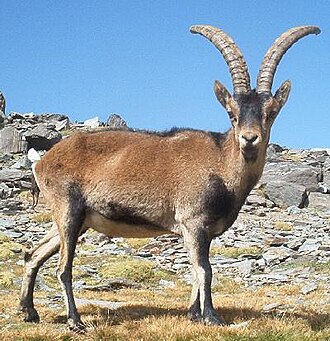
图:José M. Gómez · CC BY-SA 3.0 · Wikimedia Commons
生命之树 › 真核生物 › 动物界 › 真后生动物亚界 › 两侧对称动物 › 后口动物总门 › 脊索动物门 › 脊椎动物亚门 › 有颌下门 › 肉鳍鱼总纲 › 四足形类 › 希望螈目 › 四足总纲 › 哺乳动物 › 兽型类 › 全兽类 › 兽亚纲 › 有胎盘类 › 北方真兽高目 › 劳亚兽总目 › 偶蹄目 › 牛科 › 羊亚科 › 羊族 › 山羊属
西班牙北山羊种
Capra pyrenaica
西班牙羱羊 又称伊比利亚北山羊,是山羊属的一个物种,下有4个亚种。其中有两种仍可在伊比利亚半岛发现。其余的两种已经灭绝:波图格萨北山羊于1892年灭绝,比利牛斯羱羊于2000年1月6日确认灭绝。
摘自维基百科「西班牙羱羊」,CC BY-SA 4.0
- 学名
- Capra pyrenaica
- 分类等级
- 种
- 上级类群
- 山羊属
- 大类
- 哺乳动物
- 命名
- 海因里希·鲁道夫·辛茨,1838 年
- 保护状况(IUCN)
- 无危物种
- 特有于
- 伊比利亚半岛
- 数据库
- NCBI 分类 · GBIF · IUCN 红色名录
百科正文
特征
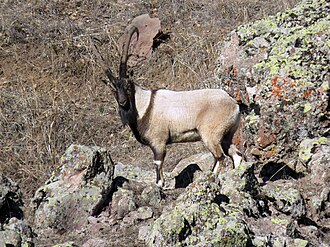
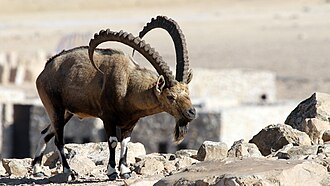
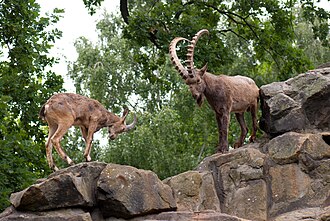
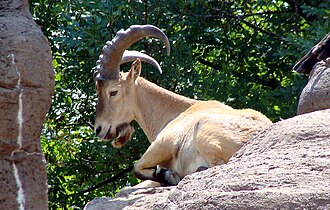
西班牙羱羊是一种强壮的山区动物,其特点为它们的大且灵活的蹄子和短腿。这些身体特点使它们可以在裸露的岩石、粗糙陡峭的山坡上上奔跑跳跃。这样潜在捕食者由于地形原因很难够到它们。西班牙羱羊两性异形现象非常明显,雄性在大小和重量上明显超过雌性,且比雌性有更大的角。西班牙羱羊的角差别很大,不同亚种之间有区别,有的朝上,有的朝下。每年角的生长主要跟年龄相关,同时也与环境和去年的生长状态相关。尽管雌性个头较小,但是骨化过程比雄性快,通常骨骼完整发育比雄性早两年。
以上内容摘自维基百科「西班牙羱羊」,按 CC BY-SA 4.0 使用,去掉了参考文献、外部链接等尾部小节,公式改写成了纯文本。全文、配图和出处见原文。
英文维基百科补充中文条目比较短,下面是英文条目「Iberian ibex」的原文
The Iberian ibex (Capra pyrenaica), also known as the Spanish ibex, Spanish wild goat and Iberian wild goat, is a species of ibex endemic to the Iberian Peninsula. Four subspecies have been described; two are now extinct. The Portuguese ibex became extinct in 1892, and the Pyrenean ibex became extinct in 2000 and in 2003. A project to clone the Pyrenean ibex resulted in one clone being born alive in July 2003, making it the first taxon to become "un-extinct", although the clone died a few minutes after birth due to physical defects in its left lung.
Subspecies
- Southeastern Iberian ibex or Beceite ibex – Capra pyrenaica hispanica Schimper, 1848
- Western Iberian ibex or Gredos ibex – C. p. victoriae Cabrera, 1911
- Portuguese ibex – C. p. lusitanica Schlegel, 1872 (extinct)
- Pyrenean ibex – C. p. pyrenaica Schinz, 1838 (extinct)
Characteristics
The Iberian ibex is characterized by its large and flexible hooves and short legs. These physical adaptations allow it to run and leap on bare, rocky, rough and steep slopes out of reach of potential predators. The horns of the Iberian ibex curve out and up and then back, inward, and, depending on subspecies, either up again or down. The annual horn growth is influenced principally by age but can also be contributed by environmental factors and the growth made in the previous year. The Iberian ibex also shows sexual dimorphism, with the male being larger in size and weight and also having larger horns than the female. The bones of the female ibex ossify nearly two years before the bones of the male.
Distribution and habitat
The Iberian ibex populates the Iberian Peninsula and consisted originally of four subspecies. However, with recent extinctions occurring within the last century, only two of the subspecies still exist. Both occur in Spain and in northern Portugal, as well a small reintroduced population in the French Pyrenees. It has been extirpated from Gibraltar and possibly Andorra.
Behaviour and ecology
Diet
The Iberian ibex is generally a mixed feeder between a browser and a grazer, depending on the plant availability in their home range. Thus, the percentage of each type of resource that is consumed will vary altitudinally, geographically, and seasonally. The ibex also has a special mechanism in the kidney that stores fat in order to be used as energy during the cold winter times. The highest body storage of kidney fat can be found during the productive warm seasons and the lowest during the cold period. The body storage is characterized by the limited food resources. Foraging in ibexes is also different depending on the season. When food resources are low during the winter, ibexes would reduce their rates of movement when foraging. However, during the spring season, when food is more available, they would increase their rate of movement and become more mobile in finding food. This would be the ideal trend of movement since the spring season is more abundant in food resources meaning that there is more competition for food resources forcing some to trek farther in order to obtain food.
Reproduction and life cycle
Iberian ibex establish two types of social groups: male-only groups and females with young juvenile groups. It is during rutting season (November/December) that the males interact with the females in order to reproduce.
Conservation
The populations of Capra pyrenaica have decreased significantly over the last centuries. This is probably due to a combination of contributing factors such as hunting pressure, agricultural development and habitat deterioration. Around 1890, one of its subspecies, C. pyrenaica lusitanica, also known as the Portuguese ibex, became extinct from its range in the Portuguese Serra do Gerês and Galicia. By the mid-nineteenth century, another of the four subspecies, the Pyrenean ibex, had lost most of its range. It finally became extinct in January 2000, when the last adult female died in the Ordesa National Park. There are also a number of threats to the future preservation of the Iberian ibex such as population overabundance, disease, and potential competition with domestic livestock and other ungulates, along with the negative effects of human disturbance through tourism and hunting.
Recently ibexes from southern Spain have become exposed to disease outbreaks such as sarcoptic mange, the animal version of human scabies. This disease, potentially fatal for infected individuals, unequally affects males and females and it limits the reproductive investment of individuals. The disease has become the main destabilizing factor in many populations of Iberian ibex.
以上节选摘自英文维基百科「Iberian ibex」,按 CC BY-SA 4.0 使用,去掉了参考文献、外部链接等尾部小节,公式改写成了纯文本。篇幅所限,较长的小节只摘了开头一部分,有的小节没有收;全文、配图和出处见原文。