格物
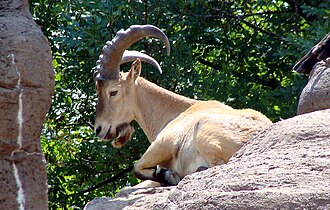
图:Dmano at English Wikipedia · CC BY-SA 3.0 · Wikimedia Commons
生命之树 › 真核生物 › 动物界 › 真后生动物亚界 › 两侧对称动物 › 后口动物总门 › 脊索动物门 › 脊椎动物亚门 › 有颌下门 › 肉鳍鱼总纲 › 四足形类 › 希望螈目 › 四足总纲 › 哺乳动物 › 兽型类 › 全兽类 › 兽亚纲 › 有胎盘类 › 北方真兽高目 › 劳亚兽总目 › 偶蹄目 › 牛科 › 羊亚科 › 羊族 › 山羊属
西高加索山羊种
Capra caucasica
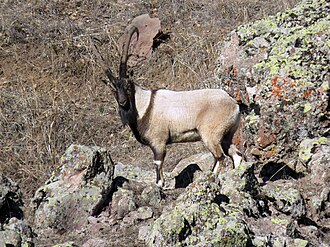
高加索羱羊,也叫西高加索羱羊,以区别于东高加索羱羊(Capra cylindricornis)。一种居住于高山的山羊,只发现于高加索山脉的西侧。为濒危野生动植物种国际贸易公约附录II所列的保护动物。
摘自维基百科「高加索羱羊」,CC BY-SA 4.0
- 学名
- Capra caucasica
- 分类等级
- 种
- 英文名
- West Caucasian Tur
- 上级类群
- 山羊属
- 大类
- 哺乳动物
- 命名
- 约翰·安东·居尔登施泰特、彼得·西蒙·帕拉斯,1783 年
- 保护状况(IUCN)
- 濒危 (保育状况)
- 数据库
- NCBI 分类 · GBIF · IUCN 红色名录
百科正文
高加索羱羊肩高1米,体重约为65公斤,腿较短。体毛为栗色,下腹部为黄色,腿的颜色较深。羊角呈弯刀式卷曲,公羊的羊角长约70厘米,母羊要短得多。
高加索羱羊的分布范围是海拔800-4000米的高山地区,以草和树叶为食,天敌为狼和猞猁。一般在夜间活动,白天则居于隐蔽场所。母羊群居,公羊一般为独居。
以上内容摘自维基百科「高加索羱羊」,按 CC BY-SA 4.0 使用,去掉了参考文献、外部链接等尾部小节,公式改写成了纯文本。全文、配图和出处见原文。
英文维基百科补充中文条目比较短,下面是英文条目「West Caucasian tur」的原文
The West Caucasian tur (Capra caucasica) is a mountain-dwelling goat-antelope native to the western half of the Caucasus Mountains range, in Georgia and European Russia.
Names and taxonomy
It is also known by the names "zebuder," "zac" and "Caucasian ibex." The East Caucasian tur is sometimes considered a subspecies of this species, though some separate the two out as different species. There is a third intermediate form that lives between the two called the Mid-Caucasian tur.
Description
West Caucasian turs stand up to 1 m (3.3 ft) tall at the shoulder and weigh around 65 kg (143 lb). They have large but narrow bodies and short legs. West Caucasian turs have a chestnut coat with a yellow underbelly and darker legs. Their horns are scimitar-shaped and heavily ridged. In males, these horns are around 70 cm (28 in), while in females they are much smaller.
They are sexually dimorphic, with the males larger than the females.
Habitat
West Caucasian turs live in rough mountainous terrain between 800 and 4,000 m (2,600 and 13,100 ft) above sea level, where they eat mainly grasses and leaves. They used to be found in much lower altitudes, have been forced upwards by humans and climate change. Their range is about 4,500 square kilometres (1,700 mi2), and likewise used to be much larger before the 20th century. In the Pleistocene, it was found as far from the Caucasus as southern France.
Behaviour, ecology, and conservation status
The West Caucasian tur is nocturnal, eating in the open at night, and sheltering during the day. They live in herds of around ten individuals in the summer, and herd sizes increase during the winter to about 20. The mating season is November to January, and the kids are born in May through July.
They are preyed upon by steppe wolves and lynxes; Persian leopards and Syrian brown bears may also be possible predators. Humans are also a risk due to hunting expeditions; it is legal to hunt them from August to November in Russia, though they are fully protected in Georgia. They are sometimes poached, for meat, skin, or horns, which are used to make drinking horns called Kantsi. Many also die of avalanches.
It is listed as Endangered on the IUCN Red List, as the wild population is estimated to be between 3,000 and 4,000 individuals. This population has been declining due to livestock grazing in their habitat and poaching, as well as harsh winters.
以上内容摘自英文维基百科「West Caucasian tur」,按 CC BY-SA 4.0 使用,去掉了参考文献、外部链接等尾部小节,公式改写成了纯文本。全文、配图和出处见原文。