格物
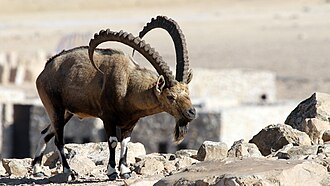
图:Greg Schechter from San Francisco, USA · CC BY 2.0 · Wikimedia Commons
生命之树 › 真核生物 › 动物界 › 真后生动物亚界 › 两侧对称动物 › 后口动物总门 › 脊索动物门 › 脊椎动物亚门 › 有颌下门 › 肉鳍鱼总纲 › 四足形类 › 希望螈目 › 四足总纲 › 哺乳动物 › 兽型类 › 全兽类 › 兽亚纲 › 有胎盘类 › 北方真兽高目 › 劳亚兽总目 › 偶蹄目 › 牛科 › 羊亚科 › 羊族 › 山羊属
努比亚北山羊种
Capra nubiana
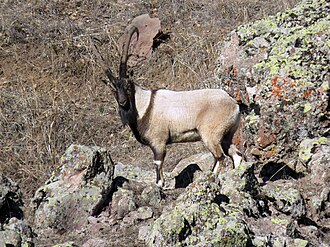
努比亚羱羊 是山羊属的一种动物,为生活在沙漠中的夜行性山羊,分布于北非、东北非与西亚。过去本种被视作羱羊 的亚种,现已基于分子证据被分作独立物种。本种族群约有4500只成羊,现被IUCN被归为易危物种。
摘自维基百科「努比亞羱羊」,CC BY-SA 4.0
- 学名
- Capra nubiana
- 分类等级
- 种
- 英文名
- Nubian ibex
- 上级类群
- 山羊属
- 大类
- 哺乳动物
- 命名
- 弗雷德里克·居维叶,1825 年
- 保护状况(IUCN)
- 易危物种
- 数据库
- NCBI 分类 · GBIF · IUCN 红色名录
百科正文
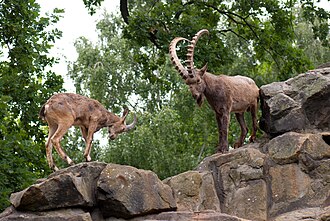
努比亚羱羊是体型最小的一种羱羊,肩高约为70公分,为两性异形的物种,雄羊(52—74.7公斤)体型大于雌羊(25.3—32.7公斤)。本种主要以相思树与金合欢树叶为食,取食时可爬到树上;这种山羊具社会性,羊群由雌羊与小羊组成,羊群中的雌羊具阶级之分,成年雄羊则大多独立生活。
希伯来圣经即有许多关于努比亚羱羊的记载,圣经人物雅亿名称的意思即为羱羊。努比亚羱羊现为以色列自然公园管理局的标志。也门也将努比亚羱羊视为国家象征之一。
以上内容摘自维基百科「努比亞羱羊」,按 CC BY-SA 4.0 使用,去掉了参考文献、外部链接等尾部小节,公式改写成了纯文本。全文、配图和出处见原文。
英文维基百科补充中文条目比较短,下面是英文条目「Nubian ibex」的原文
The Nubian ibex (Capra nubiana) is a desert-dwelling species of goat (genus Capra) found in mountainous areas of northern and northeast Africa, and the Middle East. Historically considered a subspecies of the Alpine ibex (C. ibex), it is now recognized as a distinct species. The wild population is estimated at 4,500 mature individuals, and it is classified as vulnerable by the International Union for Conservation of Nature.
Taxonomy
Classification
The Nubian ibex was first identified in modern science by Frédéric Cuvier in his 1825 Histoire naturelle des mammifères: avec des figures originales, coloriées, dessinées d'aprèsdes animaux vivans, in which he illustrated the animal with the label "Bouc sauvage de la Haute-Égypte" ("Wild goat of Upper Egypt"). It was initially classified as Capra ibex nubiana, a subspecies of the Alpine ibex (C. ibex) identified by Carl Linnaeus in 1758. Other early researchers classified it as a now-defunct synonym, C. sinaitica, or the Sinai ibex. While it was referred to as its own species, C.
Description
Nubian ibex are the smallest ibex species, following Bergmann's rule. They stand around 65–75 cm (26–30 in) tall at the shoulder. They are sexually dimorphic: males are significantly larger than females, with males averaging 52–74.7 kg (115–165 lb) and females 25.3–32.7 kg (56–72 lb).
They are a light tan color, with a white underbelly; males also have a dark brown mane down their backs. Their legs have a black and white pattern. They have a lighter rump with a dark brown tail. Males begin growing a beard at age 2 or 3, which continues to grow longer and darker as they age.
Distribution
Historically, Nubian ibex were distributed across the Middle East and Northeastern Africa.
Its range today is within Egypt, Jordan, Oman, Israel, Palestine, Saudi Arabia and Sudan. It was extirpated in Lebanon, though a captive breeding and reintroduction process is underway. It has been extirpated in Syria. Its presence is uncertain in Ethiopia, Eritrea and Yemen.
Ecology and behavior
Feeding
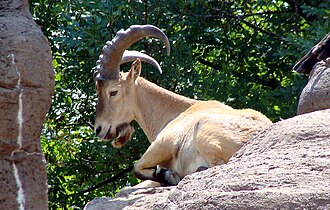
Nubian ibex live in rough, dry, mountainous terrain, where they eat mainly grasses and leaves, especially from Acacia trees (Genus Vachellia). They forage for food on the ground and may also rear up on their hind legs to reach leaves in trees. They can climb into trees while feeding. They reduce feeding on plants with strong defenses, such as tannins and thorns. Preferred plants vary depending on the amount of rain; rainy winters result in higher feeding preference for annual plants over perennials.
Physiology
Eyes and vision
Nubian ibex vision is adapted to navigating visually on mountainous terrain. A study of their retinal ganglion cell density shows that they share many traits with other artiodactyls: a temporal area, horizontal streak, and dorsotemporal extension. They have a potentially unique dorsotemporal area of high ganglion cell density that benefits vision in the lower visual field, helpful for navigating varied terrain. Additionally, they have a more loosely organized horizontal streak than other hoofed animals. Their tapetum lucidum is morphologically similar to that of goats.
Human impacts and conservation status
Human impacts
The International Union for Conservation of Nature (IUCN) has classified the Nubian ibex as "vulnerable" on the basis that fewer than 10,000 mature individuals remain and the population is declining. Threats faced by the animal include competition with livestock for water and fodder, hunting pressure, climate change, habitat fragmentation, chemical pollution, and habitat destruction.
Ecotourism and outdoor recreation may disturb ibex in nature reserves, causing them to change their behavior in order to avoid people.
Cultural significance
Ancient Middle Eastern cultures
Nubian ibex played an important role in cultures of the ancient Near East. They have been a common image in petroglyphs (rock art), metal work, pottery, and other artwork across the Middle East for thousands of years, with some artwork dating back to the late Pleistocene. One example is a life-sized image carved in sandstone in Egypt, dated to the Upper Paleolithic. In petroglyphs, ibex are often portrayed as hunted by dogs and human archers. They are also frequently depicted alongside celestial imagery such as a star, sun, cross, or circle.
以上节选摘自英文维基百科「Nubian ibex」,按 CC BY-SA 4.0 使用,去掉了参考文献、外部链接等尾部小节,公式改写成了纯文本。篇幅所限,较长的小节只摘了开头一部分,有的小节没有收;全文、配图和出处见原文。