格物
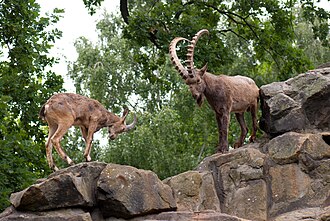
图:Quinet · CC BY 3.0 · Wikimedia Commons
- 学名
- Capra sibirica
- 分类等级
- 种
- 英文名
- Siberian ibex
- 上级类群
- 山羊属
- 大类
- 哺乳动物
- 命名
- 彼得·西蒙·帕拉斯,1776 年
- 中文别名
- 北山羊
- 保护状况(IUCN)
- 近危物种
- 栖息地
- 灌丛
- 体重
- 3.64 千克(出生体重)
- 数据库
- NCBI 分类 · GBIF · IUCN 红色名录
百科正文
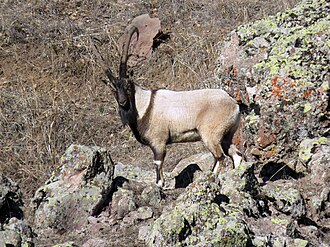
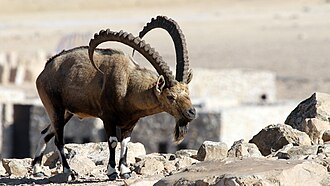
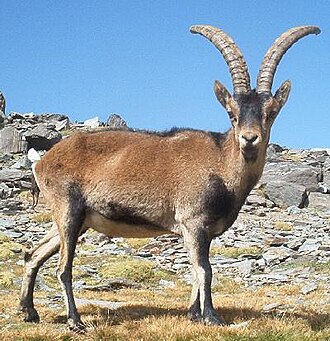
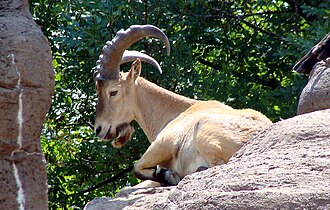
西伯利亚羱羊是一种体型庞大的山羊,尽管个体差异很大。雄性肩高为88至110厘米,体重则为60至130千克。雌性明显较小,肩高67至92厘米,体重34至56公克。雌雄两性颏部皆有须,但雄性的更长。其角呈镰刀状,雄性平均角长115厘米左右,在某些极端情况下可长到148厘米。雌性平均角长则仅有27厘米。
以上内容摘自维基百科「西伯利亚羱羊」,按 CC BY-SA 4.0 使用,去掉了参考文献、外部链接等尾部小节,公式改写成了纯文本。全文、配图和出处见原文。
英文维基百科补充中文条目比较短,下面是英文条目「Siberian ibex」的原文
The Siberian ibex (Capra sibirica), also known by regional names including Altai ibex, Asian ibex, Central Asian ibex, Gobi ibex, Himalayan ibex, Mongolian ibex, and Tian Shan ibex, is a polytypic species of ibex, a wild relative of goats and sheep. It lives in Central Asia, and is, by far, the most widely distributed species in the genus Capra. In terms of population stability, Siberian ibex are currently ranked as near
threatened. Low densities (in most areas) and overall decline; still, reliable data is minimal and difficult to come by, in addition to the animals' expansive natural range, so accurate observations are still scant. The Siberian ibex has formerly been treated as a subspecies of the Eurasian Alpine ibex, and whether or not it is a single species or a complex of distinct units that stand out as genetically-distinct (at species level) is still not entirely clear. The Siberian ibex is the longest and heaviest member of the genus Capra, though its shoulder height is slightly surpassed by the markhor.
Appearance
Siberian ibexes are large and heavily built goats, although individual sizes vary greatly. Males are between 88 and 110 cm (35 and 43 in) in shoulder height, and weigh between 60 and 130 kg (130 and 290 lb). Females are noticeably smaller, with heights between 67 and 92 cm (26 and 36 in), and weights between 34 and 56 kg (75 and 123 lb). The nose is straight in profile, the neck short, and the back straight. The neck is also particularly thick and muscular in males, but much less so in females. Both sexes have beards, although the male's beard is more pronounced, and those of females are sometimes absent altogether. Both sexes also possess a large scent gland, about 3 cm (1.2 in) across, beneath the tail.
Reproduction
The rut takes place from late October to early January. During the rut, the males spend considerable effort courting females, and they are often emaciated from lack of grazing by the time it ends. Courtship lasts for over 30 minutes, and consists of licking, ritualised postures, and flehmen if the female urinates. Males compete for dominance during the rut, rearing up on their hind legs and clashing their horns together.
Gestation lasts 170 to 180 days, and usually results in the birth of a single kid, although twins occur in up to 14% of births, and triplets are born on rare occasions. Newborn kids weigh about 3 kg (6.6 lb), and grow rapidly during their first year. The horns are visible after about three to four weeks.
Behavior
Usually living at high elevations, sometimes at the vegetation line and well above the tree line, Siberian ibexes seek out lower slopes during the winter in search of food. They have also been known to seek out tree lines on hot days, but they do not enter forested areas, preferring to return to their alpine habitat when the weather has cooled. When snow is heavy, they have to paw away snow to reach the vegetation below.
Their diet primarily consists of alpine grasses and herbs. During spring and summer, grasses and sedges form the bulk of their diet, while during winter they eat more tall herbs, and the twigs and needles of trees such as aspen, spruce, juniper, and willow. During the summer, they often visit salt licks.
Habitat and distribution
Siberian ibexes live mostly above the tree line, in areas of steep slopes and rocky scree. Their habitat consists of a mixture of high altitude steppe, alpine meadows, and regions of semidesert. In the Gobi Desert, they may be found on hills as low as 700 m (2,300 ft), but they are more commonly found between about 2,000 and 5,000 metres (6,600 and 16,400 ft) in summer, descending to lower, sometimes sparsely forested, slopes during the winter. In Tajikistan, the ibex distribution is controlled by climatic variables such as seasonal temperature and precipitation of warmest quarter.
Tributes
The Ladakh Scouts regiment of the Indian Army has the ibex as its mascot. The Ashina Dynasty of the Turkic Khaganate, had a Siberian ibex on their tamga.
以上节选摘自英文维基百科「Siberian ibex」,按 CC BY-SA 4.0 使用,去掉了参考文献、外部链接等尾部小节,公式改写成了纯文本。篇幅所限,较长的小节只摘了开头一部分,有的小节没有收;全文、配图和出处见原文。