格物
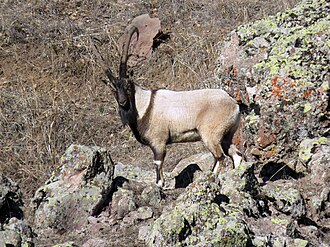
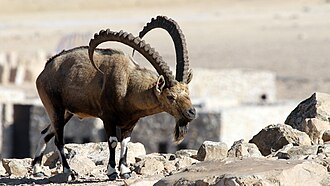
图:Alexander Malkhasyan · CC BY-SA 4.0 · Wikimedia Commons
- 学名
- Capra aegagrus
- 分类等级
- 种
- 英文名
- Wild Goat
- 上级类群
- 山羊属
- 大类
- 哺乳动物
- 命名
- 约翰·克里斯蒂安·波利卡普·埃克斯莱本,1777 年
- 保护状况(IUCN)
- 近危物种
- 数据库
- NCBI 分类 · GBIF · IUCN 红色名录
百科正文
群族结构
群族中野山羊的数量可以多达500头。较老的公羊会在发情期驱使年幼的公山羊进到母群中交配。平均妊娠期为70日。母山羊一般会产下一只幼山羊。幼山羊出生后会立即跟随母山羊,在6个月后断奶。母山羊在岁半至两岁半时就达至性成熟,公山羊则要到三岁半至四岁。它们的寿命介乎12至22岁之间。
环境问题
虽然野山羊在一些地区是原生种,但做为入侵物种则会是非常具破坏性的。在加拉帕戈斯群岛,外来的野山羊大量啃食当地的植物,破坏了生态的平衡,后来人们只能将它们猎杀至岛内灭绝来解决问题。
分布
野山羊分布在阿富汗、亚美尼亚、阿塞拜疆、孟加拉国、塞浦路斯、格鲁吉亚、希腊、印度、以色列、伊朗、伊拉克、意大利、黎巴嫩、阿曼、巴基斯坦、克什米尔、俄罗斯、斯洛伐克、叙利亚、土耳其及土库曼斯坦。
以上内容摘自维基百科「野山羊」,按 CC BY-SA 4.0 使用,去掉了参考文献、外部链接等尾部小节,公式改写成了纯文本。全文、配图和出处见原文。
英文维基百科补充中文条目比较短,下面是英文条目「Wild goat」的原文
The wild goat (Capra aegagrus) is a goat species, inhabiting forests, shrublands and rocky areas ranging from Turkey and the Caucasus in the west to Iran, Turkmenistan, Afghanistan, and Pakistan in the east. It has been listed as near threatened on the IUCN Red List and is threatened by habitat destruction and degradation.
It is thought to be the ancestor of the domestic goat (C. hircus).
Taxonomy
Capra aegagrus was the first scientific name proposed by Johann Christian Polycarp Erxleben in 1777 for the wild goat populations of the Caucasus and Taurus Mountains. Capra blythi proposed by Allan Octavian Hume in 1874 was given to wild goat horns found in Sindh.
Both the Bezoar ibex (C. a. aegagrus) and the Sindh ibex (C. a. blythi) are considered to be valid wild goat subspecies. There is debate as to whether or not the Chiltan ibex (C. a. chialtanensis). Though it was initially thought to be a distinct subspecies, it is now considered a variant of the wild goat, with some scientists suggesting it may be a hybrid with markhor.
The Cretan goat, formerly C. a. pictus, or kri-kri, was once thought to be a subspecies of wild goat, but is now considered to be a feral goat (Capra hircus), now known as Capra hircus cretica.
Distribution and habitat
In Turkey, the wild goat occurs in the Aegean, Mediterranean, Black Sea, Southeastern and the Eastern Anatolia regions up to 3,250 m (10,660 ft) in the Taurus and Anti-Taurus Mountains.
In the Caucasus, it inhabits montane forests in the river basins of Andi Koysu and its tributaries in Dagestan, Chechnya and Georgia up to 2,700 m (8,900 ft).
In Armenia, wild goats were recorded in the Zangezur Mountains, in Khosrov State Reserve, and in highlands of the Syunik Province during field surveys from 2006 to 2007.
In Azerbaijan, wild goats occur in Ordubad National Park, Daralayaz and Murovdag mountain areas in Nakhchivan Autonomous Republic.
In Iran's Haftad Gholleh Protected Area, wild goat herds live foremost in west-facing areas with rocky substrates, water sources and steep slopes that are far from roads.
In Turkmenistan, wild goat populations inhabit the mountain ranges of Uly Balkan and Kopet Dag.
In Pakistan, wild goat herds occur in Kirthar National Park.
Behaviour and ecology
In Kirthar National Park, 283 wild goat groups were observed for 10 months in 1986. The group sizes ranged from two to 131 individuals but varied seasonally, with a mean ratio of two females per male.
In Dagestan, male wild goats start courting females in mid December. The rutting season lasts until the third week of January. Females give birth to between one and three kids in late June to mid July.
Older males drive younger males from the maternal herds. The gestation period averages 170 days. Kids are mobile almost immediately after birth. Kids are weaned after 6 months. Female goats reach sexual maturity at 1½–2½ years, males at 3½–4 years. The lifespan of a goat can be from 12 to 22 years.
Threats
Wild goat populations are threatened foremost by poaching, habitat loss due to logging, and competition with domestic livestock for food resources.
以上内容摘自英文维基百科「Wild goat」,按 CC BY-SA 4.0 使用,去掉了参考文献、外部链接等尾部小节,公式改写成了纯文本。全文、配图和出处见原文。