 格物
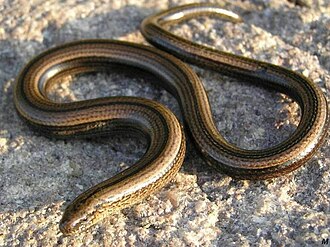
生命之树 › 真核生物 › 动物总界 › 动物界 › 真后生动物亚界 › 两侧对称动物 › 后口动物总门 › 脊索动物门 › 脊椎动物亚门 › 有颌下门 › 肉鳍鱼总纲 › 四足形类 › 希望螈目 › 四足总纲 › 爬行动物 › 鳞龙形下纲 › 鳞龙超目 › 有鳞目 › 蛇蜥科 › 脆蛇蜥 › 蛇蜥属
蛇蜥种
Anguis fragilis
蛇蜥 是一种无足蜥蜴,原产自欧亚大陆。蛇蜥属于半穴居型蜥蜴,大多时间藏于物体下方。蛇蜥的皮肤很光滑,上有互不重叠的鳞片。像其他许多蜥蜴一样,蛇蜥可以自割,即遇到捕食者时会断尾逃生,当尾巴长回来时却回不到原来的长度(它们仍有外耳与眼睑)。蛇蜥在花园中十分常见,人们可以通过在地上放一块黑色塑胶或者锡片来引诱其进入花园,驱逐害虫。在气候温和的时候,有时这些集热器的下方能找到不止一条蛇蜥。在郊区,蛇蜥最常见的死亡原因之一是家猫——它们对猫毫无招架之力。蛇蜥不同于蛇,他拥有耳朵,而蛇没有耳朵。蛇蜥同时还有蛇没有的眼皮。
摘自维基百科「蛇蜥」,CC BY-SA 4.0
- 学名
- Anguis fragilis
- 分类等级
- 种
- 上级类群
- 蛇蜥属
- 大类
- 爬行动物
- 命名
- 卡尔·林奈,1758 年
- 保护状况(IUCN)
- 无危物种
- 主要食物
- 幼虫、蠕虫、腹足纲
- 数据库
- NCBI 分类 · GBIF · IUCN 红色名录
分类阶元
- 域真核生物
- 未标等级无定形生物 Amorphea
- 演化支后鞭毛生物 Opisthokonta
- 总界动物总界 Holozoa
- 未标等级蜷丝生物 Filozoa
- 未标等级领鞭毛动物 Choanozoa
- 界动物界 Animalia
- 亚界真后生动物亚界 Eumetazoa
- 未标等级副同源异形基因动物 Parahoxozoa
- 亚界两侧对称动物 Bilateria
- 总门后口动物总门 Deuterostomia
- 门脊索动物门 Chordata
- 亚门脊椎动物亚门 Vertebrata
- 下门有颌下门 Gnathostomata
- 未标等级正真口类 Euteleostomi
- 总纲肉鳍鱼总纲 Sarcopterygii
- 未标等级扇鳍鱼类 Rhipidistia
- 亚纲四足形类 Tetrapodomorpha
- 未标等级始四足目 Eotetrapodiformes
- 下纲希望螈目 Elpistostegalia
- 未标等级坚头类 Stegocephalia
- 总纲四足总纲 Tetrapoda
- 未标等级爬行形类 Reptiliomorpha
- 未标等级羊膜动物 Amniota
- 未标等级蜥形纲 Sauropsida
- 纲爬行动物 Reptilia
- 未标等级真爬行动物类 Eureptilia
- 未标等级卢默龙类 Romeriida
- 未标等级双孔亚纲 Diapsida
- 未标等级新双弓类 Neodiapsida
- 未标等级蜥蜴亚目 Sauria
- 下纲鳞龙形下纲 Lepidosauromorpha
- 总目鳞龙超目 Lepidosauria
- 目有鳞目 Squamata
- 科蛇蜥科 Anguidae
- 亚科脆蛇蜥 Anguinae
- 属蛇蜥属 Anguis
- 种蛇蜥 Anguis fragilis
百科正文
英文维基百科补充中文条目比较短,下面是英文条目「Common slow worm」的原文
The common slow worm (Anguis fragilis) is a non-venomous species of legless lizard native to Europe. It is also called a deaf adder, blindworm, or regionally, a long-cripple, steelworm, and hazelworm.
Despite its name, the common slow worm is neither a worm nor a snake.
Common slow worms are semifossorial (burrowing) lizards that spend much of their time hiding underneath objects. The skin of slow worms is smooth, with scales that do not overlap.
Etymology
The "blind" in blindworm refers to the lizard's small eyes, similar to a blindsnake (although the slow worm's eyes are functional). The common slow worm, i.e. the species Anguis fragilis, is often called simply "slow worm", though all species of the species complex comprising the genus Anguis are also called "slow worms".
The name "slow worm" is only contaminated by the word "slow". In Middle English, it was written "slowurm", from Old English "slāwyrm", where slā- means 'earthworm' or 'slow worm' and wyrm means "serpent, reptile". It is related to the Norwegian slo or Swedish ormslå, of same meaning.
Taxonomy
Anguis fragilis was historically divided into two subspecies (A. f. fragilis and A. f. colchica). However, recent taxonomic classification has resulted in the categorisation of these as separate species:
Anguis fragilis sensu stricto (found in western Europe, northern Europe, and western Balkans)
Anguis colchica (found in eastern and northern Europe, eastern Balkans, and in western Asia)
- Three more species were later distinguished from A. fragilis:
- Anguis graeca (found in southern Balkans)
- Anguis veronensis (found on the Apennine Peninsula)
- Anguis cephalonica (native to the Peloponnese Peninsula)
Physical traits
Slow worms have an elongated body with a circular cross-section without limbs and reach a maximum length of up to 57.5cm. Most adult animals are between 40 and 45cm long, with up to 22cm on the head and trunk section and the rest on the tail. There is no visible neck. The tail, which ends in a horny tip, is continuous with the trunk and is often slightly longer. Slow worms exhibit caudal autotomy, the severing of the tail when it is pulled by predators.
Reproduction
In Central Europe, the mating season of the species is usually between late April and June. The males often fight violently for the females, although in most populations they are in the majority. The opponents try to push each other to the ground, bite each other, and wrap themselves tightly around each other. During mating, the female is often bitten on the head or the neck, while the male inserts his two hemipenes into the female's cloaca. Copulation may take several hours.
Ecology
These reptiles do not bask in the sun like other species, instead choosing to warm themselves indirectly under objects such as rocks that have been warmed by the sun. They are often found in long grass and other moist environments. In the UK, slow worms are commonly encountered in gardens and allotments, where they can be encouraged to enter and assist in the removal of pest insects by placing black plastic or providing places to shelter such as piles of logs, corrugated iron sheets, or tiles. On warm days, one or more slow worms can often be found underneath these heat collectors.
Protected status in the UK
In the United Kingdom, the slow worm has been granted protected status, alongside all other native British reptile species. The slow worm population has been declining, and under the Wildlife and Countryside Act 1981, to intentionally kill, injure, sell, or advertise to sell them is illegal.
Biogeography
The slow worm is assumed to be non-native in Ireland, possibly arriving in the 1900s. Due to their secretive habits they are difficult to observe and are sighted only in parts of County Clare and possibly County Galway, mainly in the Burren region.
Evolutionary history
Members of the genus Anguis, to which the slow worm belongs, first appeared in Europe during the Mammal Paleogene zone 14, between 43.5 and 41.2 million years ago, corresponding to the Lutetian stage of the Eocene. Remains assigned to the Anguis fragilis species complex are known from the late Miocene onwards.
以上节选摘自英文维基百科「Common slow worm」,按 CC BY-SA 4.0 使用,去掉了参考文献、外部链接等尾部小节,公式改写成了纯文本。篇幅所限,较长的小节只摘了开头一部分,有的小节没有收;全文、配图和出处见原文。