格物
- 学名
- Anguidae
- 分类等级
- 科
- 上级类群
- 有鳞目
- 大类
- 爬行动物
- 命名
- 约翰·爱德华·格雷,1825 年
- 数据库
- NCBI 分类 · GBIF
下级类群(2)
百科正文
本科被分为三个亚科,即:蛇蜥亚科(Anguinae)、复舌亚科(Diploglossinae)及侧褶蜥亚科(Gerrhonotinae),包含12属约116个物种。
下级分类
蛇蜥亚科 Anguinae
- 蛇蜥属 Anguis (两个物种)
- 亚洲脆蛇属 Dopasia Gray, 1853(七个物种)
- 摩洛哥脆蛇属 Hyalosaurus (一个物种)
- 脆蛇属 Ophisaurus,美洲脆蛇属 (五个物种)
- 帝王蛇蜥属 Pseudopus (一个现存物种)
复舌亚科 Diploglossinae
- 巨草蜥属 Celestus Gray, 1838(22个现存物种)
- 复舌蜥属 Diploglossus (16个物种)
- 残肢蜥属 Ophiodes (五个物种)
侧褶蜥亚科 Gerrhonotinae
- 侧褶蜥属 Gerrhonotus (七个物种)
- 树鼍蜥属 Abronia (29个物种)
- 艾尔蛇蜥属 Elgaria (七个物种)
- 墨西哥鼍蜥属 Barisia Gray, 1838(七个物种)
- Barisia ciliaris (Smith, 1942)
Barisia herrerae Zaldîvar-Riverón & Nieto-Montes De Oca, 2002
- Barisia imbricata (Wiegmann, 1828)
- Barisia jonesi Guillette & Smith, 1982
- Barisia levicollis Stejneger, 1890
- Barisia planifrons (Bocourt, 1878)
- Barisia rudicollis (Wiegmann, 1828)
- 梅萨蛇蜥属 Mesaspis (七个物种)
以上内容摘自维基百科「蛇蜥科」,按 CC BY-SA 4.0 使用,去掉了参考文献、外部链接等尾部小节,公式改写成了纯文本。全文、配图和出处见原文。
英文维基百科补充中文条目比较短,下面是英文条目「Anguidae」的原文
Anguidae refers to a large and diverse family of lizards native to the Northern Hemisphere. It contains 9 genera and 89 extant species. Common characteristics of this group include a reduced supratemporal arch, striations on the medial faces of tooth crowns, osteoderms, and a lateral fold in the skin of most taxa. The group is divided into two living subfamilies, the legless Anguinae, which contains slow worms and glass lizards, among others, found across the Northern Hemisphere, and Gerrhonotinae, which contains the alligator lizards, native to North and Central America. The family Diploglossidae (which contains the galliwasps) was also formerly included.
Morphology and reproduction
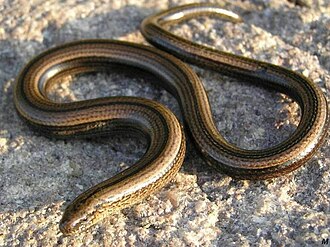
Anguids have hard osteoderms beneath their scales giving them an armored appearance. Members of the subfamily Anguinae have reduced or absent limbs, giving them a snake-like appearance, while members of Gerrohonotinae are fully limbed. Body type varies among species, with sizes ranging from 10 cm to 1.5 m. The group includes oviparous and viviparous species, both of which can be observed in a single genus at times.
Feeding and habitat
Anguids are known carnivorous or insectivorous foragers, feeding primarily on insects, although larger species have been known to feed on small reptiles and amphibians. They inhabit a wide range of different habitats across the globe, from arid to tropical environments. Most known species are terrestrial or semifossorial, with the exception of one arboreal genus: Abronia.
Evolution
Anguids have a relatively good fossil record and are relatively common as fossils in the Late Cretaceous and Paleogene of western North America. The oldest known anguid, with the most complete fossil record of any lizard, is Odaxosaurus, a member of the extinct anguid subfamily Glyptosaurinae, from the late Campanian of Canada, about 75 million years ago. Odaxosaurus and other Late Cretaceous anguids already exhibit many features found in living anguids, including chisel-like teeth and armor plates in the skin, suggesting a long evolutionary history for the group. Anguids were particularly diverse during the Paleocene and Eocene in North America; some species, such as those belonging to Glyptosaurinae, grew to large size and evolved a highly specialized crushing dentition. The long fossil record for the Anguidae in North America suggests that the group probably evolved in North America during the Cretaceous before dispersing to Europe in the Paleogene.
Classification
- Family ANGUIDAE
- Subfamily Anguinae
- Genus Anguis - slowworms (5 species)
- Genus Dopasia - Asian glass lizards (7 species)
- Genus Hyalosaurus - North African glass lizard (1 species)
- Genus Ophisaurus - American glass lizards (13 species)
- Genus Pseudopus - scheltopusik (1* species)
- Subfamily Gerrhonotinae - alligator lizards
- Genus Barisia - alligator lizards (7 species)
- Genus Gerrhonotus - alligator lizards (9 species)
- Genus Abronia - arboreal alligator lizards (39 species)
- Genus Elgaria - western alligator lizards (7 species)
- Subfamily †Glyptosaurinae
Genetic evidence indicates that Diploglossinae lies outside the clade containing Anguinae, Gerrhonotinae, and the family Anniellidae, Therefore, it has been placed in own separate family Diploglossidae.
*extant individuals
以上内容摘自英文维基百科「Anguidae」,按 CC BY-SA 4.0 使用,去掉了参考文献、外部链接等尾部小节,公式改写成了纯文本。全文、配图和出处见原文。