格物
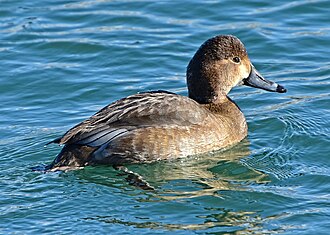
图:Mykola Swarnyk · CC BY-SA 3.0 · Wikimedia Commons
生命之树 › 真核生物 › 动物界 › 真后生动物亚界 › 两侧对称动物 › 后口动物总门 › 脊索动物门 › 脊椎动物亚门 › 有颌下门 › 肉鳍鱼总纲 › 四足形类 › 希望螈目 › 四足总纲 › 爬行动物 › 坚尾龙类 › 鸟纲 › 今鸟亚纲 › 今颚下纲 › 鸡雁小纲 › 雁形目 › 鸭科 › 鸭亚科 › 潜鸭属
美洲潜鸭种
Aythya americana
美洲潜鸭,是一种产于北美的中等大小雁鸭科潜鸭属鸟类,冬天会向南迁徙到中美洲。与美洲潜鸭最亲近的物种是红头潜鸭,帆背潜鸭是二者的姊妹群。美洲潜鸭的繁殖地包括北美洲的广泛区域,北至加拿大北部,南至加勒比海。 他们偏好的繁殖地包括不列颠哥伦比亚省、阿尔伯塔省、萨斯喀彻温省、马尼托巴省、南达科他州和北达科他州的山地,以及安大略省、魁北克省和美国南部的一些小地方。越冬地区包括美国南部的非繁殖地,并延伸到墨西哥、危地马拉、古巴和巴哈马。红头潜鸭的繁殖地和越冬地均为湿地环境。
摘自维基百科「美洲潜鸭」,CC BY-SA 4.0
- 学名
- Aythya americana
- 分类等级
- 种
- 英文名
- Redhead
- 上级类群
- 潜鸭属
- 大类
- 鸟类
- 命名
- 托马斯·坎贝尔·艾顿,1838 年
- 保护状况(IUCN)
- 无危物种
- 体重
- 1.1 千克(成年体重、雄性);990 克(成年体重、雌性)
- 数据库
- NCBI 分类 · GBIF · IUCN 红色名录
百科正文
英文维基百科补充中文条目比较短,下面是英文条目「Redhead (bird)」的原文
The redhead (Aythya americana) is a medium-sized diving duck. Its scientific name is derived from Greek aithuia, an unidentified seabird mentioned by authors including Hesychius and Aristotle, and Latin americana, of America. The redhead is 40–56 cm (16–22 in) long with an 74–84 cm (29–33 in) wingspan; weights range from 1,030–1,080 g (36–38 oz), with males weighing an average of 1,080 g (38 oz) and females an average of 1,030 g (36 oz). It belongs to the genus Aythya, together with 11 other described species. The redhead and the common pochard form a sister group, which together are sister to the canvasback. This waterfowl is easily distinguished from most other ducks by the male's copper-colored head and pale blue bill during the breeding season; from its close relative, canvasback, it is distinguished by the more rounded head, shorter bill, and (in the males) yellow, not red, eyes. The Eurasian common pochard is even more similar, but very rarely overlaps in range; it also differs in having a red eye, and a more acute, less rounded head shape.
Other names that have been used for the redhead include red-headed duck and the red-headed pochard.
Taxonomy and phylogeny
Taxonomy
The redhead is in the family Anatidae (ducks, swans, geese) and genus Aythya (diving ducks). Currently, no subspecies of the redhead are accepted.
The two syntype specimens of Fuligula americana Eyton are held in the vertebrate zoology collections of National Museums Liverpool at World Museum, with accession numbers NML-VZ D829 (male immature) and NML-VZ D829a (female adult).
Description
The redhead is a pochard, a diving duck specially adapted to foraging underwater. Its legs are placed further back on the body, which makes walking on land difficult. The webbing on its feet is larger than dabbling ducks and its bills are broader to facilitate underwater foraging. In addition, pochards have a lobed hind toe. No pochard has a metallic-colored speculum, a characteristic of other ducks.
Distribution
During breeding season, redheads are found across a wide range of North America, from as far north as Northern Canada, south to the Caribbean in winter. Their preferred areas include the intermontane regions of British Columbia, Alberta, Saskatchewan, Manitoba, with some small localities in Ontario and Quebec, and North and South Dakota inn the United States. These pochards then migrate south to winter in warmer climates.
Habitat
Small, semipermanent wetlands in nonforested country where the water is deep enough to provide dense emergent vegetation is considered ideal breeding habitat for redheads. When wintering, redheads switch to large areas of water near the coast that are protected from wave action, but can also be found in reservoirs, lakes, playa wetlands, freshwater river deltas, coastal marshes, estuaries, and bays.
Predators
Redheads do not have many predators and are most likely to die of disease or indirect human impact. These ducks are considered less desirable as table fare than other puddle ducks like the mallard. However, their beautiful plumage makes them a targeted species for waterfowl hunters looking to focus on diving ducks. Adults can be preyed upon by northern river otters, red-tailed hawks, great horned owls, bald eagles, golden eagles, and to a greater extent, minks.
Population status
The North American Waterfowl Management Plan for redheads is 760,000 North American birds. The population size has increased in the past few decades to well over 1.4 million birds. Redheads make up 2% of North America's duck population and only 1% of its harvested ducks. Populations may be stable because of restrictive bag limits for the species. In addition, the species uses semipermanent and permanent wetlands to breed, and these habitats are less likely to be affected by drought.
Behavior
Migration
Spring
Redheads begin to leave their winter range in late January and February with the northernmost birds migrating by late April. In western North America, migrants begin arriving in Oregon, British Columbia, and Colorado in February. In central North America, migrants arrive as soon as temperatures open wetlands and lakes, which can range from late February (Nebraska) to early May (Alberta, Manitoba, and Iowa).
以上节选摘自英文维基百科「Redhead (bird)」,按 CC BY-SA 4.0 使用,去掉了参考文献、外部链接等尾部小节,公式改写成了纯文本。篇幅所限,较长的小节只摘了开头一部分,有的小节没有收;全文、配图和出处见原文。