格物
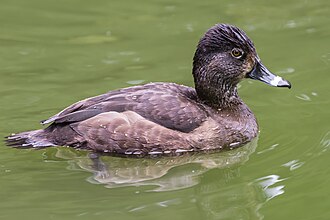
图:Becky Matsubara from El Sobrante, California · CC BY 2.0 · Wikimedia Commons
- 学名
- Aythya collaris
- 分类等级
- 种
- 英文名
- Ring-necked Duck
- 上级类群
- 潜鸭属
- 大类
- 鸟类
- 命名
- Edward Donovan,1809 年
- 保护状况(IUCN)
- 无危物种
- 体重
- 744 克(成年体重、雄性);671 克(成年体重、雌性)
- 数据库
- NCBI 分类 · GBIF · IUCN 红色名录
百科正文
外形
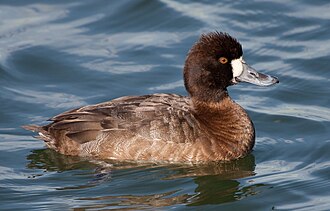
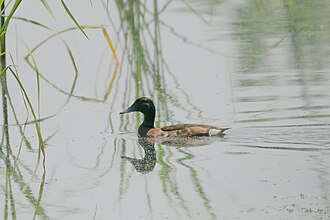
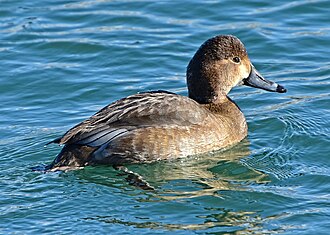
环颈潜鸭是中小型的潜水鸭,得名自颈部一圈肉桂色的环纹,但通常不明显,要趋近观察才能看到。雄鸭与相似的物种凤头潜鸭外形相似,体型比雌鸭稍大,头部、颈部与胸部均为黑色,腹部与胁部为白色至灰色,翅膀前方有一明显的白色三角形斑纹,喙为灰色,其基部与接近尖端处各有一圈白色的环纹,尖端为黑色,眼则为黄色,雌鸭头部为灰棕色,头顶颜色较深,脸颊、下巴雨喉部为白色,喙上只有一圈白色环纹,且较雄鸭的为小,眼睛周围有一圈白色环纹,另有一较细的白色条纹从眼睛延伸到头的背部。
生殖与迁徙
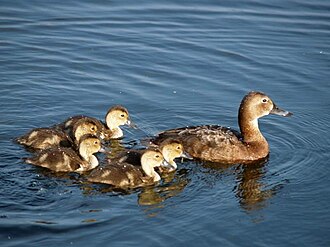
环颈潜鸭在美国北方与加拿大北方针叶林繁茂的湖泊与池塘繁殖,冬季则会迁徙至美国南方与墨西哥的淡水水域,春季开始迁徙前环颈潜鸭的雌雄鸭会开始成对,繁殖结束后即分开。其巢为碗状,位于水中挺水植物与其他杂草、树木茂密的区域。雌鸭一窝可产8-10颗蛋,25-29天后孵化,只有雌鸭参与孵蛋与照护小鸭的工作。
环颈潜鸭的迁徙能力很强,有时会作为迷鸟出现在欧洲。2003年秋季苏格兰的利文湖便发现了五只环颈潜鸭,2015年四月亦在英格兰牛津郡发现了四只。每年冬季至春季迷鸟还可能出现在中美洲,最远曾在哥斯达黎加被发现。也有迷鸟出现在日本和中国的纪录。
食性
环颈潜鸭为杂食性,可潜水觅食,亦可在水面附近寻找食物,幼鸭多以昆虫、蚯蚓、水蛭与蜗牛等为食,渐长后植物在其食物中的比例增加,以金鱼藻等沈水植物或菰等挺水植物为食。
以上内容摘自维基百科「环颈潜鸭」,按 CC BY-SA 4.0 使用,去掉了参考文献、外部链接等尾部小节,公式改写成了纯文本。全文、配图和出处见原文。
英文维基百科补充中文条目比较短,下面是英文条目「Ring-necked duck」的原文
The ring-necked duck (Aythya collaris) is a diving duck from North America commonly found in freshwater ponds and lakes. The scientific name is derived from Greek aithuia, an unidentified seabird mentioned by authors including Hesychius and Aristotle, and Latin collaris, "of the neck" from collum, "neck".
Description
Ring-necked ducks are small to medium-sized diving ducks with the following length, weight, and wingspan measurements:
- Length: 15.3–18.1 in (39–46 cm)
- Weight: 17.3–32.1 oz (490–910 g)
- Wingspan: 24.4–24.8 in (62–63 cm)
The adult male is similar in color pattern to the Eurasian tufted duck, its relative. Males are a little bit bigger than the female. It has two white rings surrounding its gray bill, a shiny black angular head, black back, white line on the wings, a white breast and yellow eyes. The adult female has a grayish brown angular head and body with a dark brown back, a dark bill with a more subtle light band than the male, grayish-blue feet and brown eyes with white rings surrounding them. Females also make a noise like trrr. The cinnamon neck ring is usually difficult to observe, which is why the bird is sometimes referred to as a "ringbill".
Breeding and migration
Their breeding habitat is wooded lakes or ponds in the northern United States and Canada. The main breeding area is Northwest boreal forest territories. Their breeding habits also take place in the eastern boreal region of Canada but nowhere near the same amount in the northwestern region. In the winter months they are usually found in southern North America in lakes, ponds, rivers or bays. Ring-necked duck pairs start during spring migration. Unpaired ducks showing up on breeding grounds will most likely end up being non-breeders. The pairs stay together only for reproduction, after that, they separate. The nest is bowl-shaped, built on water in dense emergent vegetation with sedges and woody plants. The female lays one egg per day until 8 to 10 eggs are laid. Eggs measure 1.9–2.4 cm (0.8–0.9 in) in length and 1.4–1.7 cm (0.6–0.7 in) in width. They are incubated 25–29 days and the female may remain with the young until they are able to fly.
Diet
These birds are omnivores and feed mainly by diving or dabbling at the surface. Ducklings are dependent on animal matter such as insects, earthworms, leeches, midges and snails. As they mature they tend change their diet to submerged plants such as pondweed and coontail, and emergents such as annual wild rice and snails.
Vagrancy
This strong migrant is a rare but regular vagrant to western Europe. In Britain, occasional small flocks occur, including five at Loch Leven, Scotland in September 2003 and four at Standlake in Oxfordshire in April 2015. In Ireland one or two individuals can be seen at any time of year. Vagrant individuals also occur each year in Central America as far south as Costa Rica between October/November and May/June. They have also been reported in small numbers in Suriname and French Guiana, in northern South America.
以上内容摘自英文维基百科「Ring-necked duck」,按 CC BY-SA 4.0 使用,去掉了参考文献、外部链接等尾部小节,公式改写成了纯文本。全文、配图和出处见原文。