格物
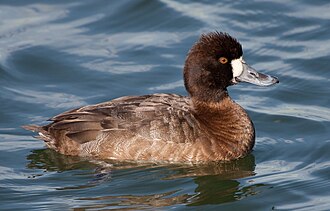
图:Basar · CC BY-SA 3.0 · Wikimedia Commons
- 学名
- Aythya affinis
- 分类等级
- 种
- 英文名
- Lesser Scaup
- 上级类群
- 潜鸭属
- 大类
- 鸟类
- 命名
- 托马斯·坎贝尔·艾顿,1838 年
- 保护状况(IUCN)
- 无危物种
- 体重
- 825 克(成年体重、雄性);748 克(成年体重、雌性)
- 数据库
- NCBI 分类 · GBIF · IUCN 红色名录
百科正文
描述
成鸭体长为38—48 cm(15—19英寸),平均体长约为41.7—43 cm(16.4—16.9英寸)。体重在454—1,089 g(1.001—2.401磅)之间;雄鸭平均体重约为820 g(1.81磅)。翅膀长度(非翼展)雄鸭约为7.5—7.9英寸(19—20 cm),雌鸭则为7.3—7.8英寸(19—20 cm);跗骨长度约为1.4—1.5英寸(3.6—3.8 cm),喙长1.4—1.7英寸(3.6—4.3 cm),翼展为 68—78 cm(27—31英寸)。
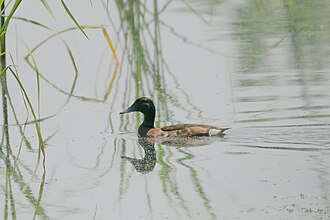
成年雄性的繁殖羽有一个黑色的头部,略带彩虹光泽,后面有一小簇头羽。胸部为黑色,背部灰白色。翅膀外围为黑色,带有深色涟纹,内侧的主要飞行羽则为灰棕色。身体下半部是白色的,侧面有一些橄榄色的涟纹,尾羽和尾下覆羽则是黑色的。
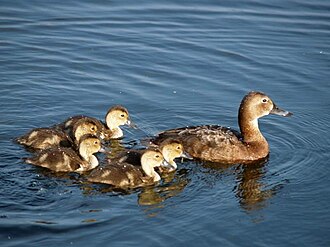
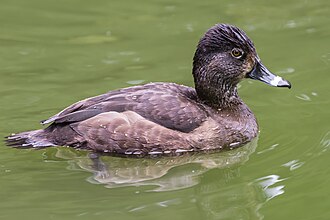
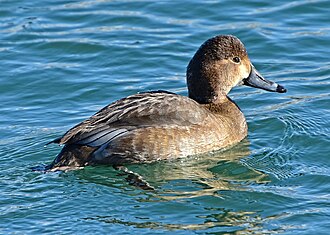
成年雌鸭在喙的基部有一白色条带,耳朵区域颜色通常较浅。整体为深褐色,渐次转为中腹部的白色。
雄鸭的蚀羽(eclipse plumage),即非繁殖羽外观变化不大,但头部和胸部非常黑,头部很少或没有白色,翅膀上常有一些灰色的涟状纹。未成熟的幼鸟外表与雌鸭相似,但颜色较为暗淡,喙的基部也几乎没有任何白色带。雌雄鸭皆有白色的第二飞行羽,蓝灰色的喙,一个黑色的“钉子”在尖端,和灰色的脚;雄鸭的虹膜为明亮的黄色,雌鸭呈橙色或琥珀色,未成熟的幼鸟则呈棕色。
以上内容摘自维基百科「小斑背潛鴨」,按 CC BY-SA 4.0 使用,去掉了参考文献、外部链接等尾部小节,公式改写成了纯文本。全文、配图和出处见原文。
英文维基百科补充中文条目比较短,下面是英文条目「Lesser scaup」的原文
The lesser scaup (Aythya affinis) is a small North American diving duck that migrates south as far as Central America in winter. It is colloquially known as the little bluebill or broadbill because of its distinctive blue bill. The origin of the name scaup may stem from the bird's preference for feeding on scalp—the Scottish word for clams, oysters, and mussels; however, some credit it to the female's discordant scaup call as the name's source. It is apparently a very close relative of the Holarctic greater scaup or "bluebill" (A. marila), with which it forms a superspecies. The scientific name is derived from Ancient Greek and Latin, with aithuia being an Ancient Greek term for an unidentified seabird, used by Hesychius and Aristotle, among other authors, and affinis, Latin for "related to", from the lesser scaup's resemblance to the greater scaup.
Description
Adults are 38–48 cm (15–19 in) long, 41.7–43 cm (16.4–16.9 in) on average. The species can weigh 454–1,089 g (1.001–2.401 lb); males weigh 820 g (1.81 lb) on average while females weigh noticeably less, at 730 g (1.61 lb) on average. Wing lengths (not wingspans) are about 7.5–7.9 in (19–20 cm) in males and 7.3–7.8 in (19–20 cm) in females. The tarsus is about 1.4–1.5 in (3.6–3.8 cm) long, and the bill is 1.4–1.7 in (3.6–4.3 cm). The wingspan is 68–78 cm (27–31 in).
The adult males (drakes) in definitive basic (breeding) plumage have a black, iridescent head and a small tuft at the hindcrown, a black breast, a whitish-grey back, wings with darker vermiculations and black outer and greyish-brown inner primary remiges.
Taxonomy
Two syntype specimens of Fuligula affinis Eyton (Monogr. Anat., 1838, p.157.) are held in the vertebrate zoology collections of National Museums Liverpool at World Museum, with accession numbers NML-VZ D826c (female adult) and NML-VZ D826b (male adult). The specimens were collected in North America and came to the Liverpool national collection via Thomas Campbell Eyton's collection and the 13th Earl of Derby's collection which was bequeathed to the people of Liverpool in 1851.
Distribution and migration
Their breeding habitats are inland lakes and arctic marsh ponds from Alaska through western Canada to western Montana; few breed east of James Bay and the Great Lakes. Notable breeding concentrations, with more than half a million birds at the height of the season, can be found in Alaska, in the woodlands of the McKenzie River valley and on the Old Crow Flats. These birds migrate south (mostly via the Central and Mississippi Flyways) when the young are fledged and return early spring, usually arriving on the breeding ground in May. Lesser scaup typically travel in flocks of 25–50 birds and winter mainly on lakes, rivers and sheltered coastal lagoons and bays between the US–Canada border and northern Colombia, including Central America, the West Indies and Bermuda.
Ecology
Lesser scaup forage mainly by sifting through the bottom mud, usually after diving and swimming underwater, occasionally by dabbling without diving. They mainly eat mollusks such as mussels and clams, as well as seeds and other parts of aquatic plants like sedges and bulrushes (Cyperaceae), "pondweeds", widgeon-grass (Ruppia cirrhosa), wild celery (Vallisneria americana) or wild rice (Zizania). In winter, but less so in summer, other aquatic animals—crustacean, insect and their larvae and small fishes—form an important part of their diet.
Conservation status
Although the lesser scaup has the largest population of any species of diving duck in North America, their population has been steadily declining since the mid-1980s, and reached an all-time low in the early 21st century. During breeding bird surveys, lesser and greater scaup are counted together due to the impossibility of identifying the species unequivocally when large numbers of birds are involved. Lesser scaup are thought to comprise slightly less than nine-tenths of the scaup population of North America. In the 1970s, the lesser scaup population was estimated at 6.9 million birds on average; in the 1990s it had declined to about half that number, and by the late 2000s it is estimated at 3 million individuals or less.
以上节选摘自英文维基百科「Lesser scaup」,按 CC BY-SA 4.0 使用,去掉了参考文献、外部链接等尾部小节,公式改写成了纯文本。篇幅所限,较长的小节只摘了开头一部分,有的小节没有收;全文、配图和出处见原文。