 格物
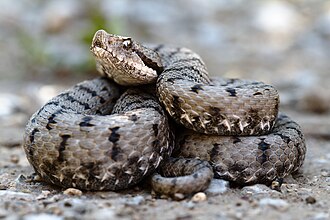
图:Felix Reimann · CC BY-SA 3.0 · Wikimedia Commons
- 学名
- Vipera aspis
- 分类等级
- 种
- 英文名
- aspic viper
- 上级类群
- 蝰属
- 大类
- 爬行动物
- 命名
- 卡尔·林奈,1758 年
- 保护状况(IUCN)
- 易危物种
- 数据库
- NCBI 分类 · GBIF · IUCN 红色名录
百科正文
特征
其体长一般在60—65厘米(24—26英寸)之间,雄蛇最长可达85 cm(33英寸),雌性则为75 cm(30英寸),但雄性身体要比雌性细一些.。
以上内容摘自维基百科「毒蝰」,按 CC BY-SA 4.0 使用,去掉了参考文献、外部链接等尾部小节,公式改写成了纯文本。全文、配图和出处见原文。
英文维基百科补充中文条目比较短,下面是英文条目「Vipera aspis」的原文
Vipera aspis is a viper species found in southwestern Europe.
Its common names include asp, asp viper, European asp, and aspic viper, among others. Like all other vipers, it is venomous. Bites from this species can be more severe than from the European adder, V. berus; not only can they be very painful, but approximately 4% of all untreated bites are fatal. The specific epithet, aspis, is a Greek word that means "viper." Five subspecies are currently recognized, including the nominate subspecies described here.
Description
The species grows to an average total length of 60–65 centimetres (24–26 in). Males reach a maximum total length of 85 cm (33 in), females rarely more than 75 cm (30 in). Males, however, are a little slimmer than females. The tail is very short: one-seventh to one-ninth of total body length in females, and one-sixth to one-eighth in males.
The head is broad, triangular and quite distinct from the neck. The tip of the snout is slightly but distinctly upturned. The rostral scale is generally higher than it is wide, touching 2 to 3 scales on the upper side of the snout. Dorsally, the snout is flat with distinct and slightly raised sharp margins.
Common names and historical usage
Common names of Vipera aspis include "asp", "asp viper", "European asp", "aspic viper", "European viper" and "Jura viper". In the past, the term "asp" has been used to refer to any venomous snake.
The snake which supposedly killed the Egyptian Queen Cleopatra is named by Velleius Paterculus as an asp, and by Martial as a viper. Virgil mentions two snakes but does not name their species, while Plutarch mentions twin prick marks on her arm but does not state that these were toothmarks, so they could also have been from a poisoned hair pin. There is a tradition that the bite was a cobra's, but experts consider that a cobra would have been too big (at over 5 feet long) to smuggle in a basket.
Distribution
It is native to France, Andorra, north-eastern Spain, extreme south-western Germany in the southern Black Forest, Switzerland, Italy, and north-western Slovenia. The original type locality was listed simply as "Gallia." However, Schwarz (1936) proposed that it be restricted to "Poitou [Frankreich]" (Poitou, France). It has been extirpated from Bulgaria.
In August–October 2006, a number of specimens were discovered in a wooded area near the town of Poortugaal in the Netherlands. Although they were doing quite well, the species is not native to this country. It is likely that one or more escaped or were set loose in the area.
Conservation status
This species was assessed as Vulnerable in 2022, according to the IUCN Red List of Threatened Species. This was done under criterion A2c, due to a population decline likely greater than 30% over the last 24 years (three estimated generations). It was previously categorized as Least Concern.
However, subspecies V. a. aspis is categorized as Critically Endangered in Switzerland, V. a. atra is categorized as Vulnerable, and V. a. francisciredi is categorized as Endangered.
In general, the species is also listed as protected (Appendix III) under the Berne Convention.
Habitat
This species has a few clearly defined and relatively specific habitat requirements. It needs warm areas that are exposed to the sun, structured vegetation and comparatively dry soils. In Italy and France, it is often found in areas with low mountains or hills, notably in limestone regions, but sometimes occurs in lower plains. It has a preference for vegetated areas or environments with at least some cover. Here it can be found on sunny slopes, on scrublands, in glades, in mountain meadows, forest clearings, at the borders of woods, in rubbish dumps and in stone quarries. In Italy, it occurs in mesic chestnut/oak woodlands and often near streams.
Venom
A bite from this species can be more severe than from V. berus and is very painful. According to Stemmler (1971), about 4% of all untreated bites are fatal. Lombardi and Bianco (1974) mention that this species is responsible for 90% of all cases of snakebite in Italy and it is the only potentially lethal snake in Italian mountains.
The toxicity of the venom varies. Stemmler (1971) states that the population in Passwang district, Switzerland have the strongest venom based on studies conducted on mice. Compared to venoms from other species, it is relatively toxic. Brown (1973) gives LD50 values of 1.0 mg/kg IV and 1.0–2.0 mg/kg SC. Tu et al. (1969) report 4.7 mg/kg IM.
以上节选摘自英文维基百科「Vipera aspis」,按 CC BY-SA 4.0 使用,去掉了参考文献、外部链接等尾部小节,公式改写成了纯文本。篇幅所限,较长的小节只摘了开头一部分,有的小节没有收;全文、配图和出处见原文。